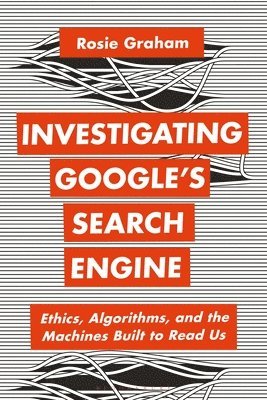
What do search engines do? And what should they do? These questions seem relatively simple but are actually urgent social and ethical issues. The influence of Google’s search engine is enormous. It does not only shape how Internet users find pages on the World Wide Web, but how we think as individuals, how we collectively remember the past, and how we communicate with one another. This book explores the impact of search engines within contemporary digital culture, focusing on the social, cultural, and philosophical influence of Google.Using case studies like Google’s role in the rise of fake news, instances of sexist and misogynistic Autocomplete suggestions, and search queries relating to LGBTQ+ values, it offers original evidence to intervene practically in existing debates. It also addresses other understudied aspects of Google’s influence, including the profound implications of its revenue generation for wider society. In doing this, this important book helps to evaluate the real cost of search engines on an individual and global scale.
Rosie Graham is Lecturer in Contemporary Literature and the Digital at the University of Birmingham, UK and co-director of its Digital Cultures Research Centre.
Introduction: Investigating Google’s Search Engine1.0 Google’s Dominance 2.0 The Three Steps of How Search Engines Work: Crawling, Ranking, and Query Results1.1 Step One: Crawling1.2. Step Two: Ranking1.3 Step Three: Query Results3.0 Five Key Challenges of Studying Google’s Search Engine3.1: Multiple Actors: Search Engine Optimisation and Economic Incentives3.2: Moving Targets3.3: Each Search a Partial Viewpoint3.4: No Real Alternatives3.5: The Myth of Black Boxes4.0 Chapter Outlines5.0 Notation and ExamplesChapter One: Understanding Google Queries and the Problem of IntentionsIntroduction 1.0 Categorising How and What People Search1.1 The Roles of Search Engines and Information Retrieval’s Question of Why1.2 Query Length and the Problems of Intention1.3 All Information is Ethical: Searching for [food for snakes]2.0 Predicting Intentions with a Lack of Information: Plato, Gadamer, and Derrida2.1 Gadamer’s Hermeneutics and Plato’s Fears of Deception2.2 Google’s Algorithms and Derrida’s Monster3.0 What Kinds of Things Do People Search Google For?3.1 Google Trends, Brexit, and “Frantically” Googling after the EU ReferendumConclusionChapter Two: Google’s Impact on Cognition and Memory: Histories, Concepts, and Technosocial PracticesIntroduction1.0 Google’s Impact on the Cognition and Memory1.1 Metaphors of Recall from Extended Minds to Transactive Memory2.0 Technosocial Memory Practices from Oral Culture to Digital Literacy3.0 The Legacy of Naturalised Technologies3.1 Truth and Knowledge for Plato3.2 Aristotle’s Sensory Approach4.0 Technosocial Memory Before Google: The Ars Memoria 4.1 The Science and Magic of Search5.0 Treating the Mind as Technology: Bacon, Hooke, and Modern PsychologyConclusionChapter Three:Autocomplete: Stereotypes, Biases, and Designed DiscriminationIntroduction1.0 The Desire for a Digital Oracle1.1 Autocomplete’s Minimal Academic Attention2.0 The Biases of Autocomplete: Stereotypes and Discrimination3.0 Predicting and Shaping User Attitudes: The Origins of Autocomplete3.1 So, How Does Autocomplete Operate?4.0 Second-Order Stereotyping: Sexist Suggestions for Female Scientists4.1 RankBrain and the Biases of Machine Learning 4.2 Automated Misogyny for Every Individual 5.0 Speed5.1 Speed and Judgment: Time to ReflectConclusion Chapter Four:Google’s Search Engine Results: What is a Relevant Result? Introduction1.0 “Quantifiable Signals” and Malawian Witch Doctors2.0 What Should Search Engine Results Be? 2.1 The Idealists: Search Is Democratic, Relevance Can Be Measured Objectively, and Answers Can Exist Independently of Bias2.2 The Difficulty with Measuring Relevance2.3 The Contextualists: Search Is Undemocratic, Relevance Is a Measure of Personalisation, and All Answers Are Inherently Biased2.4 Are Search Results Personalised?3.0 Methodological Challenges of Studying Search Engines3.1 Particular Considerations for Collecting Search Engine Results4.0 Variables that Matter: Search Experiments in 2015, 2017, and 20214.1 The Rationale Behind Focusing on Same-Sex Sexual Orientation4.2 Queries Used4.3 Capturing the Spread of Results from the First Page4.4 Evaluation Method5.0 Google’s Public Position on How They Provide Results6.0 The Importance of Language and Location in Search Results (2015) 6.1 How Do Variations in Terminology and Phrasing Alter Search Results?6.2 Unimaginable Communities7.0 How Search Results Change Throughout Time: 2015, 2017, 2021 7.1 Longitudinal Overview: Official Languages in Each Domain7.2 Terminology Throughout Time: “Homosexual” vs. “Gay”6.3 Phrasing Throughout Time: “Good” vs. “Wrong”Conclusion Chapter Five:The Real Cost of Search Engines: Digital Advertising, Linguistic Capitalism, and the Rise of Fake NewsIntroduction1.0 The Economics of Google2.0 The Context of Post-Fordism3.0 AdWords: Organic vs. Sponsored Results3.1 AdWords: The Multilingual Linguistic Market and an Economy of Bias3.2 Google’s Institutionalisation, Data-Collection, and Advertising3.3 AdWords in the Context of “The Magic System”3.4 AdWords and the General Intellect4.0 The Economic Profits of Discrimination5.0 Private Profits and Public Loses5.1 Google’s International Expansion6.0 AdSense and Post-Fordism: The Cost of Google’s Billboards 6.1 AdSense and Fake News in the 2016 US Presidential Election 6.2 The Reciprocal Relationship Between AdSense and FacebookConclusionConclusion: What if Search Engines Were Actually Built to Benefit Users?
Revisits and pushes forward Google critique in significant ways, providing not just methods and techniques to unearth how Google shapes our memory but a firm foundation for considering how it steers what we ultimately come to know.
Jennifer Edmond, Nicola Horsley, Jörg Lehmann, Mike Priddy, Ireland) Edmond, Jennifer (Trinity College Dublin, Germany) Lehmann, Jorg (University of Tubingen, Anthony Mandal