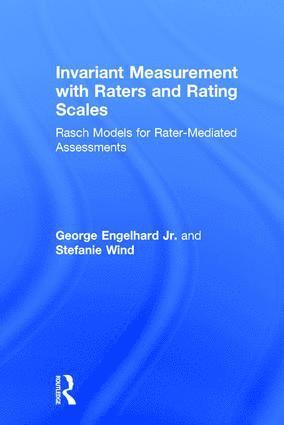
This is the second edition of an introductory text that describes the principles of invariant measurement; how invariant measurement can be achieved using Rasch measurement theory; and how to use invariant measurement to solve a variety of measurement problems in the social, behavioral, and health sciences. Rasch models are used throughout the text, but brief comparisons of Rasch models to other item response theory (IRT) models are also provided.Written with students in mind, this new edition was class-tested to help maximize accessibility. Chapters open with an introduction and close with a discussion and summary. All chapters have been updated from the first edition, and a new chapter on explanatory Rasch models has been added. Features include numerous examples and exercises to demonstrate the main issues addressed in each chapter. Key terms are defined when first introduced and included in a helpful end-of-text glossary.This book also benefits from online materials which include the data sets used in the book, sample syntax files for running the Facets program, Excel files for creating item and person response functions, and links to related websites.This book will act as a supplementary text for graduate or advanced undergraduate courses on measurement or test theory, IRT, scaling theory, psychometrics, advanced measurement techniques, research methods, or evaluation research taught in education, psychology, and other social and health sciences. It will also appeal to practitioners and researchers in these fields who develop or use scales and instruments. Only a basic mathematical level is required, including a basic course in statistics, ensuring it is an accessible resource for students and researchers alike.
George Engelhard, Jr. is a professor of educational measurement and policy at the University of Georgia.Jue Wang is a professor at the University of Science and Technology of China.
PrefaceAcknowledgmentsAbout the authorsPart I: Introduction1. Introduction and OverviewVariable mapsWhat are logits?The dichotomous Rasch modelFive requirements of invariant measurementMethod and meaning of Rasch measurementIllustrative data set: Measuring the home environmentDiscussion and summaryPart II: Conceptual and Theoretical Issues2. Invariant MeasurementWhat is measurement?What is invariant measurement?Ideal-type scales and the structure of measurement dataWhat are Rasch Models?Item-invariant person measurementPerson-invariant item calibrationDiscussion and Summary3. Rasch ModelsOperating characteristic functionsDichotomous Rasch modelPolytomous Rasch ModelsPartial Credit modelRating Scale modelMany Facet ModelDiscussion and Summary4. Researcher-Constructed MeasuresBuilding Blocks for Researcher-Constructed Measures1. Latent variable: What is the latent variable being measured?2. Observational Design: What is the plan for collecting structured observations or responses from persons in order to define the latent variable?3. Scoring rules: How do we categorize the systematic observations, and then assign scores to the categories to be used as indicators of the latent variable?4. Rasch Measurement model: How are person and item responses or observations mapped onto the latent variable?Applications1. Learning stimulation in the home environments of preschool children2. Assessment in the health sciences: The five rights of safe administration of medicationsDiscussion and summary5. An Historical and Comparative Perspective on Research Traditions in MeasurementWhat are measurement theories?What are research traditions?What are the three major research traditions in measurement?Test-Score Tradition1. The founding of classical test theory: Spearman2. Generalizability Theory: Cronbach and his colleaguesScaling Tradition1. Psychophysics and the beginning of the scaling tradition: Thorndike2. Absolute scaling and psychophysics: Thurstone3. Item response theory: Birnbaum and Rasch4. Non-Parametric item response theory: Guttman, Lazarsfeld, and MokkenStructural Tradition1. Factor analysis: Spearman and Thurstone2. Path analysis: Wright3. Structural equation modeling: Joreskog4. Explanatory Item Response Models: De Boeck & WilsonDiscussion and summary6. The Quest for Invariant Measurement within the Scaling TraditionGeneral issues guiding the comparisons among the scaling theoriesItem-invariant person measurement1. Parametric models: Thorndike, Thurstone, Birnbaum and Rasch2. Non-parametric models: Guttman, Lazarsfeld and MokkenPerson-invariant item calibration1. Parametric models: Thorndike, Thurstone, Birnbaum and Rasch2. Non-parametric models: Guttman, Lazarsfeld and MokkenOperating characteristic functions1. Item response functions2. Person response functionsVariable mapsDiscussion and summaryPart III: Technical Issues7. Methods of Estimation for the Dichotomous Rasch ModelDichotomous Model for Rasch MeasurementMethods of EstimationNon-iterative Estimation Methods1. LOG Method2. PAIR Method3. PROX MethodIterative Estimation Methods1. Joint Maximum Likelihood Estimation Method2. Marginal Maximum Likelihood Method3. Conditional Maximum Likelihood Method4. Bayesian Estimation MethodItem calibration: Comparison of non-iterative, MLE, and Bayesian methodsPerson measurement: Illustrative data analysis of JMLE MethodDiscussion and Summary8. Model-Data Fit for the Dichotomous Rasch ModelBrief history of model-data fit for categorical dataConceptual framework for model-data fit based on residual analyses1. Guttman’s Perspective on Model-Data Fit2. Model-data fit statistics for dichotomous Rasch ModelAdditional issues related to model-data fitDiscussion and Summary9. Rasch Measurement Theory and Generalized Linear Mixed ModelsWhat are generalized linear mixed models?Specifying Explanatory Rasch Models with Generalized Linear Mixed Models1. Dichotomous Model with no covariates2. Linear Logistic Rasch Model with item covariates3. Latent Regression Rasch Model with person covariates4. Combined Covariates Rasch Model with item and person covariatesIllustrations of Explanatory Rasch Models with the Learning Stimulation Scale1. Dichotomous Model with no covariates2. LLRM with items classified as child or adult activities3. LRRM with homes categorized by education level of mother4. CCRM with both item classification and home categorization5. Model ComparisonsDiscussion and SummaryPart IV: Assessments with raters: Rater-invariant measurement10. Rater-mediated assessments: A Conceptual frameworkRater-mediated assessmentsBrief description of measurement models for ratersRater-invariant measurement1. Extending the requirements of invariant measurement2. Criteria for developing and evaluating rater-mediated assessments3. Guidelines for evaluating functioning of rating categoriesThe Many Facet Rasch ModelUsing variable maps with rater-mediated assessmentsDiscussion and summary11. Evaluating the quality of rater-mediated assessments I:Indices of rater errors and systematic biasesRater Errors and Systematic BiasesIllustrative data analyses1. Rater Facet2. Domain Facet3. Person FacetRater Invariant MeasurementDiscussion and Summary12. Evaluating the quality of rater-mediated assessments II:Direct Indices of rater accuracyWhat is rater accuracy?Rater accuracy as the underlying constructIndices of rating accuracyIllustrative data analysesRelationship between rater error and accuracyDiscussion and SummaryPart V: Final Word13. Invariant measurement: Discussion and summaryPerennial issues in assessment from the perspective of invariant measurementMeasurement ModelsAssessment DevelopmentAdministration of assessmentsUse of assessmentsEvaluation of assessmentsFinal wordReferencesGlossary (definitions of terms)Author IndexSubject Index
George Engelhard Jr., Stefanie Wind, USA) Engelhard Jr., George (University of Georgia, USA) Wind, Stefanie (University of Alabama, Jr. Engelhard, George