
In Her Own Name
The Politics of Women’s Rights Before Suffrage
Inbunden, Engelska, 2023
1 379 kr
Beställningsvara. Skickas inom 5-8 vardagar. Fri frakt för medlemmar vid köp för minst 249 kr.
Finns i fler format (1)
Co-Winner, 2024 V.O. Key Award, Southern Political Science AssociationLong before American women had the right to vote, states dramatically transformed their status as economic citizens. In the early nineteenth century, a married woman had hardly any legal existence apart from her husband. By the twentieth, state-level statutes, constitutional provisions, and court rulings had granted married women a host of protections relating to ownership and control of property. Why did powerful men extend these rights during a period when women had so little political sway?In Her Own Name explores the origins and consequences of laws guaranteeing married women’s property rights, focusing on the people and institutions that shaped them. Sara Chatfield demonstrates that the motives of male elites included personal interests, benefits to the larger economy, and bolstering state power. She shows that married women’s property rights could serve varied political goals across regions and eras, from temperance to debt relief to settlement of the West. State legislatures, constitutional conventions, and courts expanded these rights incrementally, and laws spread across the country without national-level coordination.Chatfield emphasizes that the reform of married women’s economic rights rested on exclusionary foundations, including protecting slavery and encouraging settler colonialism. Although some women benefited from property reforms, many others saw their rights stripped away by the same processes. Drawing on a mix of qualitative and quantitative evidence, In Her Own Name sheds new light on the place of women in the fitful democratization of the United States.
Produktinformation
- Utgivningsdatum2023-05-30
- Mått152 x 229 x 19 mm
- Vikt504 g
- FormatInbunden
- SpråkEngelska
- Antal sidor256
- FörlagColumbia University Press
- ISBN9780231199667
- UtmärkelserJoint winner of V.O. Key Award, Southern Political Science Association 2024
Tillhör följande kategorier
Hoppa över listan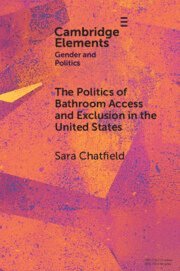
Mer från samma författare
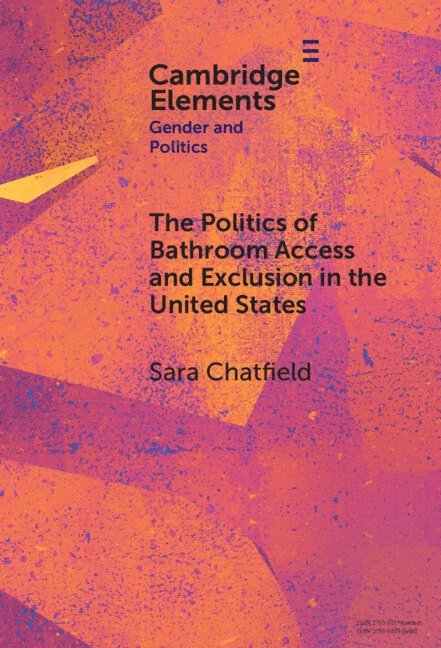
The Politics of Bathroom Access and Exclusion in the United States
Sara Chatfield
Inbunden, 2024
1 159 kr
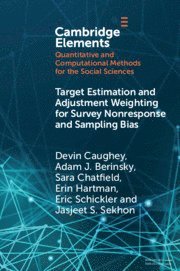
Target Estimation and Adjustment Weighting for Survey Nonresponse and Sampling Bias
Devin Caughey, Adam J. Berinsky, Sara Chatfield, Erin Hartman, Eric Schickler, Jasjeet S. Sekhon
Häftad, 2020
389 kr
Hoppa över listan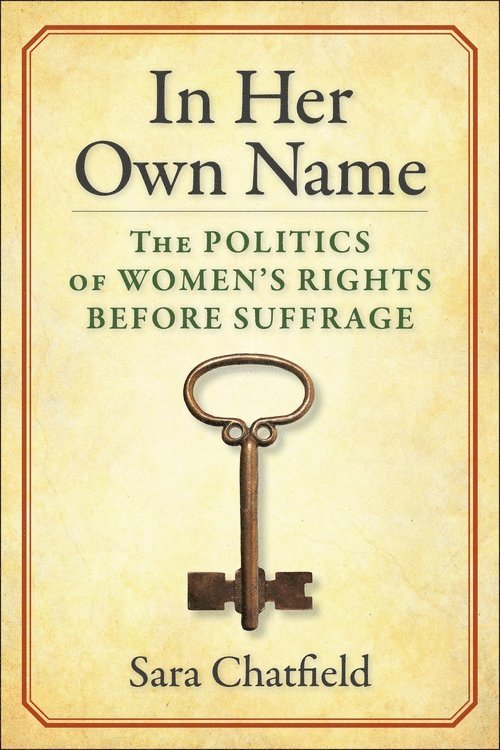




Du kanske också är intresserad av
The Politics of Bathroom Access and Exclusion in the United States
Sara Chatfield
Inbunden, 2024
1 159 kr
Target Estimation and Adjustment Weighting for Survey Nonresponse and Sampling Bias
Devin Caughey, Adam J. Berinsky, Sara Chatfield, Erin Hartman, Eric Schickler, Jasjeet S. Sekhon
Häftad, 2020
389 kr
- Nyhet
Del 11
- Nyhet
Del 3
- Nyhet
Del 4
- Nyhet
Del 6
- Nyhet
Del 1