
Del i serien The Stone Lectures in Economics
Imperfect Knowledge and Monetary Policy
Inbunden, Engelska, 2006
2 159 kr
Beställningsvara. Skickas inom 5-8 vardagar. Fri frakt för medlemmar vid köp för minst 249 kr.
Finns i fler format (1)
Based on lectures given as part of The Stone Lectures in Economics, this book discusses the problem of formulating monetary policy in practice, under the uncertain circumstances which characterize the real world. The first lecture highlights the limitations of decision rules suggested by the academic literature and recommends an approach involving, first, a firm reliance on the few fundamental and robust results of monetary economics and, secondly, a pragmatic attitude to policy implementation, taking into consideration lessons from central banking experience. The second lecture revisits Milton Friedman's questions about the effects of active stabilization policies on business cycle fluctuations. It explores the implications of a simple model where the policy maker has imperfect knowledge about potential output and the private sector forms expectations according to adaptive learning. This lecture shows that imperfect knowledge limits the scope for active stabilization policy and strengthens the case for conservatism.
Produktinformation
- Utgivningsdatum2006-02-16
- Mått140 x 216 x 10 mm
- Vikt330 g
- FormatInbunden
- SpråkEngelska
- SerieThe Stone Lectures in Economics
- Antal sidor152
- FörlagCambridge University Press
- ISBN9780521854863
Tillhör följande kategorier
Hoppa över listan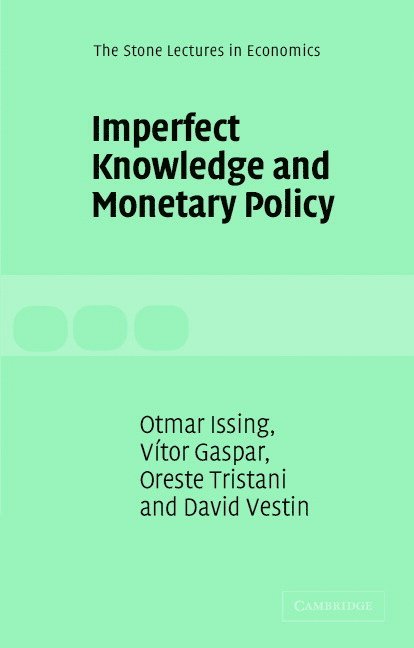

Du kanske också är intresserad av
Imperfect Knowledge and Monetary Policy
Vítor Gaspar, Otmar Issing, Oreste Tristani, David Vestin
Häftad, 2006
769 kr
Monetary Policy in the Euro Area
Otmar Issing, Vitor Gaspar, Ignazio Angeloni, Oreste Tristani
Inbunden, 2001
2 259 kr
Monetary Policy in the Euro Area
Otmar Issing, Vitor Gaspar, Ignazio Angeloni, Oreste Tristani
Häftad, 2001
749 kr
Marknad och politik
Lars Hultkrantz, Pär Österholm, Lena Andersson-Skog, Mats Bergman, Björn Carlén, Anders Forslund, Göran Hjelm, Maria Vredin, Henrik Jordahl, Hans Lind, Magnus Lindmark, Katarina Nordblom, Bo Sandelin, Oskar Nordström Skans, Ulf Söderström, David Vestin, Arvid Wallgren, Pehr Wissén
Häftad, 2022
729 kr
Nationalekonomins frågor
Lina Aldén, Tommy Andersson, Martin Berlin, Tessa Bold, Maria Börjesson, Karin Edmark, Tomas Ekenberg, Mikael Elinder, Mats Hammarstedt, Magnus Henrekson, Helena Holmlund, Henrik Jordahl, Martin Kragh, Agneta Kruse, Tommy Lundgren, Erik Mohlin, Johanna Möllerström, Maria Persson, Johanna Rickne, Mikael Stenkula, Ann-Charlotte Ståhlberg, David Sundström, David Vestin
Häftad, 2017
679 kr
Hayek, Currency Competition and European Monetary Union
Otmar Issing, Lawrence H. White, Roland Vaubel
Häftad, 2000
159 kr