
Del i serien Mathematics and Its Applications
Ill-Posed Problems: Theory and Applications
Inbunden, Engelska, 1994
729 kr
Beställningsvara. Skickas inom 10-15 vardagar. Fri frakt för medlemmar vid köp för minst 249 kr.
Finns i fler format (1)
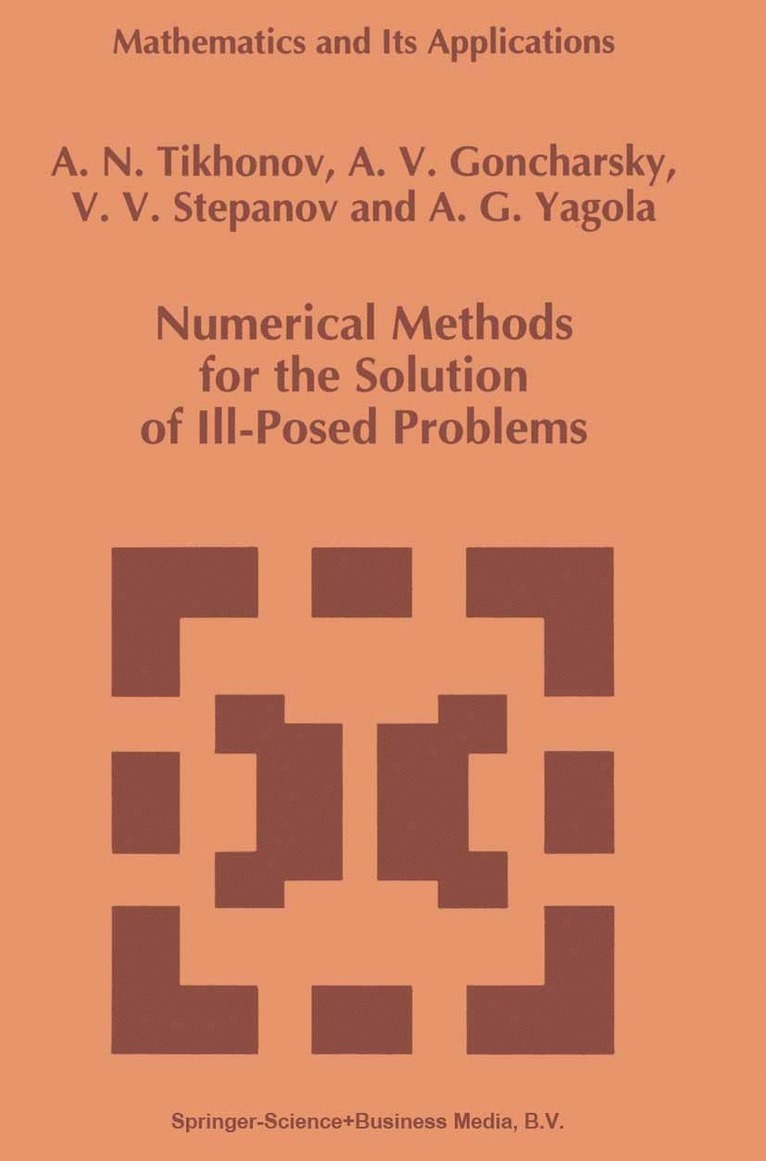
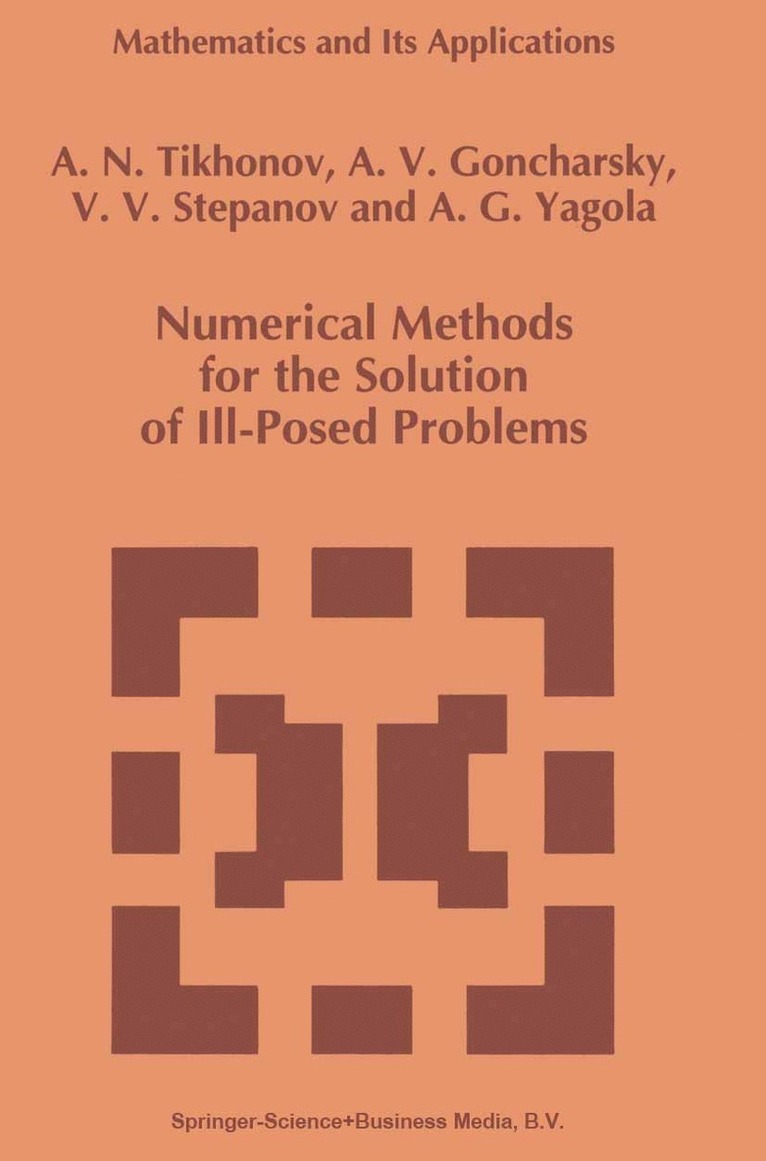
Recent years have been characterized by the increasing amountofpublications in the field ofso-called ill-posed problems. This is easilyunderstandable because we observe the rapid progress of a relatively young branch ofmathematics, ofwhich the first results date back to about 30 years ago. By now, impressive results have been achieved both in the theory ofsolving ill-posed problems and in the applicationsofalgorithms using modem computers. To mention just one field, one can name the computer tomography which could not possibly have been developed without modem tools for solving ill-posed problems. When writing this book, the authors tried to define the place and role of ill posed problems in modem mathematics. In a few words, we define the theory of ill-posed problems as the theory of approximating functions with approximately given arguments in functional spaces. The difference between well-posed and ill posed problems is concerned with the fact that the latter are associated with discontinuous functions. This approach is followed by the authors throughout the whole book. We hope that the theoretical results will be of interest to researchers working in approximation theory and functional analysis. As for particular algorithms for solving ill-posed problems, the authors paid general attention to the principles ofconstructing such algorithms as the methods for approximating discontinuous functions with approximately specified arguments. In this way it proved possible to define the limits of applicability of regularization techniques.
Produktinformation
- Utgivningsdatum1994-09-30
- Mått160 x 241 x 20 mm
- Vikt576 g
- FormatInbunden
- SpråkEngelska
- SerieMathematics and Its Applications
- Antal sidor258
- Upplaga1994
- FörlagKluwer Academic Publishers
- ISBN9780792330738
Tillhör följande kategorier
Hoppa över listan







Du kanske också är intresserad av
Numerical Methods for the Solution of Ill-Posed Problems
A.N. Tikhonov, A. Goncharsky, V.V. Stepanov, Anatoly G. Yagola
Häftad, 2010
729 kr
Numerical Methods for the Solution of Ill-Posed Problems
A.N. Tikhonov, A. Goncharsky, V.V. Stepanov, Anatoly G. Yagola
Inbunden, 1995
729 kr
- Nyhet
Del 11
- Nyhet
Del 3
- Nyhet
Del 3
- Nyhet
Del 4
Del 1
Del 3
- Nyhet
Del 6