
History and the Study of Religion
The Ancient Mediterranean as a Test Case
Inbunden, Engelska, 2024
619 kr
Beställningsvara. Skickas inom 5-8 vardagar. Fri frakt för medlemmar vid köp för minst 249 kr.
There has long been a trend in religious studies that denies that religion can be an effective category for historians to use across time and cultures. In History and the Study of Religion Stanley Stowers takes on this assessment by demonstrating a theory of religion that answers the criticisms raised by those claiming that religion is not a useful concept. Drawing on his many years of researching and teaching the history of ancient Christianity in the context of the Mediterranean cultures, he offers a detailed and comprehensive account of how religion serves as a valuable, and even necessary, theory. Stowers argues that religion is a social kind, a real and relatively stable cross-cultural entity in the social world. Through key developments in philosophy, cognitive psychology, and social theory applied to examples from the ancient Mediterranean and ethnographic analyses, he illustrates the usefulness for creating social theory and historical explanation. The beginnings of Christianity can be explained as arising from ancient Mediterranean religion, which consisted of three sub-kinds: the religion of everyday social exchange, civic religion, and the religion of literate and literary experts. Christianity emerged primarily from a social field of the experts in interaction with the other two sub-kinds so as to produce a fourth sub-kind, the religion of literate experts with political power. For this last, Stowers discusses topics such as the Christian movement's success in the Roman Empire, whether it was a socially and morally superior form of religion, how it was socially constituted in comparison to other religion in the Empire, its relation to philosophy, whether it was monotheistic, and its most fundamental social dynamics.
Produktinformation
- Utgivningsdatum2024-09-20
- Mått165 x 236 x 30 mm
- Vikt726 g
- FormatInbunden
- SpråkEngelska
- Antal sidor400
- FörlagOUP USA
- ISBN9780197775677
Tillhör följande kategorier
Hoppa över listan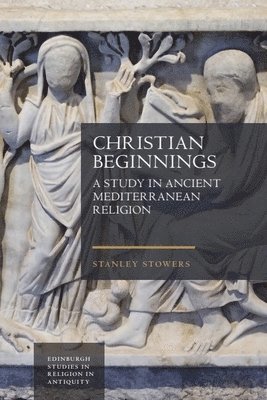







Du kanske också är intresserad av
- Nyhet
Del 3
- Nyhet
Del 11
- Nyhet
Del 1
- Nyhet
Del 4
- Nyhet
Del 4
- Nyhet
Del 6