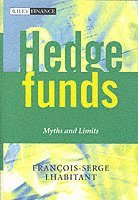
Del 332 - Wiley Finance Series
Handbook of Hedge Funds
Inbunden, Engelska, 2006
Av François-Serge Lhabitant, Francois-Serge (Union Bancaire Privee,) Lhabitant, François-Serge Lhabitant
2 159 kr
Produktinformation
- Utgivningsdatum2006-12-08
- Mått178 x 246 x 38 mm
- Vikt1 261 g
- FormatInbunden
- SpråkEngelska
- SerieWiley Finance Series
- Antal sidor656
- FörlagJohn Wiley & Sons Inc
- ISBN9780470026632
Tillhör följande kategorier
About the author FRANÇOIS-SERGE LHABITANT, PHD, is Chief Investment Officer at Kedge Capital in London. He was formerly a Member of Senior Management at Union Bancaire Privée, and prior to this, a Director at UBS/Global Asset Management. On the academic side, he is a Professor of Finance at the University of Lausanne and at EDHEC Business School. His specialist skills are in the areas of alternative investment (hedge funds) and emerging markets. He is the author of several books on these two subjects and has published numerous research and scientific popularisation articles. He is also a member of the Scientific Council of the Autorité des Marches Financiers, the French regulatory body.
- Foreword by Mark Anson xv1 Introduction 1PART I HEDGE FUND OVERVIEW2 History Revisited 72.1 The very early years: The 1930s 72.2 The formative years (1949–1968) 82.3 The dark ages (1969–1974) 112.4 The renaissance (1975–1997) 122.5 The Asian and Russian crises (1997–1998) 152.6 The equity bubble years 182.7 Hedge funds today 192.8 The key characteristics of modern hedge funds 242.9 The future 353 Legal Environment 373.1 The situation in the US 393.1.1 The Securities Act (1933) 393.1.2 Securities Exchange Act (1934) 443.1.3 Investment Company Act 463.1.4 Investment Advisers Act (1940) 483.1.5 Blue-sky laws 553.1.6 National Securities Markets Improvement Act (1996) 553.1.7 Employee Retirement Income Security Act (1974) 563.1.8 Other regulations 563.1.9 The Commodity Futures Trading Commission 573.2 The situation in Europe 593.2.1 The UCITS directives and mutual fund regulation 593.2.2 The case of European hedge funds 623.2.3 Germany 633.2.4 France 693.2.5 Italy 753.2.6 Switzerland 763.2.7 Ireland 783.2.8 Spain 803.3 The situation in Asia 813.4 Internet and the global village 814 Operational and Organizational Structures 854.1 Legal structures for stand-alone funds 854.1.1 In the United States (“onshore”) 854.1.2 Outside the United States (“offshore”) 874.2 A network of service providers 904.2.1 The sponsor and the investors 914.2.2 The board of directors 914.2.3 The investment adviser 924.2.4 The investment manager or management company 924.2.5 The brokers 934.2.6 The fund administrator 994.2.7 The custodian/trustee 1034.2.8 The legal counsel(s) 1034.2.9 The auditors 1054.2.10 The registrar and transfer agent 1064.2.11 The distributors 1064.2.12 The listing sponsor 1074.3 Specific investment structures 1084.3.1 Mirror funds 1084.3.2 Master/feeder structures 1094.3.3 Managed accounts 1124.3.4 Umbrella funds 1144.3.5 Multi-class/multi-series funds 1154.3.6 Side pockets 1164.3.7 Structured products 1174.4 Disclosure and documents 1184.4.1 Private placement memorandum (PPM) 1184.4.2 Memorandum and articles of association 1184.4.3 ADV form 1184.4.4 Limited partnership agreements 1194.4.5 Side letters 1195 Understanding the Tools Used by Hedge Funds 1215.1 Buying and selling using a cash account 1215.2 Buying on margin 1225.2.1 Mechanics 1225.2.2 Buying on margin: an example 1245.3 Short selling and securities lending 1265.3.1 Mechanics of short selling 1275.3.2 A detailed example 1345.3.3 Restrictions on short selling 1355.3.4 Potential benefits of short selling 1395.3.5 Alternatives to securities lending: repos and buys/sell backs 1405.4 Derivatives 1425.4.1 Terminology 1445.4.2 Basic derivatives contracts 1445.4.3 Credit derivatives 1465.4.4 Benefits and uses of derivatives 1495.5 Leverage 151PART II HEDGE FUND STRATEGIES AND TRADE EXAMPLES6 Introduction 1597 Long/Short Equity Strategies 1637.1 The mechanics of long/short equity investing 1637.1.1 A single position 1637.1.2 Sources of return and feasible portfolios 1657.1.3 Disadvantages of long/short equity investing 1697.2 Investment approaches 1707.2.1 The valuation-based approach 1707.2.2 Sector specialist hedge funds 1747.2.3 Quantitative approaches 1757.2.4 Equity non-hedge hedge funds 1757.2.5 Activist strategies 1767.3 Historical performance 1818 Dedicated Short 1878.1 The pros and cons of dedicated short selling 1878.2 Typical target companies and reactions 1888.3 Historical performance 1939 Equity Market Neutral 1979.1 Definitions of market neutrality 1979.1.1 Dollar neutrality 1979.1.2 Beta neutrality 1989.1.3 Sector neutrality 2009.1.4 Factor neutrality 2009.1.5 A double alpha strategy 2029.2 Examples of equity market neutral strategies and trades 2039.2.1 Pairs trading 2039.2.2 Statistical arbitrage 2079.2.3 Very-high-frequency trading 2089.2.4 Other strategies 2119.3 Historical performance 21110 Distressed Securities 21510.1 Distressed securities markets 21510.1.1 The origins: railways 21510.1.2 From high yield to distressed securities 21610.1.3 The distressed securities market today 21910.2 Distressed securities investing 22610.2.1 Why distressed securities? 22610.2.2 Legal framework 22710.2.3 Valuation 22810.2.4 Active versus passive 23010.2.5 Risks 23210.3 Examples of distressed trades 23310.3.1 Kmart 23310.3.2 Failed leveraged buyouts 23410.3.3 Direct lending 23510.3.4 The case of airlines 23610.4 Historical performance 23911 Merger Arbitrage 24311.1 Mergers and acquisitions: a historical perspective 24311.2 Implementing merger arbitrage: basic principles 24611.2.1 Arbitraging a cash tender offer 24711.2.2 Arbitraging a stock-for-stock offer (fixed exchange rate) 25011.2.3 Arbitraging more complex offers 25211.3 The risks inherent in merger arbitrage 25411.4 Historical performance 26312 Convertible Arbitrage 26912.1 The terminology of convertible bonds 26912.2 Valuation of convertible bonds 27212.2.1 Valuation from an academic perspective 27212.2.2 Valuation from a practitioner perspective (the component approach) 27312.2.3 Risk measurement and the Greek alphabet 27712.3 Convertible arbitrage: the basic delta hedge strategy 27912.4 Convertible Arbitrage in practice: stripping and swapping 28512.5 The strategy evolution 28712.6 Historical performance 29313 Fixed Income Arbitrage 29713.1 The basic tools of fixed income arbitrage 29713.2 Examples of sub-strategies 29913.2.1 Treasuries stripping 29913.2.2 Carry trades 30113.2.3 On-the-run versus off-the-run Treasuries 30113.2.4 Yield-curve arbitrage 30313.2.5 Swap-spread arbitrage 30413.2.6 The Treasury–Eurodollar spread (TED) 30513.3 Historical performance 30614 Emerging Markets 31114.1 The case for emerging market hedge funds 31114.2 Examples of strategies 31414.2.1 Equity strategies 31414.2.2 Fixed income strategies 31914.3 Historical performance 32315 Global Macro 32715.1 Global macro investment approaches 32715.2 Examples of global macro trades 32815.2.1 The ERM crisis (1992) 32915.2.2 The ECU arbitrage 33215.2.3 The Asian crisis (1997) 33315.2.4 The euro convergence (1995–1997) 33715.2.5 Carry trades 34015.2.6 The twin deficits 34415.2.7 Risk management and portfolio construction 34515.3 Historical performance 34616 Managed Futures and Commodity Trading Advisors (CTAs) 35116.1 The various styles of managed futures 35216.1.1 Trading approach: discretionary versus systematic 35216.1.2 Type of analysis: fundamental versus technical 35416.1.3 Source of returns: trend followers and non trend followers 35416.1.4 Timeframe for trades 35516.2 Examples of systematic trading rules 35516.2.1 Moving Average Convergence/Divergence (MACD) 35516.2.2 Examples of trading ranges signals 36116.2.3 Portfolio construction 36316.2.4 Transparency or regulated black boxes? 36316.2.5 Investment vehicles 36516.2.6 Back-testing and calibration 36516.3 Historical Performance 36616.4 The future of managed futures 37017 A Smorgasbord of Other Strategies 37317.1 Capital structure arbitrage and credit strategies 37317.2 Weather derivatives, weather insurance and catastrophe bonds 38117.3 Mutual Fund Arbitrage 38217.3.1 The forward pricing mechanism 38317.3.2 The loopholes in forward pricing 38417.3.3 Unethical, but persistent 38617.3.4 A brutal ending 38717.4 Arbitraging between NAVs and quoted price: Altin AG 38817.5 Split strike conversion 39017.6 Event-Driven Special Situations 39217.7 Cross-listing and dual-listing arbitrage 39317.7.1 Cross-listed companies and ADRs 39317.7.2 Dual-listed companies 39417.8 From public to private equity 39517.9 Regulation D and PIPEs funds 39717.10 IPO Lock-up Expirations 398PART III MEASURING RETURNS, RISKS AND PERFORMANCE18 Measuring Net Asset Values and Returns 40318.1 The difficulties of obtaining information 40418.2 Equalization, crystallization and multiple share classes 40618.3 The inequitable allocation of incentive fees 40618.4 The free-ride syndrome 40718.5 Onshore versus Offshore Funds 40818.6 The multiple share approach 40918.7 The equalization factor/depreciation deposit approach 41018.8 Simple Equalization 41418.9 Consequences for performance calculation 41418.10 The holding period return 41518.11 Annualizing 41718.12 Multiple hedge fund aggregation 41818.13 Continuous compounding 41919 Return Statistics and Risk 42319.1 Calculating return statistics 42319.1.1 Central tendency statistics 42619.1.2 Gains versus losses 42819.2 Measuring risk 42919.2.1 What is risk? 43019.2.2 Range, quartiles and percentiles 43019.2.3 Variance and volatility (standard deviation) 43119.2.4 Back to histograms, return distributions and z-scores 43419.3 Downside risk measures 43919.3.1 From volatility to downside risk 43919.3.2 Semi-variance and semi-deviation 44019.3.3 The shortfall risk measures 44319.3.4 Value at risk 44319.3.5 Drawdown statistics 44619.4 Benchmark-related statistics 44719.4.1 Intuitive benchmark-related statistics 44719.4.2 Beta and market risk 44819.4.3 Tracking error 44920 Risk-Adjusted Performance Measures 45120.1 The Sharpe ratio 45520.1.1 Definition and interpretation 45520.1.2 The Sharpe ratio as a long/short position 45720.1.3 The statistics of Sharpe ratios 45720.2 The Treynor ratio and Jensen alpha 46020.2.1 The CAPM 46020.2.2 The market model 46220.2.3 The Jensen alpha 46320.2.4 The Treynor (1965) ratio 46520.2.5 Statistical significance 46620.2.6 Comparing Sharpe, Treynor and Jensen 46620.2.7 Generalizing the Jensen alpha and the Treynor ratio 46720.3 M2, M3 and Graham–Harvey 46820.3.1 The M2 performance measure 46820.3.2 GH1 and GH2 47020.4 Performance measures based on downside risk 47220.4.1 The Sortino ratio 47220.4.2 The upside potential ratio 47320.4.3 The Sterling and Burke ratios 47420.4.4 Return on VaR (RoVaR) 47520.5 Conclusions 47621 Databases, Indices and Benchmarks 47921.1 Hedge fund databases 47921.2 The various biases in hedge fund databases 47921.2.1 Self-selection bias 48021.2.2 Database/sample selection bias 48221.2.3 Survivorship bias 48221.2.4 Backfill or instant history bias 48421.2.5 Infrequent pricing and illiquidity bias 48521.3 From databases to indices 48721.3.1 Index construction 48721.3.2 The various indices available and their differences 49021.3.3 Different indices – different returns 50321.3.4 Towards pure hedge fund indices 50521.4 From indices to benchmarks 50821.4.1 Absolute benchmarks and peer groups 50921.4.2 The need for true benchmarks 510PART IV INVESTING IN HEDGE FUNDS22 Introduction 51523 Revisiting the Benefits and Risks of Hedge Fund Investing 51723.1 The benefits of hedge funds 51823.1.1 Superior historical risk/reward trade-off 51823.1.2 Low correlation to traditional assets 52023.1.3 Negative vs positive market environments 52323.2 The benefits of individual hedge fund strategies 52723.3 Caveats of hedge fund investing 53424 Asset Allocation and Hedge Funds 53724.1 Diversification and portfolio construction: an overview 53724.1.1 Diversification 53824.1.2 Portfolio construction 53924.1.3 Asset allocation 54124.2 Strategic asset allocation without hedge funds 54324.2.1 Identifying the investor’s financial profile: the concept of utility functions 54324.2.2 Establishing the strategic asset allocation 54624.3 Introducing hedge funds in the asset allocation 54724.3.1 Hedge funds as a separate asset class 54724.3.2 Hedge funds vs traditional asset classes 54824.3.3 Hedge funds as traditional asset class substitutes 54924.4 How much should be allocated to hedge funds? 55124.4.1 An informal approach 55224.4.2 The optimizers’ answer: 100% in hedge funds 55324.4.3 Static versus dynamic allocations 55424.4.4 Dealing with “return management” 55524.4.5 Optimizer’s inputs and the GIGO syndrome 55624.4.6 Non-standard efficient frontiers 56024.4.7 How much should we allocate to hedge funds? 56124.5 Hedge funds as portable alpha overlays 56124.6 Hedge funds as sources of alternative risk exposure 56424.7 Risk budgeting and the separation of alpha from beta 56525 Hedge Fund Selection: A Route Through the Maze 56925.1 Stating objectives 56925.2 Filtering the universe 57025.3 Quantitative Analysis 57125.4 Qualitative Analysis 57225.5 Due Diligence: between art and science 57325.5.1 The strategy 57325.5.2 The fund itself 57425.5.3 The management team 57525.5.4 The infrastructure 57525.5.5 The process 57625.6 Ongoing monitoring 57625.7 Common mistakes in the selection process 57726 Funds of Hedge Funds 57926.1 What are funds of hedge funds? 57926.2 Advantages of funds of funds 57926.2.1 Efficient Risk Diversification 58026.2.2 Affordability and Accessibility 58226.2.3 Professional management and built-in asset allocation 58326.2.4 Access to closed funds 58326.2.5 Better internal and external transparency 58426.3 The dark side of funds of funds 58426.3.1 Yet another layer of fees! 58426.3.2 Extra liquidity 58526.3.3 Lack of control, overdiversification and duplication 58726.4 Selecting a fund of funds 58726.5 Fund allocation: A look inside the “black box” 58826.5.1 Qualitative approaches 58826.5.2 Quantitative approaches 58926.6 The future of funds of funds 58927 Structured Products on Hedge Funds 59127.1 Total return swaps linked to hedge funds 59127.2 Call options on hedge funds 59227.3 Basic notes and certificates 59327.4 Capital protected notes 59427.4.1 The financial engineering process of capital protected notes 59527.4.2 The first generation: the naive approach 59527.5 The second generation: The option-based approach 59827.6 The third generation: the dynamic trading approach 60227.7 The fourth generation: options on CPPI 60827.8 The flies in the ointment 60827.9 The future of capital guaranteed products 61027.10 Collateralized hedge fund obligations 61028 Conclusions 615Bibliography 617Index 625
"...Das 'Handbook of Hedge Funds'deckt ein breites Spektrum zum Thema Hedgefonds ab und ist für Praktiker und Akademiker geeignet, die sich einen umfassenden Überblick zu dieser Asset-Klasse verschaffen wollen bzw. vertiefende Kenntnisse anstreben. Ein wichtiges Standardwerk..."Absolut report Nr 36 Feb/März 2007