
Del i serien Discrete Mathematics and Its Applications
Handbook of Discrete and Computational Geometry
Inbunden, Engelska, 2017
5 419 kr
Beställningsvara. Skickas inom 10-15 vardagar. Fri frakt för medlemmar vid köp för minst 249 kr.
The Handbook of Discrete and Computational Geometry is intended as a reference book fully accessible to nonspecialists as well as specialists, covering all major aspects of both fields.The book offers the most important results and methods in discrete and computational geometry to those who use them in their work, both in the academic world—as researchers in mathematics and computer science—and in the professional world—as practitioners in fields as diverse as operations research, molecular biology and robotics.Discrete geometry has contributed significantly to the growth of discrete mathematics in recent years. This has been fueled partly by the advent of powerful computers and by the recent explosion of activity in the relatively young field of computational geometry. This synthesis between discrete and computational geometry lies at the heart of this Handbook.A growing list of application fields includes combinatorial optimization, computer-aided design, computer graphics, crystallography, data analysis, error-correcting codes, geographic information systems, motion planning, operations research, pattern recognition, robotics, solid modeling, and tomography.
Produktinformation
- Utgivningsdatum2017-11-09
- Mått178 x 254 x 72 mm
- Vikt3 780 g
- FormatInbunden
- SpråkEngelska
- SerieDiscrete Mathematics and Its Applications
- Antal sidor1 950
- Upplaga3
- FörlagTaylor & Francis Inc
- ISBN9781498711395
Tillhör följande kategorier
Hoppa över listan




Du kanske också är intresserad av
Del 52
Del 52
Combinatorial and Computational Geometry
Jacob E. Goodman, Janos Pach, Emo Welzl
Inbunden, 2005
2 109 kr
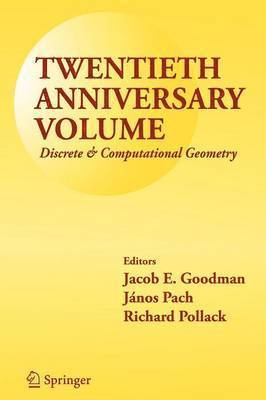
Twentieth Anniversary Volume: Discrete & Computational Geometry
Jacob E. Goodman, János Pach, Richard Pollack
Häftad, 2008
1 439 kr
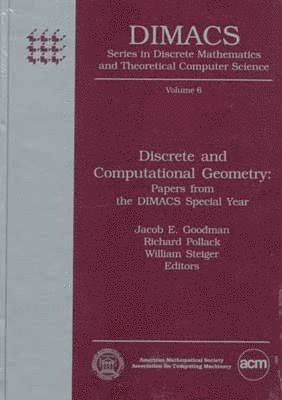
Discrete and Computational Geometry
Jacob E. Goodman, Richard Pollack, William Steiger
Inbunden, 1991
1 479 kr
Del 11904