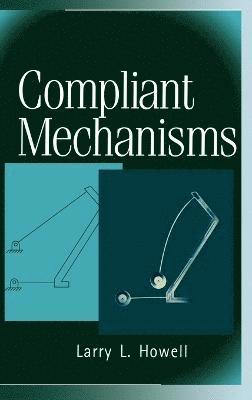
Beställningsvara. Skickas inom 7-10 vardagar. Fri frakt för medlemmar vid köp för minst 249 kr.
A fully illustrated reference book giving an easy-to-understand introduction to compliant mechanismsA broad compilation of compliant mechanisms to give inspiration and guidance to those interested in using compliant mechanisms in their designs, the Handbook of Compliant Mechanisms includes graphics and descriptions of many compliant mechanisms. It comprises an extensive categorization of devices that can be used to help readers identify compliant mechanisms related to their application. It also provides chapters on the basic background in compliant mechanisms, the categories of compliant mechanisms, and an example of how the Compendium can be used to facilitate compliant mechanism design. Fully illustrated throughout to be easily understood and accessible at introductory levelsCovers all aspects pertaining to classification, elements, mechanisms and applications of compliant mechanismsSummarizes a vast body of knowledge in easily understood diagrams and explanations Helps readers appreciate the advantages that compliant mechanisms have to offerPractical approach is ideal for potential practitioners who would like to realize designs with compliant mechanisms, members and elementsBreadth of topics covered also makes the book a useful reference for more advanced readersIntended as an introduction to the area, the Handbook avoids technical jargon to assist non engineers involved in product design, inventors and engineers in finding clever solutions to problems of design and function.
Editors LARRY L. HOWELL and SPENCER P. MAGLEBY, Brigham Young University, USA BRIAN M. OLSEN, Los Alamos National Laboratory, USA
List of Contributors xiAcknowledgments xvPreface xviiPart One Introduction to Compliant Mechanisms1 Introduction to Compliant Mechanisms 31.1 What are Compliant Mechanisms? 31.2 What are the Advantages of Compliant Mechanisms? 61.3 What Challenges do Compliant Mechanisms Introduce? 61.4 Why are Compliant Mechanisms Becoming More Common? 71.5 What are the Fundamental Concepts that Help Us Understand Compliance? 81.5.1 Stiffness and Strength are NOT the Same Thing 81.5.2 It is Possible for Something to be Flexible AND Strong 81.5.3 The Basics of Creating Flexibility 101.6 Conclusion 13References 132 Using the Handbook to Design Devices 152.1 Handbook Outline 162.2 Considerations in Designing Compliant Mechanisms 162.3 Locating Ideas and Concepts in the Library 192.4 Modeling Compliant Mechanisms 202.5 Synthesizing Your Own Compliant Mechanisms 212.6 Summary of Design Approaches for Compliant Mechanisms 22Further Reading 24Part Two Modeling of Compliant Mechanisms3 Analysis of Flexure Mechanisms in the Intermediate Displacement Range 293.1 Introduction 293.2 Modeling Geometric Nonlinearities in Beam Flexures 313.3 Beam Constraint Model 343.4 Case Study: Parallelogram Flexure Mechanism 383.5 Conclusions 41Further Reading 424 Modeling of Large Deflection Members 454.1 Introduction 454.2 Equations of Bending for Large Deflections 464.3 Solving the Nonlinear Equations of Bending 474.4 Examples 484.4.1 Fixed-Pinned Beam 484.4.2 Fixed-Guided Beam (Bistable Mechanism) 494.5 Conclusions 52Further Reading 53References 535 Using Pseudo-Rigid Body Models 555.1 Introduction 555.2 Pseudo-Rigid-Body Models for Planar Beams 575.3 Using Pseudo-Rigid-Body Models: A Switch Mechanism Case-Study 605.4 Conclusions 65Acknowledgments 65References 65Appendix: Pseudo-Rigid-Body Examples (by Larry L. Howell) 66A.1.1 Small-Length Flexural Pivot 66A.1.2 Vertical Force at the Free End of a Cantilever Beam 67A.1.3 Cantilever Beam with a Force at the Free End 67A.1.4 Fixed-Guided Beam 69A.1.5 Cantilever Beam with an Applied Moment at the Free End 70A.1.6 Initially Curved Cantilever Beam 70A.1.7 Pinned-Pinned Segments 71A.1.8 Combined Force-Moment End Loading 73A.1.9 Combined Force-Moment End Loads – 3R Model 74A.1.10 Cross-Axis Flexural Pivot 74A.1.11 Cartwheel Flexure 76References 76Part Three Synthesis of Compliant Mechanisms6 Synthesis through Freedom and Constraint Topologies 796.1 Introduction 796.2 Fundamental Principles 826.2.1 Modeling Motions using Screw Theory 826.2.2 Modeling Constraints using Screw Theory 846.2.3 Comprehensive Library of Freedom and Constraint Spaces 866.2.4 Kinematic Equivalence 866.3 FACT Synthesis Process and Case Studies 876.3.1 Flexure-Based Ball Joint Probe 876.3.2 X-Y-ThetaZ Nanopositioner 886.4 Current and Future Extensions of FACT’s Capabilities 89Acknowledgments 90References 907 Synthesis through Topology Optimization 937.1 What is Topology Optimization? 937.2 Topology Optimization of Compliant Mechanisms 957.3 Ground Structure Approach 987.4 Continuum Approach 1007.4.1 SIMP Method 1007.4.2 Homogenization Method 1037.5 Discussion 1047.6 Optimization Solution Algorithms 105Acknowledgment 106References 1068 Synthesis through Rigid-Body Replacement 1098.1 Definitions, Motivation, and Limitations 1098.2 Procedures for Rigid-Body Replacement 1118.2.1 Starting with a Rigid-Body Mechanism 1118.2.2 Starting with a Desired Task 1148.2.3 Starting with a Compliant Mechanism Concept 1158.2.4 How DoWe Choose the Best Configurations Considering Loads, Strains, and Kinematics? 1168.3 Simple Bicycle Derailleur Example 116References 1219 Synthesis through Use of Building Blocks 1239.1 Introduction 1239.2 General Building-Block Synthesis Approach 1239.3 Fundamental Building Blocks 1249.3.1 Compliant Dyad 1249.3.2 Compliant 4-Bar 1259.4 Elastokinematic Representations to Model Functional Behavior 1259.4.1 Compliance Ellipses and Instant Centers 1269.4.2 Compliance Ellipsoids 1279.4.3 Eigentwist and Eigenwrench Characterization 1309.5 Decomposition Methods and Design Examples 1349.5.1 Single-Point Mechanisms 1359.5.2 Multi-Port Mechanisms using Compliance Ellipsoids 1399.5.3 Displacement Amplifying Mechanisms using Instant Centers 1439.6 Conclusions 145Further Reading 145References 146Part Four Library of Compliant Mechanisms10 Library Organization 14910.1 Introduction 14910.1.1 Categorization 14910.2 Library of Compliant Designs 15110.3 Conclusion 153References 15311 Elements of Mechanisms 15511.1 Flexible Elements 15511.1.1 Beams 15511.1.2 Revolute 16111.1.3 Translate 17911.1.4 Universal 18111.2 Rigid-Link Joints 18611.2.1 Revolute 18611.2.2 Prismatic 18711.2.3 Universal 18811.2.4 Others 189References 19112 Mechanisms 19312.1 Basic Mechanisms 19312.1.1 Four-Bar Mechanism 19312.1.2 Six-Bar Mechanism 19512.2 Kinematics 19712.2.1 Translational 19712.2.2 Rotational 20412.2.3 Translation—Rotation 20912.2.4 Parallel Motion 21412.2.5 Straight Line 21812.2.6 Unique Motion Path 22012.2.7 Stroke Amplification 22712.2.8 Spatial Positioning 23012.2.9 Metamorphic 23312.2.10 Ratchet 23712.2.11 Latch 24112.2.12 Others 24312.3 Kinetics 24512.3.1 Energy Storage 24512.3.2 Stability 25212.3.3 Constant Force 26212.3.4 Force Amplification 26312.3.5 Dampening 26712.3.6 Mode 26812.3.7 Others 269References 27213 Example Application 27713.1 Elements of Mechanisms: Flexible Elements 27713.2 Mechanisms: Kinematic 28213.3 Mechanisms: Kinetic 291References 317Index 319