Beställningsvara. Skickas inom 7-10 vardagar. Fri frakt för medlemmar vid köp för minst 249 kr.
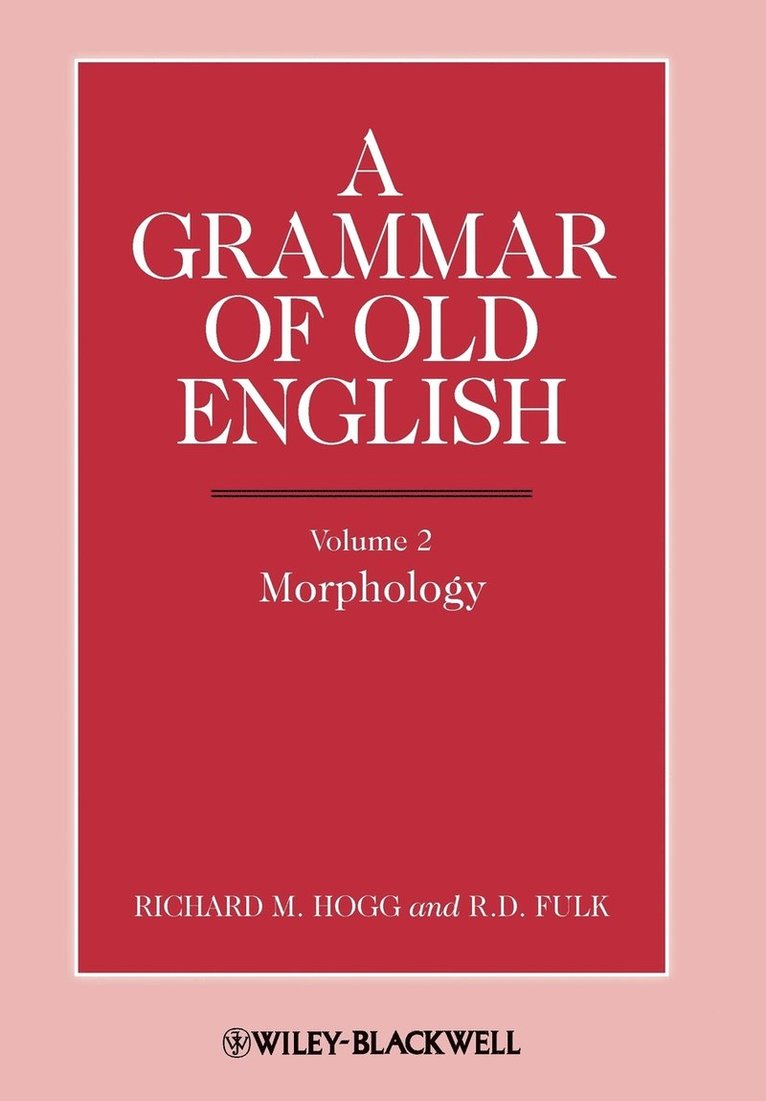
First published in 1992, A Grammar of Old English, Volume 1: Phonology was a landmark publication that in the intervening years has not been surpassed in its depth of scholarship and usefulness to the field. With the 2011 posthumous publication of Richard M. Hogg’s Volume 2: Morphology, Volume 1 is again in print, now in paperback, so that scholars can own this complete work. Takes account of major developments both in the field of Old English studies and in linguistic theoryTakes full advantage of the Dictionary of Old English project at Toronto, and includes full cross-references to the DOE dataFully utilizes work in phonemic and generative theory and related topicsProvides material crucial for future research both in diachronic and synchronic phonology and in historical sociolinguistics
The late Richard M. Hogg was Professor of English Language at the University of Manchester. He was the General Editor of the Cambridge History of the English Language and author, with C. B. McCully, of Metrical Phonology: A Coursebook (1987), and editor, with David Denison, of A History of the English Language (2008).
Preface viiiList of abbreviations xi1 Introduction 12 Orthography and phonology 103 The vowels in Germanic 52I Primitive Germanic (§§1–4) 52II Vowel harmony (§§5–12) 53III Loss of nasals and compensatory lengthening (§§13–15) 55IV Diphthongization (§§16–19) 56V Influence of */z/ (§§20–1) 59VI Long vowels (§§22–6) 59VII Unstressed vowels (§§27–33) 62VIII Raising of back vowels (§34) 644 The consonants in Germanic 66I Primitive Germanic (§§1–3) 66II Verner’s Law (§§4–5) 67III Germanic approximants (§§6–9) 68IV Consonant loss (§10) 70V West Germanic gemination (§§11–14) 71VI Miscellanea (§§15–19) 725 Old English vowels 74I First fronting and associated changes (§§3–15) 75II Breaking (§§16–34) 82III Restoration of A (§§35–40) 93IV Lowering of second elements of diphthongs (§§41–6) 99V Palatal diphthongization (§§47–73) 104VI I-umlaut (§§74–86) 118VII Second fronting (§§87–92) 135VIII Anglian smoothing (§§93–102) 139IX Back umlaut (§§103–12) 149X Palatal umlaut (§§113–18) 163XI Palatal monophthongization (§§119–23) 166XII Compensatory lengthening (§§124–30) 169XIII Hiatus (§§131–54) 172XIV Merger of /io/ and /eo/ (§§155–62) 185XV West Saxon developments of high front vowels and diphthongs (§§163–75) 190XVI The influence of /w/ (§§176–87) 198XVII The development of Kentish front vowels (§§188–96) 203XVIII Changes in quantity (§§197–205) 206XIX Monophthongization of diphthongs (§§206–14) 210XX Merger of /æ/ and /w/ (§§215–16) 2136 Unstressed vowels 214I First fronting and associated changes (§§2–6) 214II Breaking, palatal diphthongization, i-umlaut, and back umlaut (§§7–12) 217III Syncope and apocope (§§13–25) 220IV Shortening (§§26–33) 227V Epenthesis and syllabification (§§34–45) 230VI Mergers of unstressed vowels (§§46–62) 235VII Unstressed medial vowels (§§63–71) 2427 Old English consonants 246I Dissimilation (§§4–14) 247II Palatalization and assibilation (§§15–43) 252III Development of fricatives (i): lenition (§§44–53) 270IV Development of fricatives (ii): voicing and devoicing (§§54–68) 276V Post-vocalic approximants (§§69–76) 283VI Consonant clusters (§§77–97) 287VII Loss of final nasals (§§98–100) 298VIII Late Old English changes (§§101–3) 299References 301Word index 315