
Del i serien Routledge Explorations in Development Studies
Global Architecture of Multilateral Development Banks
A System of Debt or Development?
Häftad, Engelska, 2022
889 kr
Beställningsvara. Skickas inom 10-15 vardagar. Fri frakt för medlemmar vid köp för minst 249 kr.
Finns i fler format (1)
This book explores the evolution of the 30 functioning multilateral development banks (MDBs). MDBs have their roots in the growing system of international finance and multilateral cooperation, with the first recognisable MDB being proposed by Latin America in financial cooperation with the US in the late 1930s. That Inter-American Bank did not eventuate but was a precursor to the World Bank being negotiated at Bretton Woods in 1944. Since then, a complex network of regional, sub-regional, and specialised development banks has progressively emerged across the globe, including two significant recent entrants established by China and the BRICS. MDBs arrange loans, credits, and guarantees for investment in member states, generally with the stated aim of fostering economic growth. They operate in both the Global North and South, though there are more MDBs focusing on emerging and developing states. While the World Bank and some of the larger regional banks have been scrutinised, little attention has been paid to the smaller banks or the overall system. This book provides the first study of all 30 MDBs and it evaluates their interrelationships. It analyses the emergence of the MDBs in relation to geopolitics, development paradigms and debt. It includes sections on each of the banks as well as on how MDBs have approached the key sectors of infrastructure, human development, and climate.This book will be of particular interest to researchers of development finance, global governance, and international political economy.
Produktinformation
- Utgivningsdatum2022-09-26
- Mått156 x 234 x 21 mm
- Vikt453 g
- FormatHäftad
- SpråkEngelska
- SerieRoutledge Explorations in Development Studies
- Antal sidor286
- FörlagTaylor & Francis Ltd
- ISBN9780367708122
Tillhör följande kategorier
Hoppa över listan








Mer från samma serie
Power of Civil Society in the Middle East and North Africa
Ibrahim Natil, Chiara Pierobon, Lilian Tauber
Inbunden, 2019
3 209 kr
Critical Reflections on Public Private Partnerships
Jasmine Gideon, Elaine Unterhalter
Inbunden, 2020
3 209 kr
Youth, Gender and the Capabilities Approach to Development
Aurora Lopez-Fogues, Firdevs Melis Cin
Häftad, 2019
1 049 kr
Chinese Hydropower Development in Africa and Asia
Giuseppina Siciliano, Frauke Urban
Häftad, 2019
1 049 kr
Political Participation and Democratic Capability in Authoritarian States
Lien Pham, Ance Kaleja
Inbunden, 2021
3 209 kr
Hoppa över listan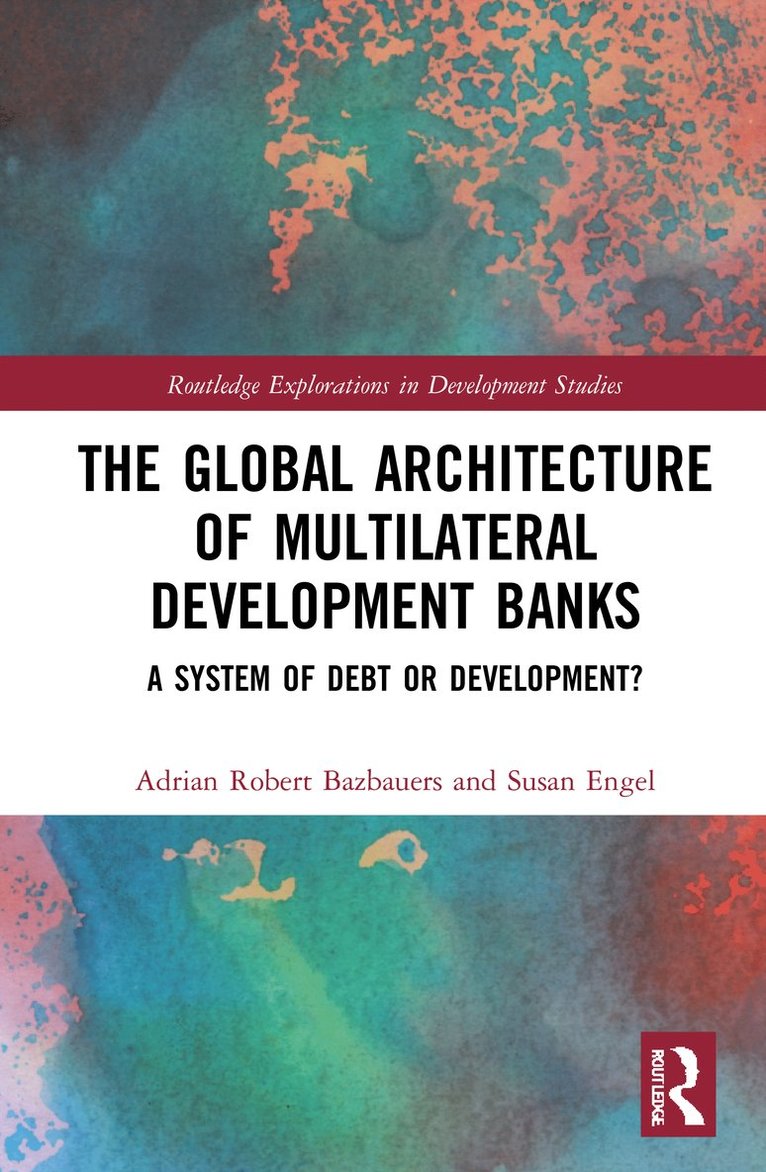









Du kanske också är intresserad av
Global Architecture of Multilateral Development Banks
Adrian Robert Bazbauers, Susan Engel
Inbunden, 2021
3 209 kr
Routledge Handbook of Global Development
Kearrin Sims, Nicola Banks, Susan Engel, Paul Hodge, Jonathan Makuwira, Naohiro Nakamura, Jonathan Rigg, Albert Salamanca, Pichamon Yeophantong
Häftad, 2024
649 kr
World Bank and the post-Washington Consensus in Vietnam and Indonesia
Susan Engel
Inbunden, 2009
3 619 kr