
Del i serien Algorithms and Combinatorics
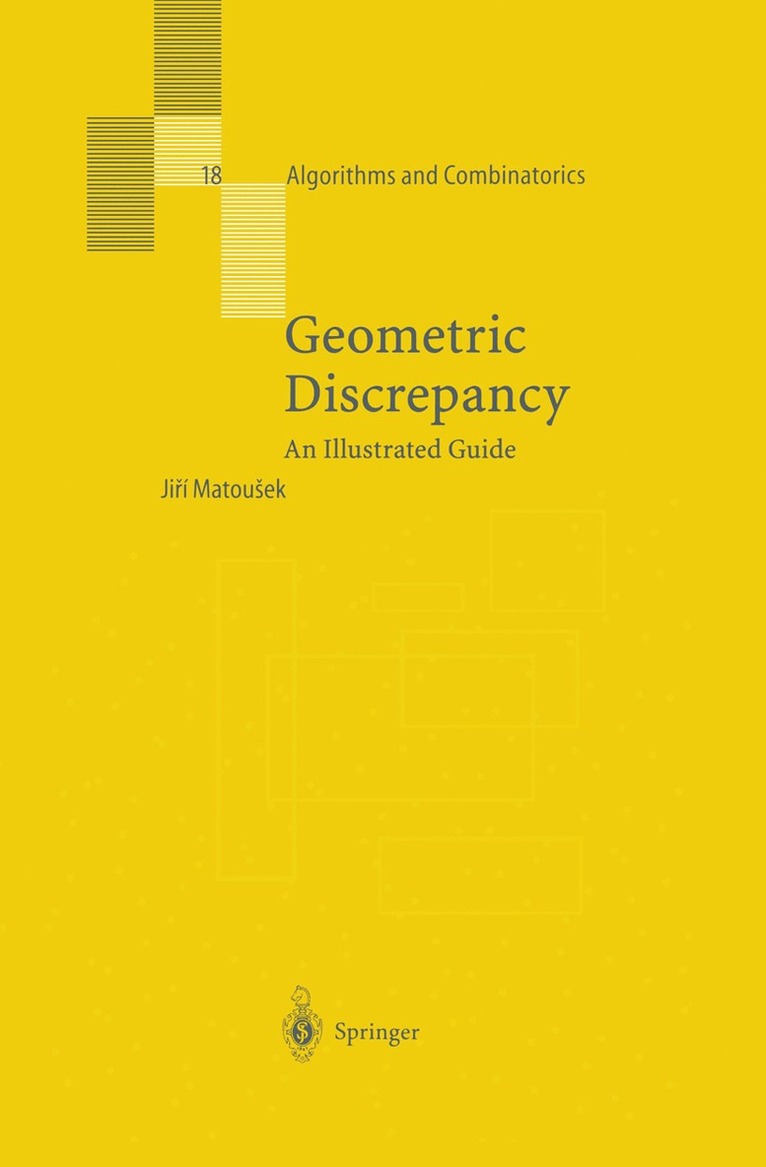
Geometric Discrepancy
An Illustrated Guide
Inbunden, Engelska, 1999
2 149 kr
Beställningsvara. Skickas inom 10-15 vardagar. Fri frakt för medlemmar vid köp för minst 249 kr.
Discrepancy theory is also called the theory of irregularities of distribution. Here are some typical questions: What is the "most uniform" way of dis tributing n points in the unit square? How big is the "irregularity" necessarily present in any such distribution? For a precise formulation of these questions, we must quantify the irregularity of a given distribution, and discrepancy is a numerical parameter of a point set serving this purpose. Such questions were first tackled in the thirties, with a motivation com ing from number theory. A more or less satisfactory solution of the basic discrepancy problem in the plane was completed in the late sixties, and the analogous higher-dimensional problem is far from solved even today. In the meantime, discrepancy theory blossomed into a field of remarkable breadth and diversity. There are subfields closely connected to the original number theoretic roots of discrepancy theory, areas related to Ramsey theory and to hypergraphs, and also results supporting eminently practical methods and algorithms for numerical integration and similar tasks. The applications in clude financial calculations, computer graphics, and computational physics, just to name a few. This book is an introductory textbook on discrepancy theory. It should be accessible to early graduate students of mathematics or theoretical computer science. At the same time, about half of the book consists of material that up until now was only available in original research papers or in various surveys.
Produktinformation
- Utgivningsdatum1999-05-19
- Mått155 x 235 x 23 mm
- Vikt629 g
- FormatInbunden
- SpråkEngelska
- SerieAlgorithms and Combinatorics
- Antal sidor289
- Upplaga1999
- FörlagSpringer-Verlag Berlin and Heidelberg GmbH & Co. KG
- ISBN9783540655282
Tillhör följande kategorier
Hoppa över listan


Du kanske också är intresserad av
Approximation Algorithms and Semidefinite Programming
Bernd Gärtner, Jiri Matousek
Inbunden, 2012
1 149 kr