
Del 87
First Course in Mathematical Logic and Set Theory
Inbunden, Engelska, 2015
1 799 kr
Beställningsvara. Skickas inom 5-8 vardagar. Fri frakt för medlemmar vid köp för minst 249 kr.
A mathematical introduction to the theory and applications of logic and set theory with an emphasis on writing proofsHighlighting the applications and notations of basic mathematical concepts within the framework of logic and set theory, A First Course in Mathematical Logic and Set Theory introduces how logic is used to prepare and structure proofs and solve more complex problems.The book begins with propositional logic, including two-column proofs and truth table applications, followed by first-order logic, which provides the structure for writing mathematical proofs. Set theory is then introduced and serves as the basis for defining relations, functions, numbers, mathematical induction, ordinals, and cardinals. The book concludes with a primer on basic model theory with applications to abstract algebra. A First Course in Mathematical Logic and Set Theory also includes: Section exercises designed to show the interactions between topics and reinforce the presented ideas and conceptsNumerous examples that illustrate theorems and employ basic concepts such as Euclid’s lemma, the Fibonacci sequence, and unique factorizationCoverage of important theorems including the well-ordering theorem, completeness theorem, compactness theorem, as well as the theorems of Löwenheim–Skolem, Burali-Forti, Hartogs, Cantor–Schröder–Bernstein, and KönigAn excellent textbook for students studying the foundations of mathematics and mathematical proofs, A First Course in Mathematical Logic and Set Theory is also appropriate for readers preparing for careers in mathematics education or computer science. In addition, the book is ideal for introductory courses on mathematical logic and/or set theory and appropriate for upper-undergraduate transition courses with rigorous mathematical reasoning involving algebra, number theory, or analysis.
Produktinformation
- Utgivningsdatum2015-10-16
- Mått155 x 236 x 28 mm
- Vikt772 g
- FormatInbunden
- SpråkEngelska
- Antal sidor464
- FörlagJohn Wiley & Sons Inc
- ISBN9780470905883
Tillhör följande kategorier
Hoppa över listan

Mer från samma författare
Del 88
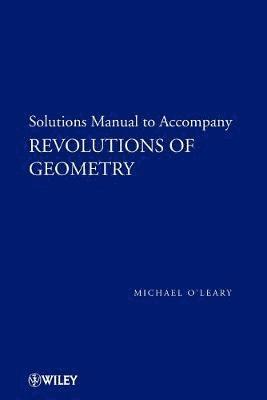
Revolutions of Geometry, Solutions Manual to Accompany Revolutions in Geometry
Michael L. O'Leary
Häftad, 2010
659 kr
Del 105
Hoppa över listan





Du kanske också är intresserad av
Del 105
Del 87
Del 88
Revolutions of Geometry, Solutions Manual to Accompany Revolutions in Geometry
Michael L. O'Leary
Häftad, 2010
659 kr
- Nyhet
Del 11
- Nyhet
Del 4
- Nyhet
Del 3
Del 1
Del 3
- Nyhet
Del 6