
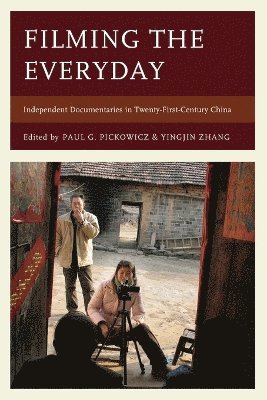
Filming the Everyday
Independent Documentaries in Twenty-First-Century China
Inbunden, Engelska, 2016
1 739 kr
Beställningsvara. Skickas inom 10-15 vardagar. Fri frakt för medlemmar vid köp för minst 249 kr.
This cutting-edge book examines the rapidly developing scene of Chinese independent documentary, arguably the most courageous player in contemporary Chinese visual culture. The authors explore two areas that are of special interest to China studies and film studies, respectively: (1) filming the everyday in twenty-first-century China to foreground contestation and diversity and (2) exploring the aesthetic of remembering in an embodied documentary practice, which turns the gaze on artists themselves and encourages the viewer’s engagement with the filmed subjects and environment. Highlighting documentary contestation in China, the book traces its cacophony of expressions, some of it featuring confrontations with domineering elites, some of it highlighting negotiations among the independent filmmakers themselves. Their goal is not a “movement” that seeks to establish and impose a single truth, but rather a creative dynamic that fosters a community of tolerance and respects diverse forms of expression. Independent documentary is quite literally a moving target that is witnessing ongoing and widening diversity and complexity when it comes to directors, themes, aesthetics, human subjects, audiences, and impact. The authors stress the enormous potential of cultural production that features non-elites (including amateurs) and that dwells on the everyday, the bottom up, the grassroots, the seemingly mundane, and the apparently marginal. The book’s emphasis on contemporary issues and its discussion of aesthetic experiments will appeal to all readers interested in China’s culture, media, politics, and society.
Produktinformation
- Utgivningsdatum2016-12-15
- Mått161 x 238 x 17 mm
- Vikt440 g
- FormatInbunden
- SpråkEngelska
- Antal sidor212
- FörlagBloomsbury Publishing Plc
- ISBN9781442270237
Hoppa över listan

Du kanske också är intresserad av
Locating Taiwan Cinema in the Twenty-First Century
Paul G Pickowicz, Yingjin Zhang
Inbunden, 2020
1 999 kr
China Tripping
Rowman & Littlefield, Jeremy A. Murray, Perry Link, Paul G. Pickowicz
Häftad, 2019
489 kr
Revolution, Resistance, and Reform in Village China
Edward Friedman, Paul G. Pickowicz, Mark Selden
Häftad, 2007
789 kr