Beställningsvara. Skickas inom 10-15 vardagar. Fri frakt för medlemmar vid köp för minst 249 kr.
11 . 2 Study objectives 147 11 . 3 Approach to analysis 147 11. 4 Presentation and discussion of results 151 11 . 5 Conclusions 165 12 Accident management and failure analysis G. C. Meggitt 170 12. 1 Introduction 170 12. 2 Nuclear safety 170 12. 3 The accident 171 12. 4 The accident response 171 12. 5 The automatic response 171 12. 6 The tailored response 173 12. 7 The emergency plan 181 13 Decision support systems and emergency management M. Grauer 182 13. 1 Introduction 182 13. 2 The problem 183 13. 3 The multiple-criteria approach 184 3 13. 4 OveNiew of the 1-decision support software 186 13. 5 A case study from chemical industry 189 13. 6 Conclusions 195 References 196 14 Safety integrity management using expert systems Dr P. Andow 198 14. 1 Introduction 198 14. 2 Safety and risk analysis 198 14. 3 The effects of applying safety and risk analysis 199 14. 4 Safety integrity management 201 14. 5 Knowledge-base contents 204 14. 6 Summary of system functions 204 14. 7 Discussion 205 References 205 15 Power system alarm analysis and fault diagnosis using expert systems P. H. Ashmole 207 15. 1 Introduction 207 15. 2 Expert systems for power system alarm analysis already developed 208 15. 3 Existing substation control arrangements 209 15. 4 Discussion of alarm data flow 210 15. 5 Expert system requirements 210 15. 6 User interface 211 15. 7 Requirements under different fault conditions 211 15.
1 Fail-safe control systems: an introduction.- References.- 2 Software fault tolerance.- 2.1 Introduction.- 2.2 What is software fault tolerance?.- 2.3 Sequential, concurrent and real-time systems.- 2.4 Analysis and synthesis tool.- 2.5 An overview of software fault tolerance techniques.- 2.6 Software fault tolerance in sequential systems.- 2.7 Software fault tolerance in concurrent systems.- 2.8 Transaction processing and distributed decisionmechanisms in distributed systems.- References.- 3 Software reliability: the way forward.- 3.1 Advantages and disadvantages of programmable systems.- 3.2 Features of software related failures.- 3.3 Reliability/integrity in design.- 3.4 The approach to safety/reliability assessment.- 3.5 Limitations and drawbacks of software assessments.- 3.6 The way forward.- References.- 4 Design principles for diagnostics decision support systems.- 4.1 Introduction.- 4.2 The operators’model.- 4.3 Diagnostic support.- 4.4 Conclusions.- 5 A fault tolerant control scheme.- 5.1 Summary.- 5.2 Introduction.- 5.3 Feedback path.- 5.4 Controller assessment.- 5.5 Decision and monitoring.- 5.6 Conclusions.- References.- 6 Fault tolerant procedures for boiler control systems design.- 6.1 Introduction.- 6.2 Motivation and design criteria.- 6.3 Scope of the problem.- 6.4 Computer architecture.- 6.5 Control loop structure.- 6.6 Scanners and data input.- 6.7 Output commands and actuator drives.- 6.8 Control algorithm.- 6.9 Operator interface.- 6.10 Software structure.- 6.11 Conclusions.- References.- 7 Framework for the design and assessment of safety related control systems.- 7.1 Introduction.- 7.2 Systems under consideration.- 7.3 Considerations underlying the guidelines.- 7.4 Safety principles.- 7.5 Design and assessment general framework.- 7.6 Applicationof the safety principles.- 7.7 Total system environment.- 7.8 Protection systems.- 7.9 Safety cases for CIMAH.- 7.10 Future development: General.- 7.11 Future development: Application-specific guidelines.- 7.12 Future development: Standards.- 7.13 Summary.- References.- 8 Failure-to-safety in turbine-generator control.- 8.1 Introduction.- 8.2 Modes of failure.- 8.3 Provisions to assure failure-to-safety.- 8.4 Fault detection requirements.- 8.5 Condition monitoring.- 8.6 Conclusion.- References.- 9 Expert systems for monitoring process control.- 9.1 Introduction.- 9.2 Benefits of the expert system.- 9.3 Process monitoring.- 9.4 Speed considerations.- 9.5 The use of history.- 9.6 Trending and forecasting.- 9.7 Supporting data acquisition.- 9.8 Meta process control.- References.- 10 Robust fault diagnosis in dynamic systems.- 10.1 Introduction.- 10.2 Problem specification.- 10.3 Robust fault detection.- 10.4 The sensor fault detection problem.- 10.5 IFD system design example.- 10.6 IFD simulation results.- 10.7 Conclusion.- References.- 11 Prediction of failure conditions.- 11.1 Introduction.- 11.2 Study objectives.- 11.3 Approach to analysis.- 11.4 Presentation and discussion of results.- 11.5 Conclusions.- 12 Accident management and failure analysis.- 12.1 Introduction.- 12.2 Nuclear safety.- 12.3 The accident.- 12.4 The accident response.- 12.5 The automatic response.- 12.6 The tailored response.- 12.7 The emergency plan.- 13 Decision support systems and emergency management.- 13.1 Introduction.- 13.2 The problem.- 13.3 The multiple-criteria approach.- 13.4 Overview of the l3-decision support software.- 13.5 A case study from chemical industry.- 13.6 Conclusions.- References.- 14 Safety integrity management using expert systems.- 14.1 Introduction.- 14.2 Safety and risk analysis.- 14.3 The effects of applying safety and risk analysis.- 14.4 Safety integrity management.- 14.5 Knowledge-base contents.- 14.6 Summary of system functions.- 14.7 Discussion.- References.- 15 Power system alarm analysis and fault diagnosis using expert Systems.- 15.1 Introduction.- 15.2 Expert systems for power system alarm analysis already developed.- 15.3 Existing substation control arrangements.- 15.4 Discussion of alarm data flow.- 15.5 Expert system requirements.- 15.6 User interface.- 15.7 Requirements under different fault conditions.- 15.8 Data structure.- 15.9 Expert system structure.- 15.10 Demonstrator phase objective.- References.- 16Intelligent process control.- 16.1 Introduction.- 16.2 Why an expert system for process control?.- 16.3 What should an expert system for process control consist of?.- 16.4 Integrating the expert system in the control system of the plant.- 16.5 Conclusions.- References.- 17 New technology for improved quality control and security of process operations.- 17.1 Introduction.- 17.2 Conventional regulation and its limitations.- 17.3 Techniques that can address product control.- 17.4 A simple comparison of conventional and predictive control.- 17.5 Discussion.- References.
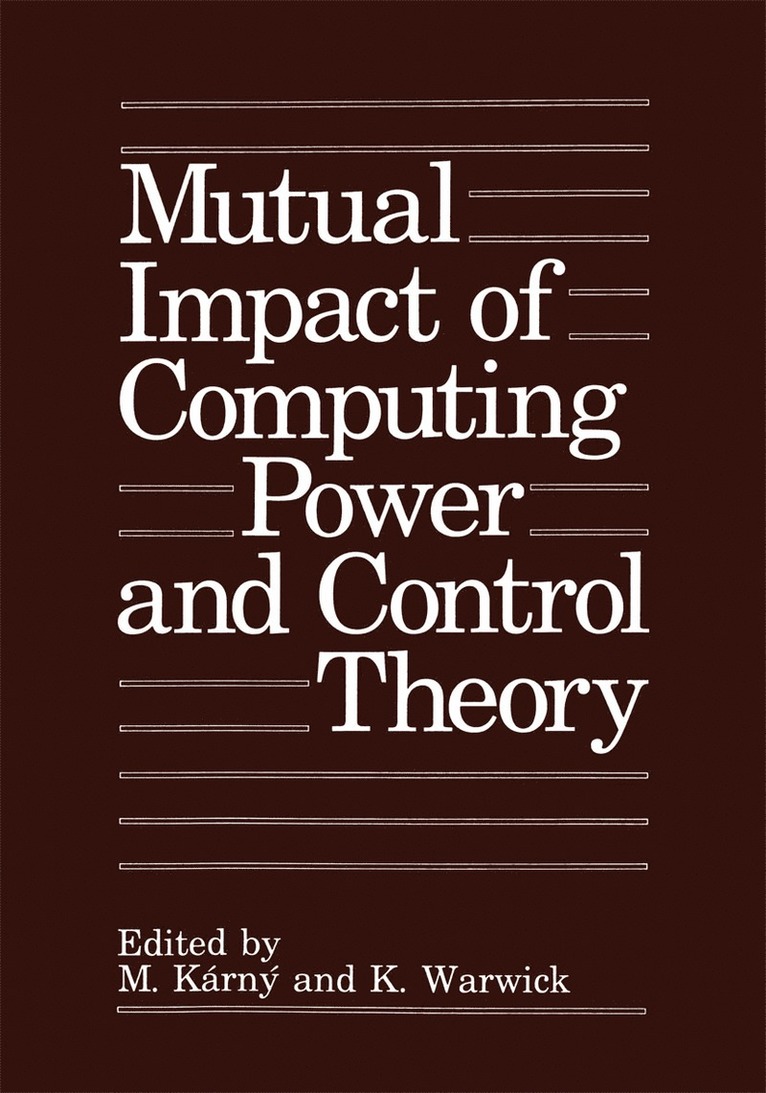
International Federation of Automatic Co, Ifac Workshop on the Mutual Impact of Co, International Federation of Automatic Control, Ifac Workshop on the Mutual Impact of Computing Power and Control Theory, M. Karny, K. Warwick, M. Kárny