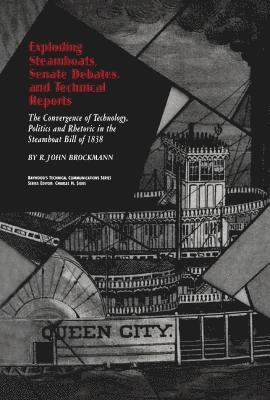
By 1838, over two thousand Americans had been killed and many hundreds injured by exploding steam engines on steamboats. After calls for a solution in two State of the Union addresses, a Senate Select Committee met to consider an investigative report from the Franklin Institute of Philadelphia, the first federally funded investigation into a technical.
CHAPTER 1. Steamboat Politics and Steamboat SocietyNew York Harbor, May 15, 1824, 7:00 PMFour Days Later—Washington City, May 19, 1824 CHAPTER 2. Steamboat TechnologyHigh-Pressure Steam Engines and Hulls that Ride On the WaterWhat Could Go Wrong with the Boiler TechnologyProblems Operating a Problem-Prone TechnologyFebruary 24, 1830, Memphis Tennessee, Early MorningWashington City, May 4, 1830—Two and a Half Months Later CHAPTER 3. Steamboats, The Presidency, and Public OpinionRed River, May 19, 1833, Early on a Spring Sunday MorningDecember 3, 1833—President Jackson’s State of the Union Message to CongressBut What About the Public Pressure for Steamboat Safety?The Franklin Institute Reports—A Reasoned Technical Response to CatastropheTraditional Technical Writing of the Era—Communications Received by the Committee ofthe Franklin Institute on the Explosion of Steam Boilers (1832)Report of the Committee of the Franklin Institute of the State of Pennsylvania for thePromotion of the Mechanic Arts, on the Explosions of Steam-Boilers, Part I, Containingthe First Report of Experiments Made by the Committee for the Treasury Department ofthe U. States (1836)General Report on the Explosions of Steam-Boilers by a Committee of the Franklin Instituteof the State of Pennsylvania for the Promotion of the Mechanic Arts (1837)Report of the Committee of the Franklin Institute of the State of Pennsylvania for thePromotion of the Mechanic Arts, on the Explosions of Steam-Boilers Made at theRequest of the Treasury Department of the United States, Part II, Containing the Reportof the Sub-Committee to Whom Was Referred the Examination of the Strength ofMaterials Employed in the Construction of Steam Boilers (1837)Contemporaneous Reactions to the Institute Reports in the Scientific Community: Hales’sOpen Letter to Grundy, Locke’s Cincinnati Report, and Steam Textbooks by Renwickand WardContemporaneous Reactions to Institute’s Reports by Those Most Directly Involved:Steamboat Inspectors, Engineers, and FiremenThe Gold Dust FireChapter 37. The End of the “Gold Dust”Chapter 20. A CatastropheCHAPTER 4. Steamboat Politics and RhetoricMay 11, 1837, Thirty Miles South of NatchezA Brief Coincidence of Political InterestsThe Select CommitteeThe Initial Proposed Bill in December 1837The Bill Reported Out of Committee CHAPTER 5. The Law Didn’t Work GLOSSARYAPPENDIX 1. Comparing the Four Legislative AttemptsINDEX