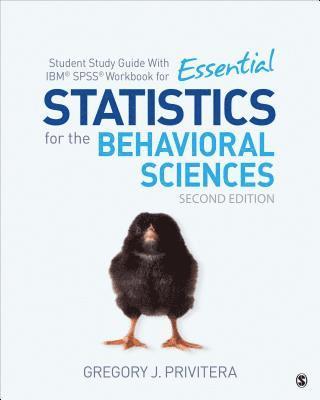
Essential Statistics for the Behavioral Sciences - International Student Edition
Häftad, Engelska, 2018
2 449 kr
Essentials of Statistics for the Behavioral Sciences is a concise version of Statistics for the Behavioral Sciences by award-winning teacher, author, and advisor Gregory J. Privitera.
The Second Edition provides balanced coverage for today’s students, connecting the relevance of core concepts to daily life with new introductory vignettes for every chapter, while speaking to the reader as a researcher when covering statistical theory, computation, and application. Robust pedagogy allows students to continually check their comprehension and hone their skills while working through carefully developed problems and exercises that include current research and seamless integration of IBM® SPSS® Statistics.
Readers will welcome Privitera’s thoughtful instruction, conversational voice, and application of statistics to real-world problems.
Produktinformation
- Utgivningsdatum2018-04-20
- Mått203 x 254 x 32 mm
- Vikt1 360 g
- FormatHäftad
- SpråkEngelska
- Upplaga2
- FörlagSAGE Publications
- ISBN9781544328010
Tillhör följande kategorier
Gregory J. Privitera is a three-time national-award-winning author and a professor of psychology at St. Bonaventure University where he is a recipient of its highest teaching honor, The Award for Professional Excellence in Teaching, and its highest honor for scholarship, The Award for Professional Excellence in Research and Publication. Dr. Privitera received his PhD in behavioral neuroscience in the field of psychology at the State University of New York at Buffalo and continued with his postdoctoral research at Arizona State University. His texts span diverse topics in psychology and the behavioral sciences and include an introductory psychology text, three statistics texts, two research methods texts, and multiple other texts bridging knowledge creation across health, health care, and analytics. In addition, Dr. Privitera has authored more than three dozen peer-reviewed papers aimed at advancing our understanding of health, health literacy, and informing policy in health care. His research has earned recognition by the American Psychological Association and in media to include Oprah’s Magazine, Time Magazine, and the Wall Street Journal. He mentors a variety of undergraduate research projects at St. Bonaventure University, where dozens of students, many of whom have gone on to earn graduate and doctoral degrees at various institutions, have coauthored and presented research work. In addition to his teaching, research, and advisement, Dr. Privitera is a veteran of the U.S. Marine Corps, is an identical twin, and is married with two daughters, Grace Ann and Charlotte Jane, and two sons, Aiden Andrew and Luca James.
- PART I: Introduction and Descriptive StatisticsChapter 1:Introduction to Statistics1.1 The Use of Statistics in Science1.2 Descriptive and Inferential StatisticsMAKING SENSE—Populations and Samples1.3 Research Methods and StatisticsMAKING SENSE—Experimental and Control Groups1.4 Scales of Measurement1.5 Types of Variables for Which Data Are Measured1.6 Research in Focus: Evaluating Data and Scales of Measurement1.7 SPSS in Focus: Entering and Defining VariablesChapter 2: Summarizing Data: Frequency Distributions in Tables and Graphs2.1 Why Summarize Data?2.2 Frequency Distributions for Grouped Data2.3 Identifying Percentile Points and Percentile Ranks2.4 SPSS in Focus: Frequency Distributions for Quantitative Data2.5 Frequency Distributions for Ungrouped Data2.6 Research in Focus: Summarizing Demographic Information2.7 SPSS in Focus: Frequency Distributions for Categorical Data2.8 Graphing Distributions: Continuous Data2.9 Graphing Distributions: Discrete and Categorical DataMAKING SENSE— Deception Due to the Distortion of Data2.10 Research in Focus: Frequencies and Percents2.11 SPSS in Focus: Histograms, Bar Charts, and Pie ChartsChapter 3: Summarizing Data: Central Tendency3.1 Introduction to Central Tendency3.2 Measures of Central TendencyMAKING SENSE—Making the Grade3.3 Characteristics of the Mean3.4 Choosing an Appropriate Measure of Central Tendency3.5 Research in Focus: Describing Central Tendency3.6 SPSS in Focus: Mean, Median, and ModeChapter 4: Summarizing Data: Variability4.1 Measuring Variability4.2 The Range and Interquartile Range4.3 Research in Focus: Reporting the Range4.4 The Variance4.5 Explaining Variance for Populations and Samples4.6 The Computational Formula for Variance4.7 The Standard Deviation4.8 What Does the Standard Deviation Tell Us?MAKING SENSE—Standard Deviation and Nonnormal Distributions4.9 Characteristics of the Standard Deviation4.10 SPSS in Focus: Range, Variance, and Standard DeviationPART II: Probability and the Foundations of Inferential StatisticsChapter 5: Probability, Normal Distributions, and z Scores5.1 Introduction to Probability5.2 Calculating Probability5.3 Probability and the Normal Distribution5.4 Characteristics of the Normal Distribution5.5 Research in Focus: The Statistical Norm5.6 The Standard Normal Distribution and z Scores5.7 A Brief Introduction to the Unit Normal Table5.8 Locating Proportions5.9 Locating ScoresMAKING SENSE—Standard Deviation and the Normal Distribution5.10 SPSS in Focus: Converting Raw Scores to Standard z ScoresChapter 6: Characteristics of the Sample Mean6.1 Selecting Samples From Populations6.2 Selecting a Sample: Who’s In and Who’s Out?6.3 Sampling Distributions: The Mean6.4 The Standard Error of the Mean6.5 Factors That Decrease Standard Error6.6 SPSS in Focus: Estimating the Standard Error of the Mean6.7 APA in Focus: Reporting the Standard Error6.8 Standard Normal Transformations With Sampling DistributionsChapter 7: Hypothesis Testing: Significance, Effect Size, and Power7.1 Inferential Statistics and Hypothesis Testing7.2 Four Steps to Hypothesis TestingMAKING SENSE—Testing the Null Hypothesis7.3 Hypothesis Testing and Sampling Distributions7.4 Making a Decision: Types of Error7.5 Testing for Significance: Examples Using the z Test7.6 Research in Focus: Directional Versus Nondirectional Tests7.7 Measuring the Size of an Effect: Cohen’s d7.8 Effect Size, Power, and Sample Size7.9 Additional Factors That Increase Power7.10 SPSS in Focus: A Preview for Chapters 8 to 147.11 APA in Focus: Reporting the Test Statistic and Effect SizePART III: Making Inferences About One or Two MeansChapter 8: Testing Means: One-Sample t Test With Confidence Intervals8.1 Going From z to t8.2 The Degrees of Freedom8.3 Reading the t Table8.4 Computing the One-Sample t Test8.5 Effect Size for the One- Sample t Test8.6 Confidence Intervals for the One-Sample t Test8.7 Inferring Significance and Effect Size From a Confidence Interval8.8 SPSS in Focus: One-Sample t Test and Confidence Intervals8.9 APA in Focus: Reporting the t Statistic and Confidence IntervalsChapter 9: Testing Means: Two-Independent-Sample t Test With Confidence Intervals9.1 Introduction to the Between- Subjects Design9.2 Selecting Samples for Comparing Two Groups9.3 Variability and Comparing Differences Between Two Groups9.4 Computing the Two-Independent-Sample t TestMAKING SENSE—The Pooled Sample Variance9.5 Effect Size for the Two-Independent-Sample t Test9.6 Confidence Intervals for the Two-Independent-Sample t Test9.7 Inferring Significance and Effect Size From a Confidence Interval9.8 SPSS in Focus: Two-Independent- Sample t Test and Confidence Intervals9.9 APA in Focus: Reporting the t Statistic and Confidence IntervalsChapter 10: Testing Means: Related-Samples t Test With Confidence Intervals10.1 Related Samples Designs10.2 Introduction to the Related-Samples t Test10.3 Computing the Related-Samples t TestMAKING SENSE—Increasing Power by Reducing Error10.4 Measuring Effect Size for the Related-Samples t Test10.5 Confidence Intervals for the Related-Samples t Test10.6 Inferring Significance and Effect Size From a Confidence Interval10.7 SPSS in Focus: Related-Samples t Test and Confidence Intervals10.8 APA in Focus: Reporting the t Statistic and Confidence IntervalsPART IV: Making Inferences About The Variability of Two or More MeansChapter 11: One-Way Analysis of Variance: Between-Subjects and Within-Subjects (Repeated-Measures) Designs11.1 An Introduction to Analysis of Variance11.2 The Between-Subjects Design for Analysis of Variance11.3 Computing the One-Way Between-Subjects ANOVAMAKING SENSE—Mean Squares and Variance11.4 Post Hoc Tests: An Example Using Tukey’s HSD11.5 SPSS in Focus: The One-Way Between-Subjects ANOVA11.6 The Within-Subjects Design for Analysis of Variance11.7 Computing the One-Way Within-Subjects ANOVA11.8 Post Hoc Tests for the Within-Subjects Design11.9 SPSS in Focus: The One-Way Within-Subjects ANOVA11.10 A Comparison of Within-Subjects and Between-Subjects Designs for ANOVA: Implications for Power11.11 APA in Focus: Reporting the Results of the One-Way ANOVAs327 Chapter Summary Organized by Learning ObjectiveChapter 12: Two-Way Analysis of Variance: Between- Subjects Factorial Design12.1 Introduction to Factorial Designs12.2 Structure and Notation for the Two-Way ANOVA12.3 Describing Variability: Main Effects and InteractionsMAKING SENSE—Graphing Interactions12.4 Computing the Two-Way Between-Subjects ANOVA12.5 Analyzing Main Effects and Interactions12.6 Measuring Effect Size for Main Effects and the Interaction12.7 SPSS in Focus: The Two-Way Between-Subjects ANOVA12.8 APA in Focus: Reporting the Results of the Two-Way ANOVAsPART V: Making Inferences About Patterns, Prediction, and Nonparametric TestsChapter 13: Correlation and Linear Regression13.1 The Structure of Data Used for Identifying Patterns and Making Predictions13.2 Fundamentals of the Correlation13.3 The Pearson Correlation CoefficientMAKING SENSE—Understanding Covariance13.4 SPSS in Focus: Pearson Correlation Coefficient13.5 Assumptions and Limitations for Linear Correlations13.6 Alternatives to Pearson: Spearman, Point-Biserial, and Phi13.7 SPSS in Focus: Computing the Alternatives to Pearson13.8 Fundamentals of Linear Regression13.9 Using the Method of Least Squares to Find the Regression LineMAKING SENSE—SP, SS, and the Slope of a Regression Line13.10 Using Analysis of Regression to Determine Significance13.11 SPSS in Focus: Analysis of Regression13.12 A Look Ahead to Multiple Regression13.13 APA in Focus: Reporting Correlations and Linear RegressionChapter 14: Chi-Square Tests: Goodness-of-Fit and the Test for Independence14.1 Distinguishing Parametric and Nonparametric Tests14.2 The Chi-Square Goodness-of-Fit TestMAKING SENSE—The Relative Size of a Discrepancy14.3 SPSS in Focus: The Chi-Square Goodness-of-Fit Test14.4 Interpreting the Chi-Square Goodness-of-Fit Test14.5 The Chi-Square Test for Independence14.6 Measures of Effect Size for the Chi-Square Test for Independence14.7 SPSS in Focus: The Chi-Square Test for Independence14.8 APA in Focus: Reporting the Chi-Square Tests