
Del i serien Contributions to Phenomenology
Eros in a Narcissistic Culture
An Analysis Anchored in the Life-World
Inbunden, Engelska, 1996
2 159 kr
Beställningsvara. Skickas inom 10-15 vardagar. Fri frakt för medlemmar vid köp för minst 249 kr.
Finns i fler format (1)
The Urgency of Changing Our Thinking about Eros In Atlanta recently, a man broke into the apartment of his former girlfriend and brutally murdered both her and her new lover with an axe. When asked later whether he had considered the consequences of being apprehended and prosecuted, he responded that without his relationship to this particular woman his life had no meaning, and for this reason it made no difference what happened to him. All-too-facile explanations of such events can be devised in terms of neurological imbalances or improper child-rearing practices. But why are suicide, the murder of spouses and lovers, and other crimes of passion so much more prevalent in advanced, urban-industrial cultures, and especially in those where people's value is assessed in terms of socio-economic success and failure? And why do the associated psychic disturbances express themselves so prominently in terms of disruption of attitudes toward love relationships? It cannot be a mere coincidence that the most heinous crimes are crimes of love. I shall suggest here that the most direct way to understand the most prevalent dysfunctions of the modern psyche is to understand the dysfunctions of eros. The reason for this is twofold. First, eros is central tQl the project of defining meaning for conscious beings - for reasons more fundamentally philosophical than anything envisioned by Freud or other drive-reduction theorists.
Produktinformation
- Utgivningsdatum1996-03-31
- Mått210 x 297 x 21 mm
- Vikt617 g
- FormatInbunden
- SpråkEngelska
- SerieContributions to Phenomenology
- Antal sidor286
- Upplaga1996
- FörlagKluwer Academic Publishers
- ISBN9780792339823
Tillhör följande kategorier
Hoppa över listan
Mer från samma serie
Phenomenology and Beyond: The Self and Its Language
H.A. Durfee, David F.T. Rodier
Inbunden, 1989
2 159 kr
Del 6
Phenomenology and the Formal Sciences
Thomas M. Seebohm, Dagfinn Føllesdal, J.N. Mohanty
Inbunden, 1991
2 159 kr
Del 10
Hoppa över listan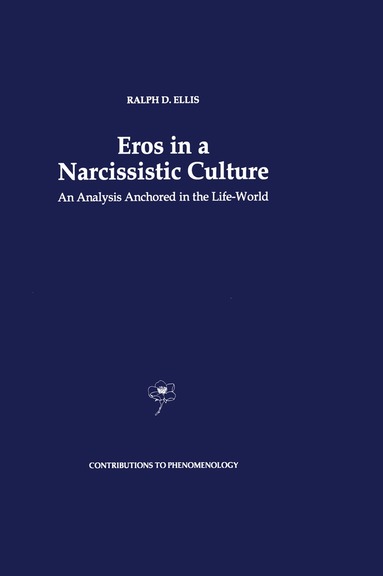









Du kanske också är intresserad av
Del 22
- Nyhet
Del 7
- Nyhet
Del 6
- Nyhet
Del 3
- Nyhet
Del 4
- Nyhet
Del 11
- Nyhet
- Nyhet
- Nyhet
Del 3
- Nyhet