
Del i serien Princeton Legacy Library
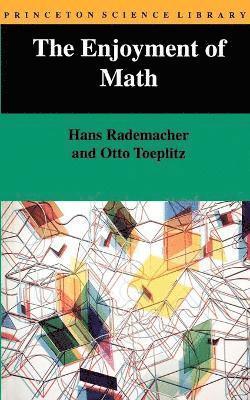
Enjoyment of Math
Häftad, Engelska, 2015
539 kr
Beställningsvara. Skickas inom 5-8 vardagar. Fri frakt för medlemmar vid köp för minst 249 kr.
Finns i fler format (3)
What is so special about the number 30? How many colors are needed to color a map? Do the prime numbers go on forever? Are there more whole numbers than even numbers? These and other mathematical puzzles are explored in this delightful book by two eminent mathematicians. Requiring no more background than plane geometry and elementary algebra, this book leads the reader into some of the most fundamental ideas of mathematics, the ideas that make the subject exciting and interesting. Explaining clearly how each problem has arisen and, in some cases, resolved, Hans Rademacher and Otto Toeplitz's deep curiosity for the subject and their outstanding pedagogical talents shine through. Originally published in 1957. The Princeton Legacy Library uses the latest print-on-demand technology to again make available previously out-of-print books from the distinguished backlist of Princeton University Press. These editions preserve the original texts of these important books while presenting them in durable paperback and hardcover editions.The goal of the Princeton Legacy Library is to vastly increase access to the rich scholarly heritage found in the thousands of books published by Princeton University Press since its founding in 1905.
Produktinformation
- Utgivningsdatum2015-12-08
- Mått127 x 203 x 12 mm
- Vikt218 g
- FormatHäftad
- SpråkEngelska
- SeriePrinceton Legacy Library
- Antal sidor214
- FörlagPrinceton University Press
- ISBN9780691626765
Tillhör följande kategorier
Hoppa över listan






Mer från samma serie
Princeton Encyclopedia of Classical Sites
Richard Stillwell, William L. MacDonald, Marian Holland McAllister
Häftad, 2017
2 389 kr
Hoppa över listan





Du kanske också är intresserad av
Del 169
Quellen und Studien zur Geschichte der Mathematik, Astronomie und Physik
O. Neugebauer, Julius Stenzel, Otto Toeplitz
Häftad, 1929
679 kr
Del 41