
Del i serien Routledge Research in Language and Communication
Emoticons, Kaomoji, and Emoji
The Transformation of Communication in the Digital Age
Häftad, Engelska, 2021
939 kr
Beställningsvara. Skickas inom 10-15 vardagar. Fri frakt för medlemmar vid köp för minst 249 kr.
This collection offers a comprehensive treatment of emoticons, kaomoji, and emoji, examining these digital pictograms and ideograms from a range of perspectives to comprehend their increasing role in the transformation of communication in the digital age. Featuring a detailed introduction and eleven contributions from an interdisciplinary group of scholars, the volume begins by outlining the history and development of the field, situating emoticons, kaomoji, and emoji – expressing a variety of moods and emotional states, facial expressions, as well as all kinds of everyday objects– as both a topic of global relevance but also within multimodal, semiotic, picture theoretical, cultural and linguistic research. The book shows how the interplay of these systems with text can alter and shape the meaning and content of messaging and examines how this manifests itself through different lenses, including the communicative, socio-political, aesthetic, and cross-cultural. Making the case for further study on emoticons, kaomoji, and emoji and their impact on digital communication, this book is key reading for students and scholars in sociolinguistics, media studies, Japanese studies, and language and communication.
Produktinformation
- Utgivningsdatum2021-03-31
- Mått152 x 229 x 33 mm
- Vikt720 g
- FormatHäftad
- SpråkEngelska
- SerieRoutledge Research in Language and Communication
- Antal sidor250
- FörlagTaylor & Francis Ltd
- ISBN9780367785215
Tillhör följande kategorier
Hoppa över listan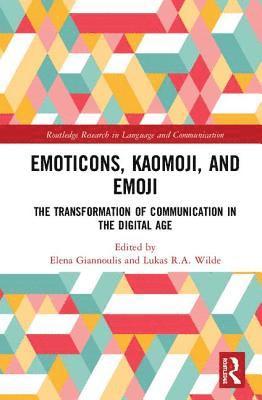






Du kanske också är intresserad av
Threat Communication and the US Order after 9/11
Vanessa Ossa, David Scheu, Lukas R.A. Wilde
Häftad, 2022
889 kr
Threat Communication and the US Order after 9/11
Vanessa Ossa, David Scheu, Lukas R.A. Wilde
Inbunden, 2020
3 219 kr
Comicanalyse
Stephan Packard, Andreas Rauscher, Véronique Sina, Jan-Noël Thon, Lukas R.A. Wilde, Janina Wildfeuer
Häftad, 2019
339 kr
Cultural Career of Coolness
Ulla Haselstein, Irmela Hijiya-Kirschnereit, Catrin Gersdorf, Elena Giannoulis
Inbunden, 2013
2 509 kr
- Nyhet
Del 3