
Del i serien Shock Wave and High Pressure Phenomena
Effects of Explosions on Materials
Modification and Synthesis Under High-Pressure Shock Compression
Inbunden, Engelska, 1994
1 429 kr
Beställningsvara. Skickas inom 10-15 vardagar. Fri frakt för medlemmar vid köp för minst 249 kr.
Finns i fler format (1)
In the 1950s explosives began to be used to generate ultrahigh pressures in condensed substances in order to modify their properties and structure. Notwithstanding the short duration of an explosion, its energy proved to be high enough to perform physical-chemical transformations of substances, and the new method gained wide industrial applications. It has both advan tages and drawbacks in comparison with the traditional method of static compression. The latter method, notorious for its cumbersome and expensive machin ery, allows one to maintain high pressure as long as one pleases and to regu late the temperature of the sample arbitrarily. But, the pressure available is rather limited and for any increase of this limit one has to pay by the progres sive shrinking of the working volume of a press. The dynamic method has the advantages of low cost and practically no restrictions of magnitude of pressure and the size of a processed sample, but the temperature in a compressed body is no longer controlled by an experi mentor. Rather, it is firmly dictated by the level of loading, according to the equation of state. Hence, it is difficult to recover metastable products and impossible to prepare solids with a low concentration of defects as the dura tion of explosion is too short for their elimination.
Produktinformation
- Utgivningsdatum1994-03-18
- Mått155 x 235 x 17 mm
- Vikt481 g
- FormatInbunden
- SpråkEngelska
- SerieShock Wave and High Pressure Phenomena
- Antal sidor194
- Upplaga1994
- FörlagSpringer-Verlag New York Inc.
- ISBN9780387941233
Tillhör följande kategorier
Hoppa över listan


Mer från samma författare
Refractive Indices of Solids
Stepan S. Batsanov, Evgeny D. Ruchkin, Inga A. Poroshina
Häftad, 2016
719 kr
Hoppa över listan




Mer från samma serie
Shock-Wave Phenomena and the Properties of Condensed Matter
Gennady I. Kanel, Sergey V. Razorenov, Vladimir E. Fortov
Inbunden, 2004
3 279 kr
High-Pressure Shock Compression of Solids VII
Vladimir E. Fortov, L.V. Altshuler, R.F. Trunin, A.I. Funtikov
Inbunden, 2004
2 859 kr
High-Pressure Shock Compression of Solids V
Lee Davison, Yasuyuki Horie, Lee Davison, Yasuyuki Horie, Toshimori Sekine
Inbunden, 2002
1 429 kr
Spall Fracture
Tarabay Antoun, Lynn Seaman, Donald R Curran, Gennady I. Kanel, Sergey V. Razorenov, Alexander V. Utkin
Inbunden, 2003
2 859 kr
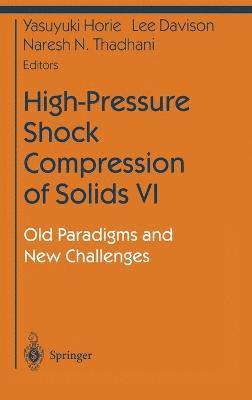
High-Pressure Shock Compression of Solids VI
Yasuyuki Horie, Lee Davison, Y. Horie, Lee Davison, Naresh Thadani
Inbunden, 2003
1 149 kr
Explosive Effects and Applications
Jonas A. Zukas, William Walters, Jonas A. Zukas, William Walters
Häftad, 2002
1 149 kr
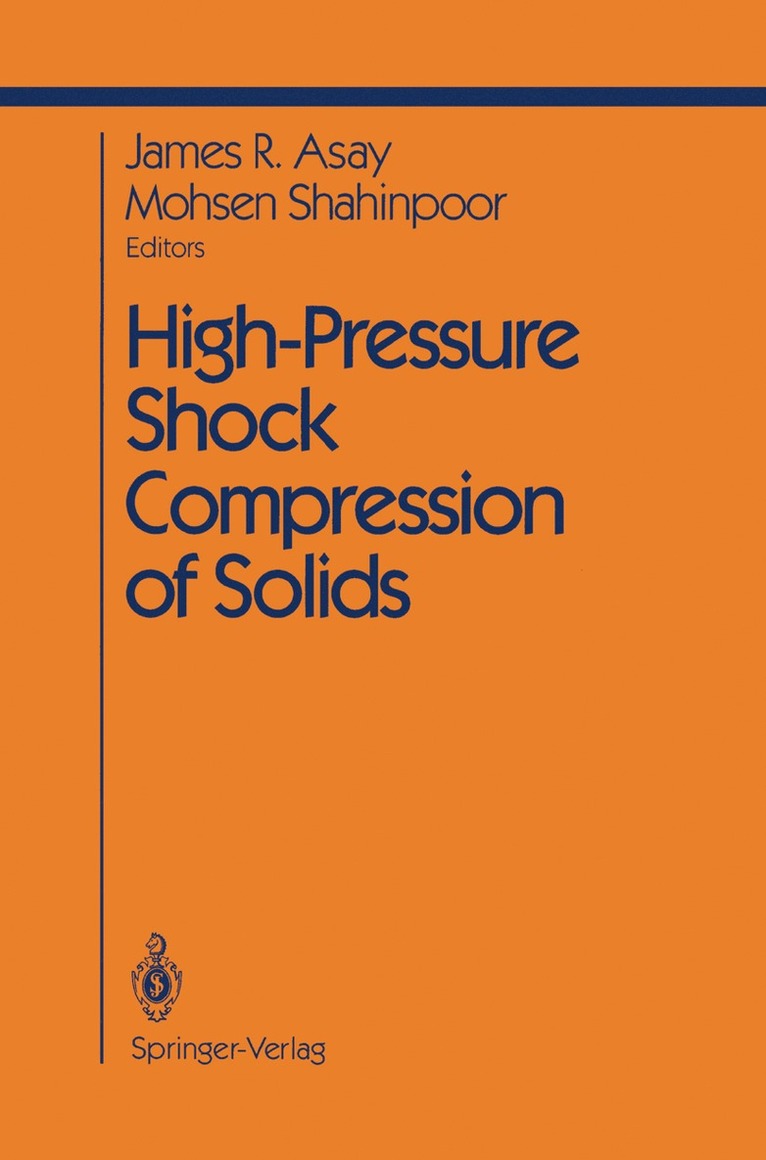
High-Pressure Shock Compression of Solids
James R. Asay, Mohsen Shahinpoor, J.R. Asay, M. Shahinpoor
Inbunden, 1993
4 989 kr
Hoppa över listan








Du kanske också är intresserad av
Computability, Complexity, and Languages
Martin Davis, Ron Sigal, Elaine J. Weyuker
Häftad, 1994
919 kr
Del 48
Del 9