Beställningsvara. Skickas inom 7-10 vardagar. Fri frakt för medlemmar vid köp för minst 249 kr.
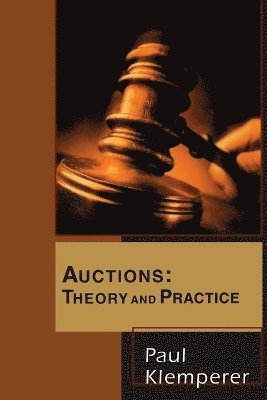
This major two volume collection presents some of the most influential theoretical and empirical papers on the economic theory of auctions.Auction theory has been the basis of fundamental theoretical work in industrial economics, public economics, labour economics and finance, and has helped the understanding of price formation in markets. There has recently been an explosion of interest in its practical applications, especially in organising the sale of government assets (for example, treasury bonds, radio spectrum licenses, and firms to be privatised) and in developing new markets for electricity and transport. Because auctions are such simple and well defined environments, they provide a valuable testing ground for economic theory that has been increasingly exploited in empirical work.The book will also include important previously unpublished papers by P.R. Milgrom, R. Weber and A. Ortega-Reichert, and other hard-to-find papers by W. Vickery and others.
Edited by Paul Klemperer, Fellow of the British Academy, Edgeworth Professor of Economics, Oxford University, UK
Contents:Acknowledgements • ForewordVolume I: Part I: Introduction to the Papers1. Paul Klemperer (1999), ‘Auction Theory: A Guide to the Literature’ Part II: Early Literature2. William Vickrey (1961), ‘Counterspeculation, Auctions, and Competitive Sealed Tenders’3. William Vickrey (1962), ‘Auction and Bidding Games’4. James H. Griesmer, Richard E. Levitan and Martin Shubik (1967), ‘Toward a Study of Bidding Processes Part IV- Games with Unknown Costs’5. Simon Board and Paul Klemperer (1999), ‘A Note on Ortega Reichert’s “A Sequential Game with Information Flow”’6. Armando Ortega Reichert (1968), ‘A Sequential Game with Information Flow’7. Robert B. Wilson (1969), ‘Competitive Bidding With Disparate Information’Part III: Introduction to the Recent Literature8. R. Preston McAfee and John McMillan (1987), ‘Auctions and Bidding’9. Eric S. Maskin and John G. Riley (1985), ‘Auction Theory with Private Values’Part IV: The Basic Analysis of Optimal Auctions, Revenue Equivalence, and Marginal Revenues10. Roger B. Myerson (1981), ‘Optimal Auction Design’11. John G. Riley and William F. Samuelson (1981), ‘Optimal Auctions’12. Jeremy Bulow and John Roberts (1989), ‘The Simple Economics of Optimal Auctions’Part V: Risk Aversion13. Eric Maskin and John Riley (1984), ‘Optimal Auctions with Risk Averse Buyers’14. Steven Matthews (1987), ‘Comparing Auctions for Risk Averse Buyers: A Buyer’s Point of View’Part VI: Correlation and Affiliation15. Paul R. Milgrom and Robert J. Weber (1982), ‘A Theory of Auctions and Competitive Bidding’16. Jacques Crémer and Richard P. McLean (1985), ‘Optimal Selling Strategies Under Uncertainty for a Discriminating Monopolist When Demands are Interdependent’17. Dan Levin and James L. Smith (1996), ‘Optimal Reservation Prices in Auctions’Part VII: AsymmetriesAPrivate Value Differences18. R. Preston McAfee and John McMillan (1989), ‘Government Procurement and International Trade’19. Eric Maskin and John G. Riley (1996), ‘Asymmetric Auctions’BAlmost Common Values20. Sushil Bikhchandani (1988), ‘Reputation in Repeated Second-Price Auctions’21. Paul Klemperer (1998), ‘Auctions with Almost Common Values: The ‘Wallet Game’ and its Applications’CInformation Advantages22. Paul Milgrom and Robert J. Weber (1982), ‘The Value of Information in a Sealed-Bid Auction’Part VIII: Entry Costs, and the Number of BiddersAEndogenous Entry of Bidders23. Dan Levin and James L. Smith (1994), ‘Equilibrium in Auctions with Entry’24. Richard Engelbrecht-Wiggans (1993), ‘Optimal Auctions Revisited’25. Steven Matthews (1984), ‘Information Acquisition in Discriminatory Auctions’26. Michael J. Fishman (1988), ‘A Theory of Preemptive Takeover Bidding’BThe Value of Additional Bidders27. Jeremy Bulow and Paul Klemperer (1996), ‘Auctions Versus Negotiations’CInformation Aggregation with Large Numbers of Bidders28. Robert Wilson (1977), ‘A Bidding Model of Perfect Competition’29. Paul R. Milgrom (1981), ‘Rational Expectations, Information Acquisition, and Competitive Bidding’Part IX: Collusion30. Marc S. Robinson (1985), ‘Collusion and the Choice of Auction’31. R. Preston McAfee and John McMillan (1992), ‘Bidding Rings’32. Kenneth Hendricks and Robert H. Porter (1989), ‘Collusion in Auctions’Name IndexVolume II: Part X: Multiple UnitsAOptimal1. Eric Maskin and John Riley (1989), ‘Optimal Multi-unit Auctions’2. Thomas R. Palfrey (1983), ‘Bundling Decisions by a Multiproduct Monopolist with Incomplete Information’BSimultaneous3. Robert Wilson (1979), ‘Auctions of Shares’4. Kerry Back and Jaime F. Zender (1993), ‘Auctions of Divisible Goods: On the Rationale for the Treasury Experiment’5. James J. Anton and Dennis A. Yao (1992), ‘Coordination in Split Award Auctions’6. Paul D. Klemperer and Margaret A. Meyer (1989), ‘Supply Function Equilibria in Oligopoly Under Uncertainty’7. Robert G. Hansen (1988), ‘Auctions with Endogenous Quantity’CSequential8. Paul R. Milgrom and Robert J. Weber (1982), ‘A Theory of Auctions and Competitive Bidding, II’9. Jeremy Bulow and Paul Klemperer (1994), ‘Rational Frenzies and Crashes’10. R. Preston McAfee and Daniel Vincent (1993), ‘The Declining Price Anomaly’11. Robert J. Weber (1983), ‘Multi-Object Auctions’Part XI: Royalties, Incentive Contracts, and Payments for Quality12. John G. Riley (1988), ‘Ex Post Information in Auctions’13. Jean-Jacques Laffont and Jean Tirole (1987), ‘Auctioning Incentive Contracts’14. Yeon-Koo Che (1993), ‘Design Competition through Multidimensional Auctions’Part XII: Double Auctions, EtcADouble Auctions15. Kalyan Chatterjee and William Samuelson (1983), ‘Bargaining under Incomplete Information’16. Robert Wilson (1985), ‘Incentive Efficiency of Double Auctions’17. Aldo Rustichini, Mark A. Satterthwaite and Steven R. Williams (1994), ‘Convergence to Efficiency in a Simple Market with Incomplete Information’18. R. Preston McAfee (1992), ‘A Dominant Strategy Double Auction’BRelated Two-Sided Trading Mechanisms19. Roger B. Myerson and Mark A. Satterthwaite (1983), ‘Efficient Mechanisms for Bilateral Trading’20. Peter Cramton, Robert Gibbons and Paul Klemperer (1987), ‘Dissolving a Partnership Efficiently’Part XIII: Other TopicsABudget Constraints21. Yeon-Koo Che and Ian Gale (1998), ‘Standard Auctions with Financially Constrained Bidders’BExternalities between Bidders22. Philippe Jehiel and Benny Moldovanu (1996), ‘Strategic Nonparticipation’CJump Bidding23. Christopher Avery (1998), ‘Strategic Jump Bidding in English Auctions’DWar of Attrition24. Jeremy Bulow and Paul Klemperer (1999), ‘The Generalized War of Attrition’ECompeting Auctioneers25. R. Preston McAfee (1993), ‘Mechanism Design by Competing Sellers’Part XIV: Testing the TheoryAEmpirical26. Jean-Jacques Laffont (1997), ‘Game Theory and Empirical Economics: The Case of Auction Data’BExperimental27. John H. Kagel (1995), ‘Auctions: A Survey of Experimental Research’Name Index
'Auctions play a crucial role in the allocation of resources in many industries. Paul Klemperer's very careful selection of topics and papers will be of tremendous help to the student, researcher and practitioner. From the classics of the sixties (Vickrey, Ortega-Reichert, Wilson) to the most recent advances, this two volume collection performs a real public service.'