
Duty to Obey the Law
Selected Philosophical Readings
Häftad, Engelska, 1998
1 029 kr
Beställningsvara. Skickas inom 10-15 vardagar. Fri frakt för medlemmar vid köp för minst 249 kr.
Finns i fler format (1)
The question, "Why should I obey the law?" introduces a contemporary puzzle that is as old as philosophy itself. The puzzle is especially troublesome if we think of cases in which breaking the law is not otherwise wrongful, and in which the chances of getting caught are negligible. Philosophers from Socrates to H.L.A. Hart have struggled to give reasoned support to the idea that we do have a general moral duty to obey the law but, more recently, the greater number of learned voices has expressed doubt that there is any such duty, at least as traditionally conceived.The thought that there is no such duty poses a challenge to our ordinary understanding of political authority and its legitimacy. In what sense can political officials have a right to rule us if there is no duty to obey the laws they lay down? Some thinkers, concluding that a general duty to obey the law cannot be defended, have gone so far as to embrace philosophical anarchism, the view that the state is necessarily illegitimate. Others argue that the duty to obey the law can be grounded on the idea of consent, or on fairness, or on other ideas, such as community.
Produktinformation
- Utgivningsdatum1998-12-23
- Mått155 x 234 x 24 mm
- Vikt549 g
- FormatHäftad
- SpråkEngelska
- Antal sidor362
- FörlagBloomsbury Publishing Plc
- ISBN9780847692552
Tillhör följande kategorier
Hoppa över listan


Mer från samma författare
Del 30
Blackwell Guide to the Philosophy of Law and Legal Theory
Golding, Edmundson, Martin P. Golding, William A. Edmundson
Häftad, 2004
619 kr
Hoppa över listan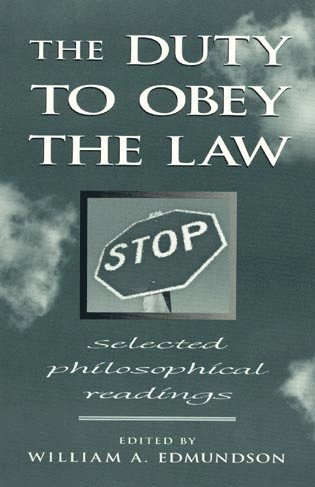

Du kanske också är intresserad av
Del 30
Blackwell Guide to the Philosophy of Law and Legal Theory
Golding, Edmundson, Martin P. Golding, William A. Edmundson
Häftad, 2004
619 kr
- Nyhet
Del 6