
Doing Bad by Doing Good
Why Humanitarian Action Fails
Häftad, Engelska, 2013
499 kr
Beställningsvara. Skickas inom 5-8 vardagar. Fri frakt för medlemmar vid köp för minst 249 kr.
Finns i fler format (1)
In 2010, Haiti was ravaged by a brutal earthquake that affected the lives of millions. The call to assist those in need was heard around the globe. Yet two years later humanitarian efforts led by governments and NGOs have largely failed. Resources are not reaching the needy due to bureaucratic red tape, and many assets have been squandered. How can efforts intended to help the suffering fail so badly? In this timely and provocative book, Christopher J. Coyne uses the economic way of thinking to explain why this and other humanitarian efforts that intend to do good end up doing nothing or causing harm.In addition to Haiti, Coyne considers a wide range of interventions. He explains why the U.S. government was ineffective following Hurricane Katrina, why the international humanitarian push to remove Muammar Gaddafi in Libya may very well end up causing more problems than prosperity, and why decades of efforts to respond to crises and foster development around the world have resulted in repeated failures.In place of the dominant approach to state-led humanitarian action, this book offers a bold alternative, focused on establishing an environment of economic freedom. If we are willing to experiment with aid—asking questions about how to foster development as a process of societal discovery, or how else we might engage the private sector, for instance—we increase the range of alternatives to help people and empower them to improve their communities. Anyone concerned with and dedicated to alleviating human suffering in the short term or for the long haul, from policymakers and activists to scholars, will find this book to be an insightful and provocative reframing of humanitarian action.
Produktinformation
- Utgivningsdatum2013-05-01
- Mått152 x 226 x 18 mm
- Vikt363 g
- FormatHäftad
- SpråkEngelska
- Antal sidor272
- FörlagStanford University Press
- ISBN9780804772280
Tillhör följande kategorier
Hoppa över listan






Mer från samma författare
The Political Economy of Terrorism, Counterterrorism, and the War on Terror
Anne R. Bradley, Christopher J. Coyne, Abigail R. Hall
Häftad, 2023
509 kr
The Economics of Conflict and Peace
Shikha Basnet Silwal, Charles H. Anderton, Jurgen Brauer, Christopher J. Coyne, J. Paul Dunne
Häftad, 2021
409 kr
Hoppa över listan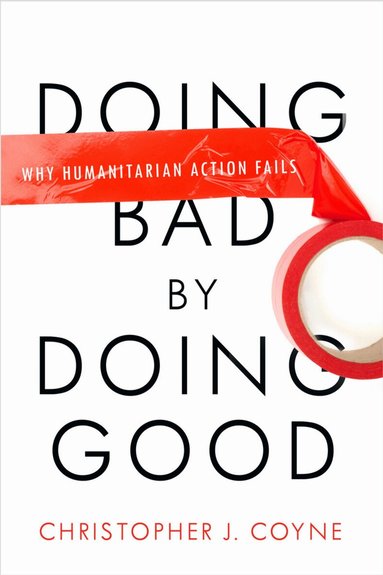





Du kanske också är intresserad av
- Nyhet
The Economics of Conflict and Peace
Shikha Basnet Silwal, Charles H. Anderton, Jurgen Brauer, Christopher J. Coyne, J. Paul Dunne
Häftad, 2021
409 kr
Interdisciplinary Studies of the Political Order
Donald J. Boudreaux, Christopher J. Coyne, Bobbi Herzberg
Inbunden, 2019
2 479 kr
Exploring the Political Economy and Social Philosophy of James M. Buchanan
Paul Dragos Aligica, Christopher J. Coyne, Stefanie Haeffele
Inbunden, 2018
2 219 kr
The Political Economy of Terrorism, Counterterrorism, and the War on Terror
Anne R. Bradley, Christopher J. Coyne, Abigail R. Hall
Häftad, 2023
509 kr
Market Process and Market Order
Rosolino A. Candela, Kristen R. Collins, Christopher J. Coyne
Häftad, 2024
589 kr