Copper Catalysis in Organic Synthesis
Inbunden, Engelska, 2020
1 989 kr
Produktinformation
- Utgivningsdatum2020-10-07
- Mått178 x 249 x 28 mm
- Vikt1 134 g
- FormatInbunden
- SpråkEngelska
- Antal sidor504
- FörlagWiley-VCH Verlag GmbH
- ISBN9783527347377
Tillhör följande kategorier
Gopinathan Anilkumar, PhD., is professor of organic chemistry at the School of Chemical Sciences, Mahatma Gandhi University in Kottayam, Kerala, India. His research interests are in the areas of organic synthesis, medicinal chemistry, heterocyclic chemistry and catalysis, particularly on ruthenium-, iron-, zinc-, copper-, manganese-, cobalt- and nickel-catalyzed reactions.Salim Saranya is a PhD student in the group of Prof. Gopinathan Anilkumar at the School of Chemical Sciences, Mahatma Gandhi University, Kottayam, Kerala, India.
- Preface xviiAbbreviations xix1 Copper Catalysis: An Introduction 1Salim Saranya and Gopinathan AnilkumarReferences 42 Cu-Catalyst in Reactions Involving Pyridinium and Indolizinium Moieties 7Bianca Furdui, Andrea V. Dediu (Botezatu), and RodicaM. Dinica2.1 Cu-Catalyst in Reactions Involving Pyridinium Moieties 72.1.1 Introduction 72.1.2 Synthesis and Functionalization of Pyridinium Compounds Catalyzed by Copper 72.1.3 Green Methods for Pyridine Synthesis 132.2 Cu-Catalyst in Reactions Involving Indolizinium Moieties 152.2.1 Introduction 152.2.2 Synthesis of Indolizinium Compounds Using a Copper Catalyst 152.2.3 Cu-Catalyzed Green Synthesis of Indolizine Moieties 192.3 Conclusions 21References 213 Copper-Catalyzed Cross-Coupling Reactions of Organoboron Compounds 23Jan Nekvinda and Webster L. Santos3.1 Introduction 233.2 Ring Opening Cross-Coupling Reactions 243.3 Coupling Reactions with Atoms Other than Carbon 263.3.1 Amines, Amides, and Sulfonamides 273.3.2 Nitrones 333.3.3 Sulfones 353.3.4 Silyls 353.3.5 Selanyls 363.4 Coupling Reactions Involving Carbon 363.4.1 Boronic Acid Esters 363.4.2 Boronic Acids 413.4.3 Single Electron Mechanism 423.5 Conclusion 43References 434 Cu-Catalyzed Homocoupling Reactions 51Ganesh C. Nandi, Sundaresan Ravindra, Cholakkaparambil Irfana Jesin, Parameswaran Sasikumar, and Kokkuvayil V. Radhakrishnan4.1 Introduction 514.2 Synthesis of 1,3-Diynes via Homocoupling Reactions 514.2.1 Synthesis of 1,3-Diynes with Homogeneous Cu Catalysis 524.2.1.1 Synthesis of Symmetrical 1,3-Diynes with Substrates Other than Terminal Alkynes 544.2.2 Synthesis of Symmetrical 1,3-Diynes with Heterogeneous Cu Catalysis 554.2.3 Synthesis of Macrocycles Through Intramolecular Coupling of Terminal Alkynes 564.3 Cu-Catalyzed Synthesis of Symmetrical Biaryls Through Homocoupling Reactions 574.3.1 Homocoupling of Aryl Boronic Acids 584.3.1.1 Homogeneous Cu-Catalyzed Homocoupling Reactions 584.3.1.2 Heterogeneous Copper-Catalyzed Homocoupling Reactions 584.3.2 Synthesis of Symmetrical Biaryls Through C–H Activation 594.3.3 Homocoupling of Arylstannane/Silane Derivatives 624.3.4 Cu-Catalyzed Homocoupling of Aryl Halides for the Synthesis of Biaryls 624.3.4.1 Symmetrical Biaryl Formation Using Homogeneous Copper Catalyst 624.3.4.2 Biaryl Formation Using Heterogeneous Cu Catalyst 654.3.5 Cu-Catalyzed Homocoupling of Aryl Halides for the Formation of Biaryls in Natural Products 664.4 Homocoupling of Alkenes 684.5 Summary and Conclusions 69References 695 Cu-Catalyzed Organic Reactions in Aqueous Media 73Noel Nebra and Joaquín García-Álvarez5.1 Introduction 735.2 Cu-Catalyzed Azide–Alkyne Cycloaddition Reactions (CuAAC) 745.2.1 Ligand-Accelerated Cu(I) Catalysts 745.2.2 Supported Cu(I) Catalysts 755.2.3 Micellar Cu(I) Catalysis 775.2.4 Heterogeneous Catalysis: CuNPs 775.2.5 Miscellaneous 805.3 Cu-Mediated Cross-Coupling Reactions: C—C and C–Heteroatom Bond Formation 815.3.1 The Ullmann Coupling 815.3.2 The Chan–Lam–Evans (CEL) Coupling 835.3.3 Cu-Catalyzed Cyclization Reactions via Cross-Coupling Events 855.3.4 Cu-Catalyzed C—H Bond Functionalization Reactions 865.4 Cu-Catalyzed Hydroelementation Reactions of Double and Triple C—C Bonds 895.4.1 Michael-Type Additions: Enone Hydrations Enabled by Cu-Based Metallo-Hydratases 895.4.2 Cu-Catalyzed Hydroelementation of α,β-Unsaturated Carbonyl Compounds 905.4.3 Cu-Catalyzed Hydroelementation of Inactivated C—C Multiple Bonds 925.5 Miscellaneous 965.6 Summary and Conclusions 98Acknowledgments 98References 1006 Cu-Catalyzed Organic Reactions in Deep Eutectic Solvents (DESs) 103Noel Nebra and Joaquín García-Álvarez6.1 Introduction 1036.2 Cu-Catalyzed Azide–Alkyne Cycloaddition Reactions (CuAAC) in DESs 1066.3 Cu-Catalyzed C—C and C—N Bond Formations in DESs 1086.3.1 Cu-Catalyzed Sonogashira C–C Coupling Using the Eutectic Mixture 1CuCl/1Gly 1086.3.2 Synthesis of Heterocyclic Compounds via Cu-Catalyzed Cross-Coupling Reactions 1106.3.3 Cu-Catalyzed C—N Bond Formation in DESs 1106.4 Cu-Catalyzed Atom Transfer Radical Polymerization Processes in DESs (SARA and ARGET) 1126.5 Summary and Conclusions 113Acknowledgments 114References 1147 Microwave-Assisted Cu-Catalyzed Organic Reactions 119Bogdan Štefane, Helena Brodnik-ugelj, Uroš Grošelj, Jurij Svete, and Franc Pogan7.1 Introduction 1197.2 Ring-Forming Reactions 1217.2.1 Synthesis of Heterocycles 1217.2.1.1 Cycloadditions 1217.2.1.2 Annulation Reactions 1237.2.1.3 Intramolecular Cyclizations 1267.2.1.4 Multicomponent Reactions (MCRs) 1267.2.2 Synthesis of Carbocycles 1287.3 Cross-Coupling Reactions 1307.3.1 Carbon–Carbon Couplings 1307.3.2 Carbon–Heteroatom Couplings 1347.3.2.1 C–N Couplings 1347.3.2.2 C–Chalcogen Couplings 1387.4 Multicomponent Reactions 1417.5 Miscellaneous Reactions 1447.6 Summary and Conclusions 146Acknowledgments 146References 1468 Cu-Catalyzed Asymmetric Synthesis 153Hidetoshi Noda, Naoya Kumagai, and Masakatsu Shibasaki8.1 Introduction 1538.1.1 Cu-Catalyzed Asymmetric Synthesis: Scope of This Chapter 1538.1.2 Structures of Chiral Ligands: Trends of the Last Decade 1548.2 In Situ Generation of Cu Nucleophiles from Unsaturated Hydrocarbons 1558.2.1 Reductive Aldol Reactions 1558.2.2 Intramolecular Oxy- and Amidocupration 1568.2.3 Hydrocupration of Unsaturated Compounds 1588.2.4 Borylcupuration of Unsaturated Compounds 1638.3 Generation of Cu Nucleophiles Under Proton Transfer Conditions 1658.4 Summary and Conclusions 172References 1729 Cu-Catalyzed Click Reactions 177Rajagopal Ramkumar and Pazhamalai Anbarasan9.1 Introduction 1779.2 Background 1789.2.1 Huisgen’s Cycloaddition Reaction 1789.2.2 Copper(I)-Catalyzed Azide–Alkyne Cycloaddition (CuAAC) 1789.2.3 Mechanistic Study of Copper Azide–Alkyne Cycloaddition Reaction 1799.3 CuAAC for the Synthesis of Substituted 1,2,3-Triazoles 1809.4 Heterogeneous CuAAC Reactions 1889.5 Ligand-Stabilized Cu(I)-Catalyzed Click Reaction 1919.6 Synthesis of Rotaxanes and Catenanes Using CuAAC 1969.7 Synthesis of N-Sulfonyl-1,2,3-Triazoles and Their Applications 1989.8 CuAAC and Asymmetric Synthesis 1989.9 CuAAC for Synthesis of Biologically Active Molecules 2029.10 Summary 204References 20410 Cu-Catalyzed Multicomponent Reactions 209Thachapully D. Suja and Rajeev S. Menon10.1 Introduction 20910.2 Cu-Catalyzed MCRs of Alkynes 20910.2.1 Cu-Catalyzed Multicomponent Alkyne–Azide Cycloadditions 21010.2.1.1 CuAAC Reactions Initiated by Azide Generation 21010.2.1.2 CuAAC Reactions Initiated by Alkyne Generation 21410.2.1.3 Other Multicomponent CuAAC Reactions 21410.2.2 Cu-Catalyzed Generation and Interception of Ketenimines from Alkynes and Azides 21610.2.3 Cu-Catalyzed Aldehyde, Alkyne, and Amine (A3) Coupling 22110.2.3.1 A3-Coupling ReactionsThat Afford Propargyl Amine Derivatives 22210.2.3.2 Variation of the Reaction Components in A3-Coupling 22410.2.3.3 Asymmetric A3 (AA3)-Coupling Reactions 22610.2.3.4 Synthetic Applications of Cu-Catalyzed A3-Coupling Reactions 22710.3 Other Cu-Catalyzed Multicomponent Reactions 22910.4 Summary and Conclusions 233References 23311 Copper-Catalyzed Aminations 239Nissy A. Harry and Rajenahally V. Jagadeesh11.1 Introduction 23911.2 Copper-Catalyzed Amination of Aryl and Alkenyl Electrophiles 24011.2.1 Ammonia as a Nucleophile 24011.2.2 Sodium Azide as Nucleophile 24111.2.3 Amines as Nucleophile 24211.2.4 Mechanism of Cu-Catalyzed Amination of Aryl/Alkyl Halides 24411.3 Chan–Lam Coupling Reaction 24411.4 Copper-Catalyzed Hydroaminations 24611.4.1 Hydroamination of Alkenes 24711.4.2 Hydroamination of Alkynes 25011.4.3 Hydroamination of Allenes 25111.5 Copper-Catalyzed C—H amination Reactions 25111.6 Conclusion 254References 25412 Cu-Catalyzed Carbonylation Reactions 261Parameswaran Sasikumar, Thoppe S. Priyadarshini, Sanjay Varma, Ganesh C. Nandi, and Kokkuvayil V. Radhakrishnan12.1 Introduction 26112.2 Single Carbonylation Reactions 26212.2.1 Copper-Catalyzed Carbonylative Coupling Reactions 26212.2.2 Cu-Catalyzed Carboxylation Reaction 26812.2.3 Cu-Catalyzed Oxidative Carbonylation Reactions 26912.2.4 Carbonylative Acetylation Reaction 27212.2.5 Aminocarbonylation Reaction 27312.2.6 Copper-Catalyzed Oxidative Amidation 27512.3 Cu-Catalyzed Double Carbonylation Reactions 27512.4 Summary and Conclusions 278References 27813 Ligand-Free, Cu-Catalyzed Reactions 279Muhammad F. Jamali, Sanoop P. Chandrasekharan, and Kishor Mohanan13.1 Introduction 27913.2 Heterocycle Synthesis 27913.2.1 Five-Membered Heterocycles 28013.2.2 Six-Membered Heterocycles 28013.2.3 Benzofused Five-Membered Heterocycles Containing One Heteroatom 28113.2.4 Benzofused Five-Membered Heterocycles Containing Two Heteroatoms 28313.2.5 Benzofused Five-Membered Heterocycles Containing Three Heteroatoms 28413.2.6 Benzofused Six-Membered Heterocycles 28413.2.7 Polycyclic Compounds 28613.2.8 Spirocyclic Compounds 28613.3 Carbon–Heteroatom Bond Formations 28913.3.1 C—N Bond Formation 28913.3.2 C—O Bond Formation 29113.3.3 C—S Bond Formation 29113.3.4 C—P Bond Formation 29513.3.5 C—B Bond Formation 29513.3.6 C—Se Bond Formation 29513.4 C–H Activation Reactions 29713.5 Cross-coupling Reactions 29913.6 Azide–Alkyne Cycloaddition Reactions (CuAAC) 30113.7 Trifluoromethylation Reactions 30213.8 Cyanation Reactions 30313.9 Carbonylation Reactions 30413.10 Conclusion 305References 30514 Copper-Catalyzed Decarboxylative Coupling 309Firas El-Hage and Jola Pospech14.1 Introduction 30914.2 Copper-Catalyzed Decarboxylation of Benzoic Acids 30914.3 Copper-Catalyzed Decarboxylation of Alkenyl Carboxylic Acids 31514.4 Copper-Catalyzed Decarboxylation of Alkynyl Carboxylic Acids 31614.5 Copper-Catalyzed Decarboxylation of Alkyl Carboxylic Acids 32014.6 Summary and Conclusions 325References 32615 Copper-Catalyzed C–H Activation 329Xun-Xiang Guo15.1 Introduction 32915.2 Carbon–Carbon Bond Formation via Cu-Catalyzed C–H Activation 32915.2.1 Cu-Catalyzed C(sp2)–H Activation 32915.2.2 Cu-Catalyzed C(sp3)–H Activation 33215.3 Carbon–Heteroatom Bond Formation via Cu-Catalyzed C–H Activation 33415.3.1 C—N Bond Formation 33415.3.2 C—O Bond Formation 33915.3.3 C—X Bond Formation 34115.3.4 C—P Bond Formation 34515.3.5 C—S Bond Formation 34615.4 Conclusion 347References 34716 Aerobic Cu-Catalyzed Organic Reactions 349Ahmad A. Almasalma and Esteban Mejía16.1 Introduction 34916.2 C—C Bond Formation Reactions 35116.2.1 Cross-dehydrogenative Couplings Under Thermal Conditions 35216.2.2 Cross-dehydrogenative Couplings Under Photochemical Conditions 35416.3 Carbonyl Synthesis via Oxidation of Alcohols 35716.3.1 “Copper-Only” Biomimetic Catalyst Systems 35816.3.2 Cu/Nitroxyl “Dual” Systems 36016.4 Summary and Conclusions 362References 36317 Copper-Catalyzed Trifluoromethylation Reactions 367Dzmitry G. Kananovich17.1 Introduction 36717.2 Trifluoromethylation of Arenes and Heteroarenes (C(sp2)—CF3 Bond Formation) 37017.3 Trifluoromethylation of Alkenes and Alkynes 37417.4 Trifluoromethylation of Aliphatic Precursors (C(sp3)—CF3 Bond Formation) 37817.4.1 Transformations via Functional Group Interconversions 37817.4.2 Direct C(sp3)–H Trifluoromethylation 38217.4.3 Ring-opening Trifluoromethylation 38617.5 Copper-Mediated Formation of CF3–Heteroatom Bonds 38817.6 Summary and Conclusions 388References 38918 Cu-Catalyzed Reactions for Carbon–Heteroatom Bond Formations 395Govindasamy Sekar, Subramani Sangeetha, Anuradha Nandy, and Rajib Saha18.1 Introduction 39518.2 Cu-Catalyzed Reactions for Carbon–Nitrogen Bond Formations 39518.2.1 Coupling Reactions with Ammonia and its Surrogates 39618.2.2 Coupling Reactions with Amines 39618.2.3 Coupling Reactions with Amides, Lactams, and Carbamates 39818.2.4 Coupling Reactions with Protected Hydrazines and Hydroxylamines 40018.2.5 Coupling Reactions with Guanidines 40018.2.6 Coupling Reactions with N-Heterocycles 40118.3 Cu-Catalyzed Reactions for Carbon–Oxygen Bond Formations 40118.3.1 Mechanism and Presence of Cu(I) Intermediate in Ullmann Ether Synthesis 40218.3.2 Role of Ligands in Copper-Catalyzed Ether Synthesis 40318.3.3 Copper-Catalyzed C—O Bond Formation for Synthesizing Phenols 40418.3.4 Copper-Catalyzed C—H Functionalization for C—O Bond Formation 40518.3.5 Copper-Catalyzed Synthesis of Oxygen Heterocycles 40518.3.6 Selectivity of Copper-Catalyzed C—O and C—N Bond Formation 40618.4 Cu-Catalyzed Reactions for Carbon–Sulfur Bond Formations 40718.5 Cu-Catalyzed Reactions for Carbon–Selenium and Carbon–Tellurium Bond Formations 41318.6 Cu-Catalyzed Reactions for Carbon–Phosphorous Bond Formations 41418.7 Cu-Catalyzed Reactions for Carbon–Silicon Bond Formations 41518.8 Cu-Catalyzed Reactions for Carbon–Halogen Bond Formations 41518.9 Conclusions 416References 41619 Cu-Assisted Cyanation Reactions 423Sumanta Garai and Ganesh A. Thakur19.1 Introduction 42319.2 Cyanation Reaction Using CN-Containing Source 42319.2.1 Metallic Bound CN-Source 42319.2.1.1 Metal Cyanide 42319.2.1.2 Potassium Ferrocyanide [K3Fe(CN)6] 42719.2.2 Nonmetallic CN-Source 42719.2.2.1 Acetone Cyanohydrin 42719.2.2.2 2,3-Dichloro-5,6-dicyano-1,4-benzoquinone (DDQ) 42819.2.2.3 2,2′-Azobisisobutyronitrile (AIBN) 42919.2.2.4 Benzyl Cyanide 42919.2.2.5 Acetonitrile 43219.2.2.6 Malononitrile 43519.2.2.7 Cyanogen Iodide 43619.2.2.8 α-Cyanoacetate 43619.3 Cyanation Reaction Using Non-CN-Containing Source 43719.3.1 N,N-Dimethylformamide (DMF) 43719.3.2 Ammonium Iodide (NH4I) and N,N-Dimethylformamide (DMF) 43919.3.3 Nitromethane 441Acknowledgments 441References 44120 Application of Cu-Mediated Reactions in the Synthesis of Natural Products 443Anas Ansari and Ramesh Ramapanicker20.1 Introduction 44320.2 Classification 44320.3 Total Synthesis Employing Cu-Catalyzed C–C Coupling Reactions 44520.3.1 (+)-Nocardioazine B 44520.3.2 (−)-Rhazinilam 44720.3.3 Isohericenone and Erinacerin A 44720.3.4 (+)-Piperarborenine B 44920.3.5 Macrocarpines D and E 45020.4 Total Synthesis Employing Cu-Catalyzed C–N Coupling Reactions 45420.4.1 (−)-Aspergilazine A 45420.4.2 (−)-Psychotriasine 45420.4.3 (−)-Indolactam V 45520.4.4 (−)-Palmyrolide A 45820.5 Total Synthesis Employing Cu-Catalyzed C–O Coupling Reactions 45820.5.1 (±})-Untenone A 45820.5.2 Coumestrol and Aureol 46020.6 Total Synthesis Employing Cu-Catalyzed Domino Reactions 46320.6.1 (±})-Sacidumlignan D 46320.7 Conclusion 463References 465Index 469
Du kanske också är intresserad av
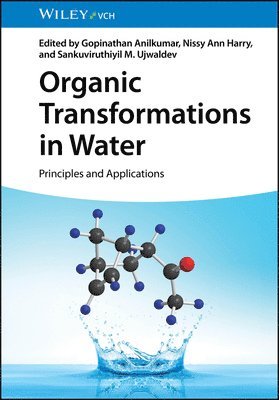
Organic Transformations in Water
Gopinathan Anilkumar, Gopinathan Anilkumar, Nissy Ann Harry, Sankuviruthiyil M. Ujwaldev, The Netherlands) Anilkumar, Gopinathan (Mahatma Gandhi University in Kerala, India; University of Nijmegen, India) Harry, Nissy Ann (Catholicate College in Pathanamthitta, Kerala, India; School of Chemical Sciences at Mahatma Gandhi University, India) Ujwaldev, Sankuviruthiyil M. (Sree Kerala Varma College in Thrissur, Kerala, India; Mahatma Gandhi University
2 269 kr