Beställningsvara. Skickas inom 11-20 vardagar. Fri frakt för medlemmar vid köp för minst 249 kr.
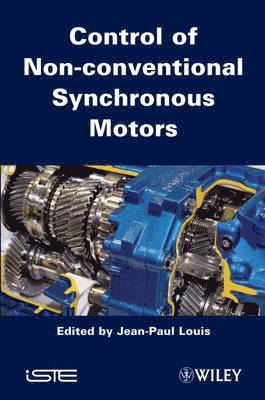
Synchronous motors are indubitably the most effective device to drive industrial production systems and robots with precision and rapidity. Their control law is thus critical for combining at the same time high productivity to reduced energy consummation. As far as possible, the control algorithms must exploit the properties of these actuators. Therefore, this work draws on well adapted models resulting from the Park’s transformation, for both the most traditional machines with sinusoidal field distribution and for machines with non-sinusoidal field distribution which are more and more used in industry. Both, conventional control strategies like vector control (either in the synchronous reference frame or in the rotor frame) and advanced control theories like direct control and predictive control are thoroughly presented. In this context, a significant place is reserved to sensorless control which is an important and critical issue in tomorrow’s motors.
Jean-Paul Louis is currently "professor emeritus" at ENS Cachan. His current research interests are in the fields of modelling and control of electrical machines and electrical systems.
Introduction xvJean-Paul LOUISChapter 1. Synchronous motor controls, Problems and Modeling 1Jean-Paul LOUIS, Damien FLIELLER, Ngac Ky NGUYEN and Guy STURTZER1.1. Introduction 11.2. Problems on the synchronous motor control 21.3. Descriptions and physical modeling of the synchronous motor 61.4. Modeling in dynamic regime of the synchronous motor in the natural three-phase a-b-c reference frame 141.5. Vector transformations and dynamic models in the α-β and d-q reference frames (sinusoidal field distribution machines with non-salient and salient poles) 241.6. Can we extend the Park transformation to synchronous motors with non-sinusoidal field distributions? 311.7. Conclusion 391.8. Appendices 391.9. Bibliography 44Chapter 2. Optimal Supply and Synchronous Motors Torque Control: Designs in the a-b-c Reference Frame 49Damien FLIELLER, Jean-Paul LOUIS, Guy STURTZER and Ngac Ky NGUYEN2.1. Introduction: problems of the controls in a-b-c 492.2. Model in the a-b-c reference frame: extension of the steady state approach in transient regime 502.3. Structures of torque controls designed in the a-b-c reference frame 542.4. Performances and criticisms of the control approach in the a-b-c reference frame 572.5. Generalization: extension of the supplies to the case of non-sinusoidal distribution machines 782.6. Use of Fourier expansion to obtain optimal currents 902.7. Conclusion 1122.8. Appendices 1132.9. Bibliography 114Chapter 3. Optimal Supplies and Synchronous Motors Torque Controls. Design in the d-q Reference Frame 119Damien FLIELLER, Jean-Paul LOUIS, Guy STURTZER and Ngac Ky NGUYEN3.1. Introduction: on the controls designed in the Park d-q reference frame 1193.2. Dynamic model (case of the salient pole machine and constant excitation) 1203.3. First approach to determine of optimal current references (d-q reference frame)1223.4. Determination of the current controls designed in the d-q reference frame 1243.5. New control by model inversion: example of an IP controller with compensations 1353.6. Optimal supply of the salient poles synchronous motors; geometrical approach of the isotorque curves 1433.7. Conclusion 1663.8. Appendices 1673.9. Bibliography 169Chapter 4. Drive Controls with Synchronous Motors 173Jean-Paul LOUIS, Damien FLIELLER, Ngac Ky NGUYEN and Guy STURTZER4.1. Introduction 1734.2. Principles adopted for speed controls: case of IP controllers 1764.3. Speed controls designed in the a-b-c reference frame (application to a non-salient pole machine) 1794.4. Determination of the speed controls designed in the d-q reference frame (application to a salient pole machine) 1844.5. Note on position regulations 2114.6. Conclusion 2154.7. Appendices 2164.8. Bibliography 217Chapter 5. Digital Implementation of Vector Control of Synchronous Motors 221Flavia KHATOUNIAN and Eric MONMASSON5.1. Introduction 2215.2. Classical, analog and ideal torque control of a synchronous motor 2235.3. Digital implementation problem of the synchronous motor vector control 2275.4. Discretization of the control system 2305.5. Study of the delays introduced by the digital implementation of the vector control of the synchronous motor 2375.6. Quantization problems 2415.7. Delays in the reverse Park transformation 2485.8. Conclusion 2485.9. Bibliography 249Chapter 6. Direct Control of a Permanent Magnet Synchronous Machine 251Jean-Marie RÉTIF6.1. Introduction 2516.2. Model of the permanent magnet synchronous machine in the d-q reference frame 2526.3. Conventional DTC with free switching frequency 2536.4. DTC at a fixed switching frequency 2586.5. Predictive direct control 2646.6. Conclusion 2796.7. Bibliography 280Chapter 7. Synchronous Machine and Inverter Fault Tolerant Predictive Controls 283Caroline DOC, Vincent LANFRANCHI and Nicolas PATIN7.1. Introduction 2837.2. Topologies of three-phase fault tolerant machines 2847.3. Topologies of fault tolerant converters 2857.4. Fault tolerant controls 2877.5. Conclusion 3027.6. Bibliography 303Chapter 8. Characterization of Control without a Mechanical Sensor in Permanent Magnet Synchronous Machines 305Maurice FADEL8.1. Introduction 3058.2. Sensorless control of PMSM, thanks to an extended Kalman filter 3138.3. Comparison with the MRAS (model reference adaptive system) method 3218.4. Experimental results comparison 3238.5. Control without sensor of the PMSM with load torque observation 3258.6. Starting the PMSM without a mechanical sensor 3348.7. Conclusion 3448.8. Bibliography 345Chapter 9. Sensorless Control of Permanent Magnet Synchronous Machines: Deterministic Methods, Convergence and Robustness 347Farid MEIBODY-TABAR and Babak NAHID-MOBARAKEH9.1. Introduction 3479.2. Modeling PMSMs for mechanical sensorless control 3509.3. Convergence analysis of mechanical sensorless control laws 3569.4. Estimation of the back-EMF vector 3719.5. Robustness of sensorless control of PMSM with respect to parameter uncertainties 3739.6. Sensorless control of PMSMs in the presence of uncertainties on the resistance 3879.7. Conclusion 3969.8. Appendix 1 3979.9. Appendix 2 3979.10. Bibliography 398List of Authors 401Index 403
Roggi Oliviero, ROGGI OLIVIERO, Oliviero Roggi, Edward I Altman, Usa) Roggi, Oliviero (Univ Of Florence, Italy & New York Univ, Usa) Altman, Edward I (New York Univ