
Conciliarism, Humanism and Law
Justifications of Authority and Power, c. 1400-c. 1520
Inbunden, Engelska, 2021
1 769 kr
Beställningsvara. Skickas inom 5-8 vardagar. Fri frakt för medlemmar vid köp för minst 249 kr.
Finns i fler format (1)
How was power justified in late medieval Europe? What justifications did people find convincing, and why? Based around the two key intellectual movements of the fifteenth century, conciliarism in the church and humanism, this study explores the justifications for the distribution of power and authority in fifteenth- and early sixteenth-century Europe. By examining the arguments that convinced people in this period, Joseph Canning demonstrates that it was almost universally assumed that power had to be justified but that there were fundamentally different kinds of justification employed. Against the background of juristic thought, Canning presents a new interpretative approach to the justifications of power through the lenses of conciliarism, humanism and law, throwing fresh light on our understanding of both conciliarists' ideas and the contribution of Italian Renaissance humanists.
Produktinformation
- Utgivningsdatum2021-07-01
- Mått158 x 235 x 15 mm
- Vikt460 g
- FormatInbunden
- SpråkEngelska
- Antal sidor216
- FörlagCambridge University Press
- ISBN9781108831796
Tillhör följande kategorier
Hoppa över listan
Mer från samma författare
Del 6
The Political Thought of Baldus de Ubaldis
Joseph Canning, Rosamond McKitterick, Rosamond Mckitterick, Christine Carpenter
Häftad, 2003
959 kr
Power, Violence and Mass Death in Pre-Modern and Modern Times
Joseph Canning, Hartmut Lehmann
Inbunden, 2004
4 149 kr
Hoppa över listan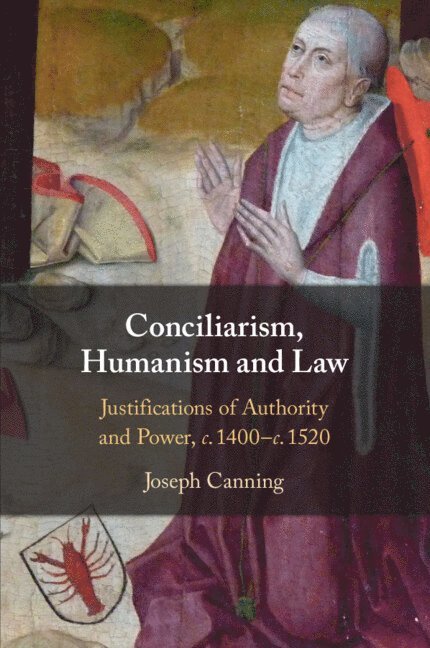


Du kanske också är intresserad av
Power, Violence and Mass Death in Pre-Modern and Modern Times
Joseph Canning, Hartmut Lehmann
Inbunden, 2004
4 149 kr
Del 6
The Political Thought of Baldus de Ubaldis
Joseph Canning, Rosamond McKitterick, Rosamond Mckitterick, Christine Carpenter
Häftad, 2003
959 kr
- Nyhet
Del 3
- Nyhet
Del 11
- Nyhet
Del 6