
Del i serien IBM Center for the Business of Government
Collaboration
Using Networks and Partnerships
Inbunden, Engelska, 2004
2 359 kr
Beställningsvara. Skickas inom 10-15 vardagar. Fri frakt för medlemmar vid köp för minst 249 kr.
As government faces more complex problems, and citizens expect more, the way government delivers services and results is changing rapidly. The traditional model of government agencies administering hundreds of programs by themselves is giving way to one-stop services and cross-agency results. This translation implies collaboration—within agencies; among agencies; among levels of governments; and among the public, private, and nonprofit sectors. The first part of this book describes what networks and partnerships are. The second part presents case examples of how collaborative approaches have actually worked in the public sector, when they should be used, and what it takes to manage and coordinate them.
Produktinformation
- Utgivningsdatum2004-03-19
- Mått162 x 239 x 33 mm
- Vikt758 g
- FormatInbunden
- SpråkEngelska
- SerieIBM Center for the Business of Government
- Antal sidor400
- FörlagBloomsbury Publishing Plc
- ISBN9780742535138
Tillhör följande kategorier
Hoppa över listan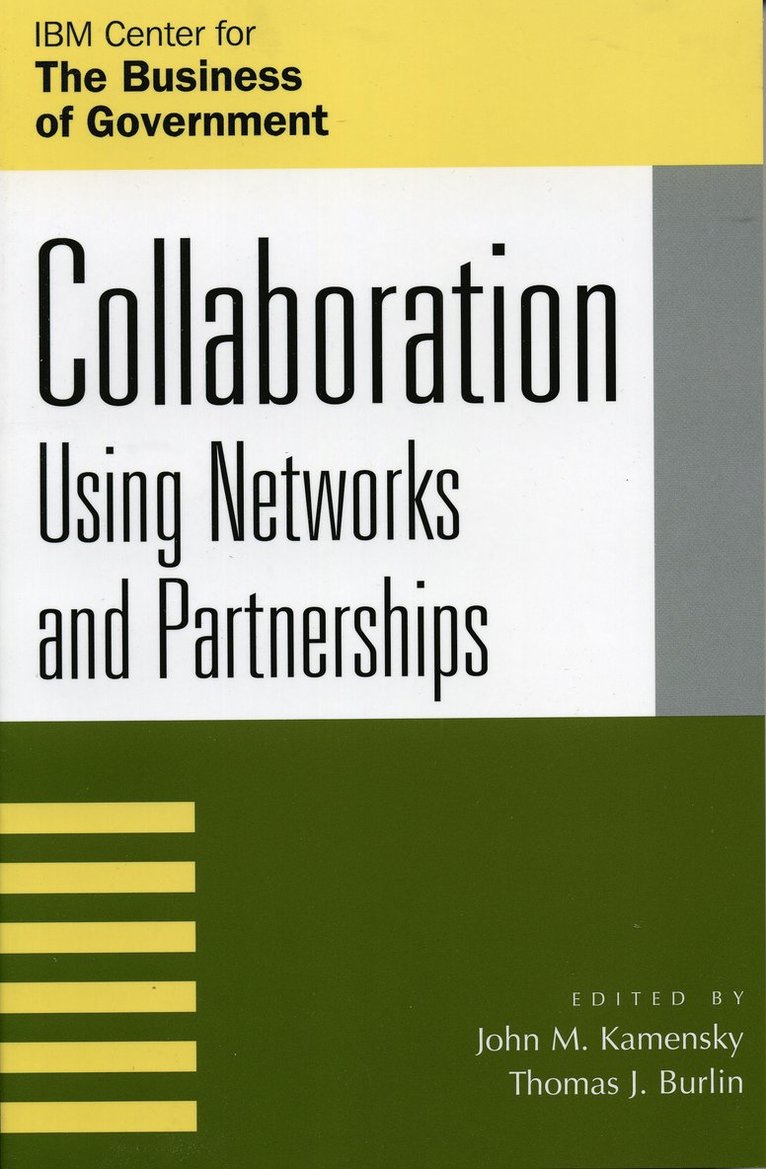









Du kanske också är intresserad av
Competition, Choice, and Incentives in Government Programs
John M. Kamensky, Albert Morales
Häftad, 2006
939 kr
Getting It Done
Mark A. Abramson, Martin G. Wagner, Jonathan D. Breul, John M. Kamensky, Daniel J. Chenok
Häftad, 2013
479 kr
Operator's Manual for the New Administration
Mark A. Abramson, Jonathan D. Breul, John M. Kamensky, Martin G. Wagner
Häftad, 2008
769 kr