
Del 41 i serien Studies in Medieval Culture
Closure in the Canterbury Tales
The Role of The Parson's Tale
Inbunden, Engelska, 2000
749 kr
Beställningsvara. Skickas inom 5-8 vardagar. Fri frakt för medlemmar vid köp för minst 249 kr.
For all its spiritual cheerfulness and obvious importance as a tale to conclude tales, a last word from a notable maker of words, The Parson's Tale seems to have inspired sentence and solaas in remarkably few critics. This volume rejects the tradition that assumes the tale to be of questionable literary value. The studies included span the range of Parson's Tale criticism from the textual, to the philological, to the hermeneutical. What they share is the assumption that if one is to understand the role of The Parson's Tale, one must begin by accepting the language and method by which Chaucer fashioned it. This rethinking of traditional scholarship on this crucial aspect of The Canterbury Tales will be of great interest to Chaucer scholars and students of medieval literature.
Produktinformation
- Utgivningsdatum2000-07-01
- Mått156 x 234 x undefined mm
- Vikt605 g
- FormatInbunden
- SpråkEngelska
- SerieStudies in Medieval Culture
- Antal sidor290
- FörlagMedieval Institute Publications
- ISBN9781580440110
Tillhör följande kategorier
Hoppa över listan


Mer från samma serie
Del 27
Del 28
Law, Custom, and the Social Fabric in Medieval Europe
Bernard S. Bachrach, David Nicholas
Inbunden, 1990
439 kr
Del 29
Del 44
Studies on the Personal Name in Later Medieval England and Wales
Dave Postles, Joel T. Rosenthal
Inbunden, 2006
409 kr
Del 42
Del 46
Del 45
New Directions in Boethian Studies
Noel Harold Kaylor Jr., Philip Edward Phillips
Inbunden, 2007
419 kr
Del 48
Del 50
Del 52
Hoppa över listan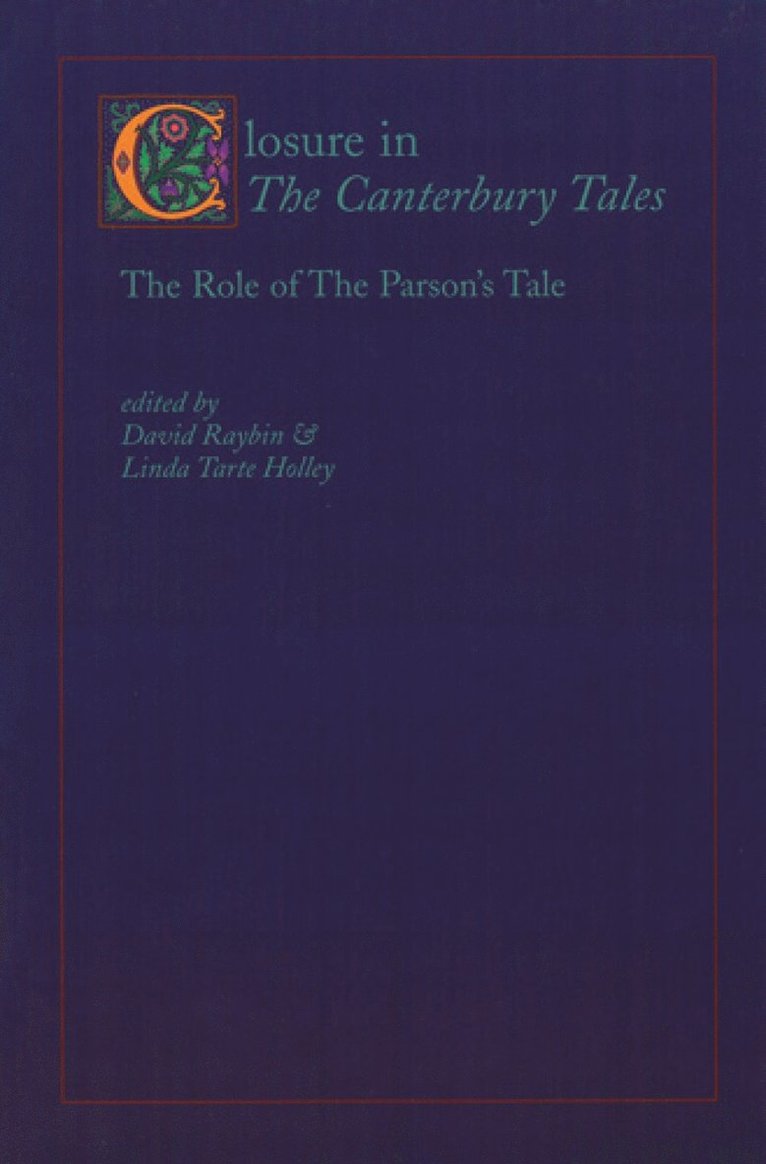


Du kanske också är intresserad av
Del 41
Del 29
Roland and Otuel Romances and the Anglo-Norman Otinel
Susanna Fein, Elizabeth Melick, David Raybin
Häftad, 2020
449 kr
Roland and Otuel Romances and the Anglo-Norman Otinel
Susanna Fein, Elizabeth Melick, David Raybin
Inbunden, 2019
2 099 kr
Del 29
Complete Harley 2253 Manuscript, Volume 3
Medieval Institute Publications, David Raybin
Häftad, 2015
679 kr
Del 34