
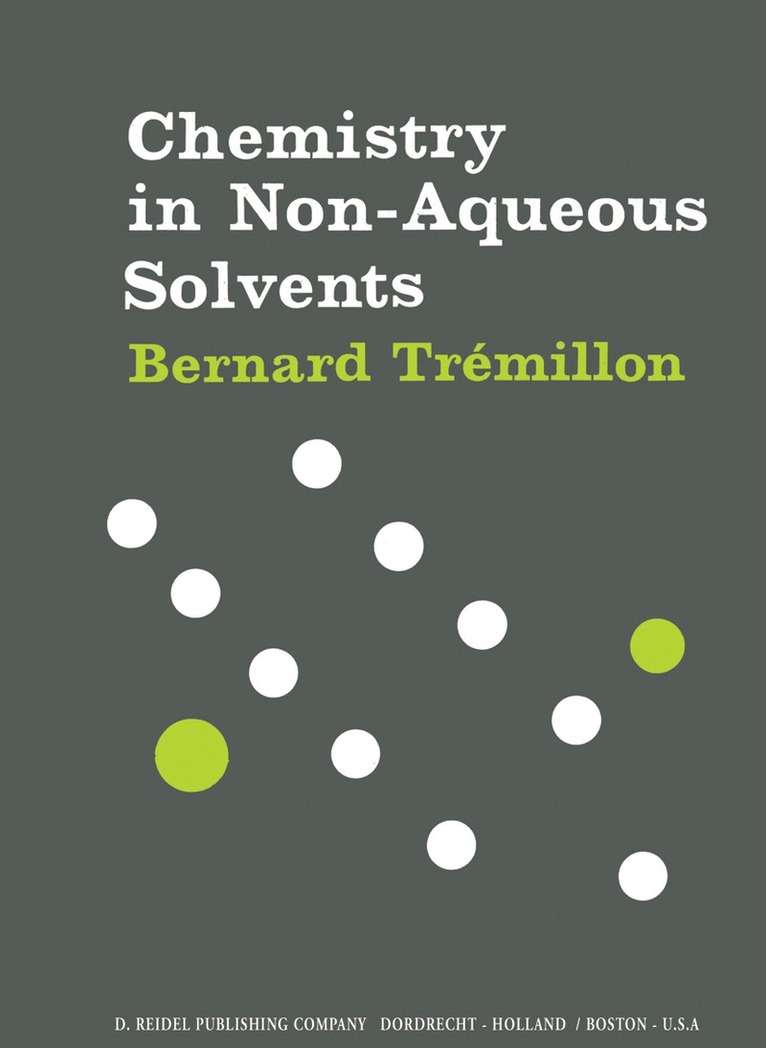
Chemistry in Non-Aqueous Solvents
Inbunden, Engelska, 1974
1 439 kr
Beställningsvara. Skickas inom 10-15 vardagar. Fri frakt för medlemmar vid köp för minst 249 kr.
Finns i fler format (1)
Arising no doubt from its pre-eminence as a natural liquid, water has always been considered by chemists as the original solvent in which very varied chemical reactions can take place, both for preparational and for analytical purposes. This explains the very long-standing interest shown in the study of aqueous solutions. In this con nection, it must be stressed that the theory of Arrhenius and Ostwald (1887-1894) on electrolytic dissociation, was originally devised solely for solutions in water and that the first true concept of acidity resulting from this is linked to the use of this solvent. The more recent development of numerous physico-chemical measurement methods has made possible an increase of knowledge in this area up to an extremely advanced degree of systematization. Thus today we have available both a very large amount of experimental data, together with very refined methods of deduction and of quantitative treatment of chemical reactions in solution which enable us to make the fullest use of this data. Nevertheless, . it appears quite evident at present that there are numerous chemical processes which cannot take place in water, and that its use as a solvent imposes 2 INTRODUCTION limitations. In order to overcome these limitations, it was natural that interest should be attracted to solvents other than water and that the new possibilities thus opened up should be explored.
Produktinformation
- Utgivningsdatum1974-04-30
- Mått210 x 297 x 20 mm
- Vikt618 g
- FormatInbunden
- SpråkEngelska
- Antal sidor285
- Upplaga1974
- FörlagSpringer
- ISBN9789027703897
- ÖversättareN. Corcoran
Tillhör följande kategorier
Hoppa över listan



Du kanske också är intresserad av
Del 45
Del 14
Methodological and Historical Essays in the Natural and Social Sciences
Robert S. Cohen, Marx W. Wartofsky
Häftad, 1974
719 kr