
By Honor Bound
State and Society in Early Modern Russia
Häftad, Engelska, 2016
359 kr
Beställningsvara. Skickas inom 10-15 vardagar. Fri frakt för medlemmar vid köp för minst 249 kr.
Finns i fler format (1)
In the sixteenth and seventeenth centuries, Russians from all ranks of society were bound together by a culture of honor. Here one of the foremost scholars of early modern Russia explores the intricate and highly stylized codes that made up this culture. Nancy Shields Kollmann describes how these codes were manipulated to construct identity and enforce social norms—and also to defend against insults, to pursue vendettas, and to unsettle communities. She offers evidence for a new view of the relationship of state and society in the Russian empire, and her richly comparative approach enhances knowledge of statebuilding in premodern Europe. By presenting Muscovite state and society in the context of medieval and early modern Europe, she exposes similarities that blur long-standing distinctions between Russian and European history.Through the prism of honor, Kollmann examines the interaction of the Russian state and its people in regulating social relations and defining an individual's rank. She finds vital information in a collection of transcripts of legal suits brought by elites and peasants alike to avenge insult to honor. The cases make clear the conservative role honor played in society as well as the ability of men and women to employ this body of ideas to address their relations with one another and with the state. Kollmann demonstrates that the grand princes—and later the tsars—tolerated a surprising degree of local autonomy throughout their rapidly expanding realm. Her work marks a stark contrast with traditional Russian historiography, which exaggerates the power of the state and downplays the volition of society.
Produktinformation
- Utgivningsdatum2016-11-01
- Mått155 x 235 x 21 mm
- Vikt907 g
- FormatHäftad
- SpråkEngelska
- Antal sidor320
- FörlagCornell University Press
- ISBN9781501707193
- UtmärkelserA Choice Magazine Outstanding Academic Title
Tillhör följande kategorier
Hoppa över listan

Mer från samma författare
Religion and Culture in Early Modern Russia and Ukraine
Samuel Baron, Nancy Shields Kollmann
Inbunden, 1997
719 kr
Hoppa över listan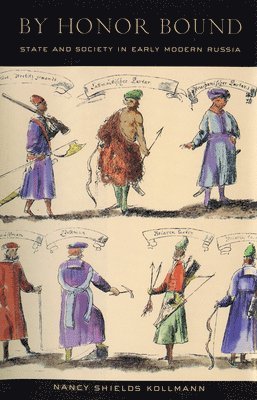







Du kanske också är intresserad av
Religion and Culture in Early Modern Russia and Ukraine
Samuel Baron, Nancy Shields Kollmann
Inbunden, 1997
719 kr
- Nyhet
Del 3
- Nyhet
Del 11
- Nyhet
Del 6
- Nyhet
- Nyhet
Del 4
Del 1
Del 3