
Breaking the Cycle of Mass Atrocities
Criminological and Socio-Legal Approaches in International Criminal Law
Häftad, Engelska, 2020
609 kr
Beställningsvara. Skickas inom 10-15 vardagar. Fri frakt för medlemmar vid köp för minst 249 kr.
Finns i fler format (1)
Breaking the Cycle of Mass Atrocities investigates the role of international criminal law at different stages of mass atrocities, shifting away from its narrow understanding solely as an instrument of punishment of those most responsible. The book is premised on the idea that there are distinct phases of collective violence, and international criminal law contributes in one way or another to each phase. The authors therefore explore various possibilities for international criminal law to be of assistance in breaking the vicious cycle at its different junctures.
Produktinformation
- Utgivningsdatum2020-12-17
- Mått156 x 234 x 15 mm
- Vikt404 g
- FormatHäftad
- SpråkEngelska
- Antal sidor288
- FörlagBloomsbury Publishing PLC
- ISBN9781509945740
Tillhör följande kategorier
Hoppa över listan




Mer från samma författare
Judges as Guardians of Constitutionalism and Human Rights
Martin Scheinin, Helle Krunke, Marina Aksenova
Inbunden, 2016
2 869 kr
Human Rights for Kids
Various, Marina Aksenova, Tuomas Ojanen, Eds Margot E Salomon
Häftad, 2025
409 kr
Human Rights for Kids
Various, Marina Aksenova, Tuomas Ojanen, Eds Margot E Salomon
Inbunden, 2025
569 kr
Hoppa över listan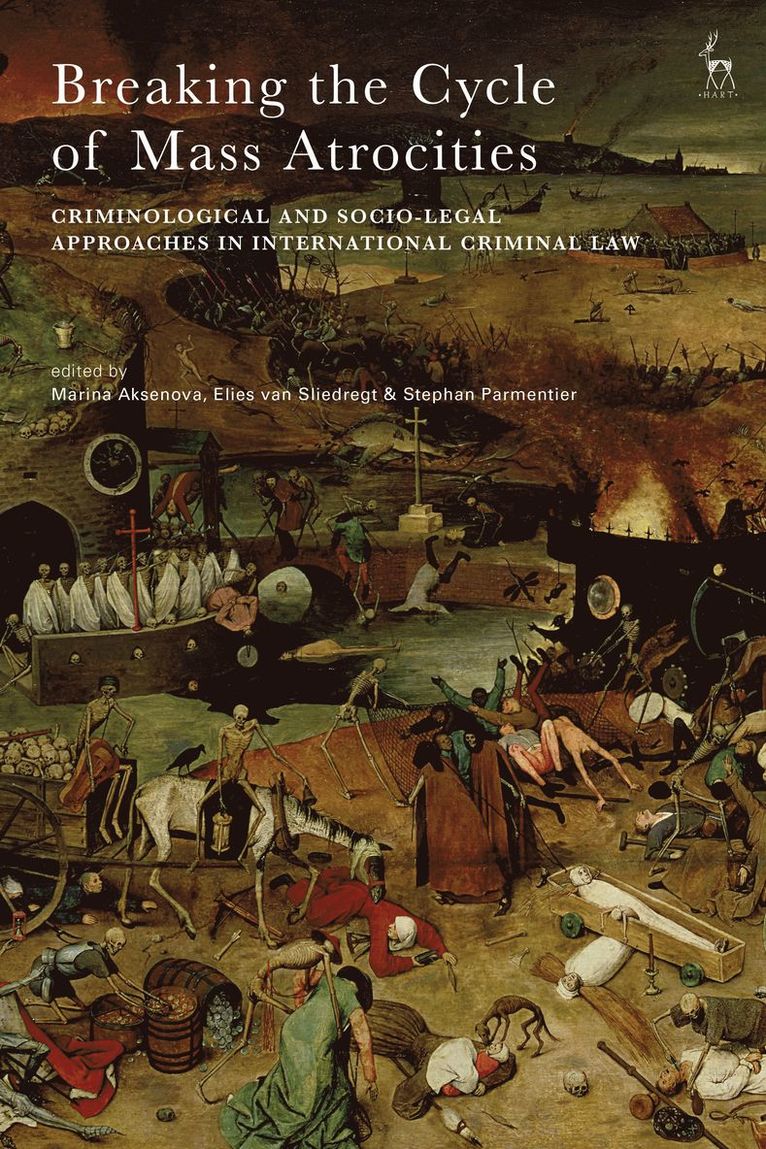




Du kanske också är intresserad av
Breaking the Cycle of Mass Atrocities
Marina Aksenova, Elies van Sliedregt, Stephan Parmentier
Inbunden, 2019
1 499 kr
Changing Role of Law in Japan
Dimitri Vanoverbeke, Jeroen Maesschalck, David Nelken, Stephan Parmentier
Inbunden, 2014
2 519 kr
The Local Relevance of Human Rights
Koen De Feyter, Stephan Parmentier, Christiane Timmerman, George Ulrich
Inbunden, 2011
2 509 kr
Between Rights and Responsibilities
Stephan Parmentier, Hans Werdmölder, Michaël Merrigan
Häftad, 2016
1 389 kr
Localising Memory in Transitional Justice
Mina Rauschenbach, Julia Viebach, Stephan Parmentier
Inbunden, 2022
3 309 kr
Human Rights for Kids
Various, Marina Aksenova, Tuomas Ojanen, Eds Margot E Salomon
Häftad, 2025
409 kr
Del 11
Localising Memory in Transitional Justice
Mina Rauschenbach, Julia Viebach, Stephan Parmentier
Häftad, 2024
909 kr
Out of the Ashes
TBD, Koen de Feyter, Stephan Parmentier, Marc Bossuyt, Paul Lemmens
Inbunden, 2006
1 529 kr