
Del 50
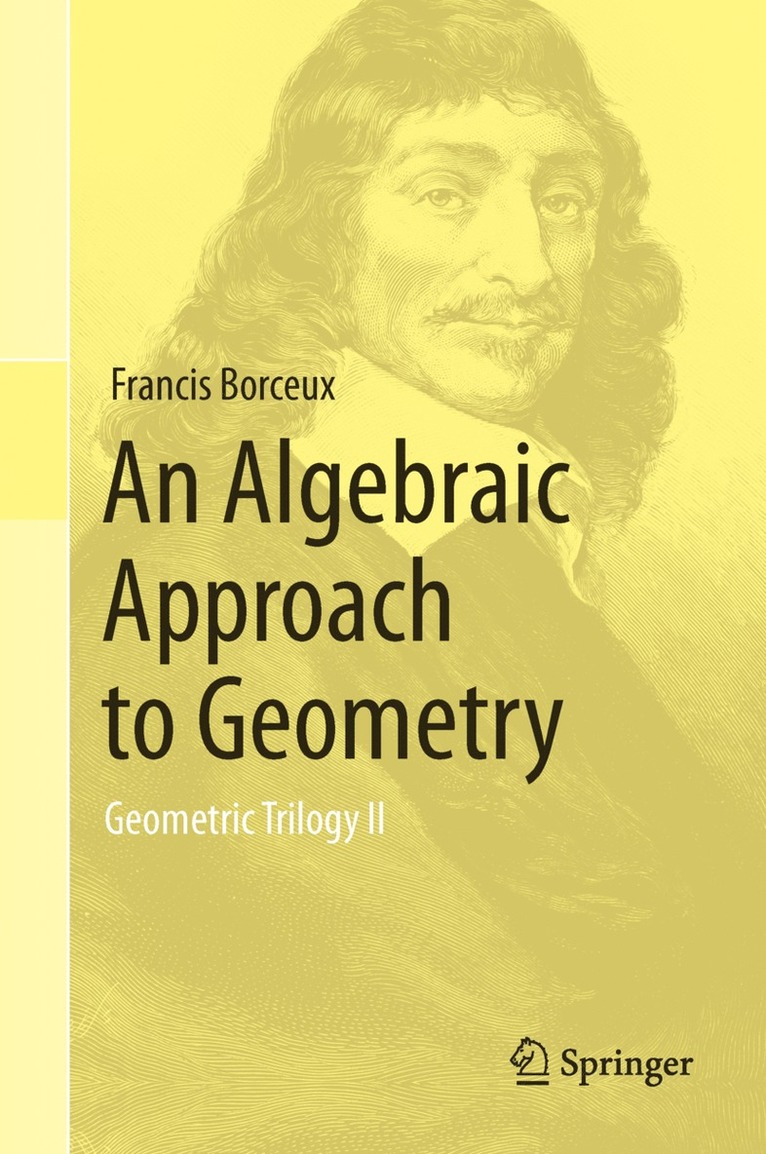
Axiomatic Approach to Geometry
Geometric Trilogy I
Inbunden, Engelska, 2013
2 009 kr
Beställningsvara. Skickas inom 10-15 vardagar. Fri frakt för medlemmar vid köp för minst 249 kr.
Finns i fler format (1)
Focusing methodologically on those historical aspects that are relevant to supporting intuition in axiomatic approaches to geometry, the book develops systematic and modern approaches to the three core aspects of axiomatic geometry: Euclidean, non-Euclidean and projective. Historically, axiomatic geometry marks the origin of formalized mathematical activity. It is in this discipline that most historically famous problems can be found, the solutions of which have led to various presently very active domains of research, especially in algebra. The recognition of the coherence of two-by-two contradictory axiomatic systems for geometry (like one single parallel, no parallel at all, several parallels) has led to the emergence of mathematical theories based on an arbitrary system of axioms, an essential feature of contemporary mathematics.This is a fascinating book for all those who teach or study axiomatic geometry, and who are interested in the history of geometry or who want tosee a complete proof of one of the famous problems encountered, but not solved, during their studies: circle squaring, duplication of the cube, trisection of the angle, construction of regular polygons, construction of models of non-Euclidean geometries, etc. It also provides hundreds of figures that support intuition.Through 35 centuries of the history of geometry, discover the birth and follow the evolution of those innovative ideas that allowed humankind to develop so many aspects of contemporary mathematics. Understand the various levels of rigor which successively established themselves through the centuries. Be amazed, as mathematicians of the 19th century were, when observing that both an axiom and its contradiction can be chosen as a valid basis for developing a mathematical theory. Pass through the door of this incredible world of axiomatic mathematical theories!
Produktinformation
- Utgivningsdatum2013-11-08
- Mått155 x 235 x 28 mm
- Vikt754 g
- FormatInbunden
- SpråkEngelska
- Antal sidor403
- Upplaga2014
- FörlagSpringer International Publishing AG
- ISBN9783319017297
Tillhör följande kategorier
Hoppa över listan
Mer från samma författare
Del 51
Handbook of Categorical Algebra: Volume 2, Categories and Structures
Francis Borceux
Häftad, 2008
1 839 kr
Del 52
Del 72
Del 50
Handbook of Categorical Algebra: Volume 1, Basic Category Theory
Francis Borceux, G. -C Rota, B. Doran
Inbunden, 1994
3 089 kr
Del 51
Handbook of Categorical Algebra: Volume 2, Categories and Structures
Francis Borceux, G. -C Rota, B. Doran
Inbunden, 1994
3 499 kr
Del 52
Handbook of Categorical Algebra: Volume 3, Sheaf Theory
Francis Borceux, G. -C Rota, B. Doran
Inbunden, 1994
3 759 kr
Del 72
Mal'cev, Protomodular, Homological and Semi-Abelian Categories
Francis Borceux, Dominique Bourn
Inbunden, 2004
1 439 kr
Del 2
Hoppa över listan
Du kanske också är intresserad av
Del 52
Handbook of Categorical Algebra: Volume 3, Sheaf Theory
Francis Borceux, G. -C Rota, B. Doran
Inbunden, 1994
3 759 kr
Del 1348
Del 50
Handbook of Categorical Algebra: Volume 1, Basic Category Theory
Francis Borceux, G. -C Rota, B. Doran
Inbunden, 1994
3 089 kr
Del 51
Handbook of Categorical Algebra: Volume 2, Categories and Structures
Francis Borceux, G. -C Rota, B. Doran
Inbunden, 1994
3 499 kr
Mal'cev, Protomodular, Homological and Semi-Abelian Categories
Francis Borceux, Dominique Bourn
Inbunden, 2004
1 439 kr
Del 72
Del 50
Del 72