
Auden's Syllabic Verse
Inbunden, Engelska, 2019
2 299 kr
Beställningsvara. Skickas inom 10-15 vardagar. Fri frakt för medlemmar vid köp för minst 249 kr.
Much of the poetry written by W. H. Auden between 1939 and the time of his death consists of syllabic verse, or lines arranged in accordance with a predetermined syllable-count but no fixed number or distribution of stresses. This book presents a comprehensive, in-depth analysis of his many and widely varied syllabics, grouping them primarily by the formal sub-categories to which they belong (as measured by line-length, stanza-type, or some other aspect of their overall design). With this approach the book clarifies the dynamic range and technical inventiveness of Auden’s syllabics. It also shows how his work of compares with that of Robert Bridges and Marianne Moore, two pioneers in the writing of English syllabic whose verse he was familiar with.
Produktinformation
- Utgivningsdatum2019-12-12
- Mått159 x 229 x 29 mm
- Vikt653 g
- FormatInbunden
- SpråkEngelska
- Antal sidor318
- FörlagBloomsbury Publishing Plc
- ISBN9781498591461
Tillhör följande kategorier
Hoppa över listan
Mer från samma författare
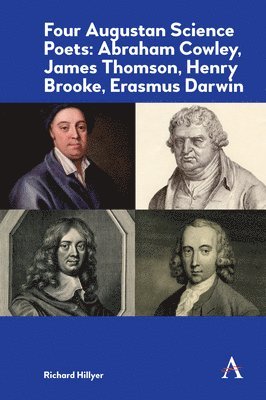
Four Augustan Science Poets: Abraham Cowley, James Thomson, Henry Brooke, Erasmus Darwin
Richard Hillyer
Häftad, 2020
859 kr
Hoppa över listan



Du kanske också är intresserad av
Four Augustan Science Poets: Abraham Cowley, James Thomson, Henry Brooke, Erasmus Darwin
Richard Hillyer
Häftad, 2020
859 kr
- Nyhet
Del 3
- Nyhet
Del 11
- Nyhet
- Nyhet
Del 6
- Nyhet
Del 4
- Nyhet