Del 124 - Islamic Philosophy, Theology and Science. Texts and Studies
At the Roots of Causality
Ontology and Aetiology from Avicenna to Fakhr al-Dīn al-Rāzī
Inbunden, Engelska, 2023
AvFrancesco Omar Zamboni,Francesco Omar Zamboni,Francesco Zamboni
2 489 kr
Beställningsvara. Skickas inom 5-8 vardagar. Fri frakt för medlemmar vid köp för minst 249 kr.
The book approaches the conceptual background of Avicenna's account of efficient causality, outlining the positions held by him and his early interpreters (eleventh and twelfth centuries), as well as the arguments that support those positions. The first aim of the book is to show the systematic unity of the Avicennian doctrines on ontology and aetiology, highlighting the threads connecting the two. The second aim is to investigate Avicenna’s influence over his interpreters, assessing continuities and discontinuities.
Produktinformation
- Utgivningsdatum2023-10-11
- Mått155 x 235 x 26 mm
- Vikt719 g
- FormatInbunden
- SpråkEngelska
- SerieIslamic Philosophy, Theology and Science. Texts and Studies
- Antal sidor344
- FörlagBrill
- ISBN9789004684867
Tillhör följande kategorier
Francesco Omar Zamboni, Ph.D. (2021), Scuola Normale Superiore (Pisa), is post-doctoral researcher at the university of Jyväskylä. He has published several articles on Mediaeval Islamic metaphysics, as well as a full Italian translation of Avicenna's Ishārāt.
- AcknowledgementsIntroduction1 Avicenna2 The Avicennians: Bahmanyār, Lawkarī, Khayyām, and Sāwī3 The Anti-Avicennians: Ghazālī, Ibn al-Malāḥimī, Shahrastānī, Masʿūdī, and Ibn Ghaylān4 The Innovators: Abū l-Barakāt and Suhrawardī5 The Systematiser: Fakhr al-Dīn al-Rāzī6 The Thirteenth Century: Traditional Mutakallimūn, Post-Rāzians, Ishrāqis, and Neo-Avicennians7 General Overview of the Study1 Efficient Causality in Avicenna1.1 The Subject of and the Reason for Causal Dependence1.2 Categories of Efficient Causality1.3 Necessitation Contra Contingent Choice1.4 Corollaries of Efficient Causality1.5 The Epistemic Function of Avicenna’s Aetiology2 The Essence of Existence2.1 Avicenna: Primitivity, Simplicity, Identity with Reality, Distinction from Quiddity2.2 Bahmanyār, Khayyām, and Rāzī: The Rejection of Grounding and Dependent Knowability2.3 Masʿūdī and Abū l-Barakāt: Grounding and Inferential Knowability2.4 Ibn al-Malāḥimī: Reduction to Quiddity, Nominalism, and Extensionalisation2.5 Debates: on Grounding2.6 Debates: on Simplicity and Knowability2.7 Debates: on Primitivity3 The Universality of Existence and Mental Existence3.1 Avicenna and the Majority: the Universality of Existence and Mental Existence3.2 Masʿūdī and Rāzī: the Rejection of Mental Existence and the Aporia of Universality3.3 Avicenna, Khayyām, Abū l-Barakāt, and Rāzī: the Distinction between Mental and Concrete3.4 Debates: on Universality3.5 Debates: on Mental Existence4 The Conceptual Invariance of Existence4.1 Avicenna and the Majority: Conceptual Invariance4.2 Ibn al-Malāḥimī: Unrestricted Conceptual Variance4.3 Shahrastānī: Restricted Conceptual Variance4.4 Debates: on the Case for Invariance4.5 Debates: on the Case for Variance, Unrestricted and Restricted5 The Modulation of Existence5.1 Avicenna and Sāwī: The Modulation of Existence by Priority and Worth5.2 Ibn al-Malāḥimī, Shahrastānī, and Suhrawardī: the Rejection of the Modulation of Existence5.3 Bahmanyār: Modulation by Intensity and Accidental Unity5.4 Ibn al-Malāḥimī, Shahrastānī, Masʿūdī, and Rāzī: Essential Unity and the Rejection of Intensity5.5 Debates: on Intensity5.6 Debates: on the Accidentality and Essentiality of Unity6 The Accidentality of Existence6.1 Avicenna, Bahmanyār, Sāwī, Masʿūdī, and Rāzī: the Accidentality of Existence6.2 Ghazālī and Ibn al-Malāḥimī: the Rejection of Distinction (Nominalism)6.3 Khayyām, Shahrastānī, Ibn Ghaylān, and Suhrawardī: the Rejection of Concrete Reality (Conceptualism)6.4 Abū l-Barakāt: the Rejection of Inherence6.5 Debates: on Distinction6.6 Debates: on Concrete Reality6.7 Debates: on Externality6.8 Debates: on Inherence7 The Contingency of Existence7.1 Avicenna: Intuitivity, Temporal Neutrality, Equidistance, Attribution to Pure Quiddity, and Concrete Reality7.2 Bahmanyār and Lawkarī: Relativity, Modulation, and the Problem of Concrete Reality7.3 Ghazālī and Masʿūdī: Contingency as Causal Dependence7.4 Ibn al-Malāḥimī: Temporal Qualification and Non-equidistance7.5 The Majority: the Rejection of Concrete Reality7.6 Debates: on Contingency as Causal Dependence7.7 Debates: on the Possibility of Contingency7.8 Debates: on Equidistance7.9 Debates: on Concrete Reality8 The Signs of Contingency8.1 Avicenna and the Majority: the Contingency of the Conditional and of What Comes-to-be8.2 Ghazālī and Masʿūdī: the Insufficiency of Conditionality for Contingency8.3 Ibn al-Malāḥimī: the Insufficiency of Composition for Contingency8.4 Suhrawardī: the Contingency of the Imperfect and the Multipliable8.5 Debates: on the Contingency of the Conditional8.6 Debates: on the Contingency of What Comes-to-be8.7 Debates: on the Contingency of the Imperfect and the Multipliable9 The Principle of Sufficient Reason9.1 Avicenna and the Majority: Sufficient Reason, Causal Necessitarianism, Unrestricted Applicability9.2 Ghazālī and Ibn Ghaylān: Non-applicability to Voluntary Actions9.3 Ibn al-Malāḥimī: the Weakening of the Principle9.4 Shahrastānī: Possible Applicability to Divine Actions9.5 Rāzī: the Preference for Non-applicability to Divine Actions9.6 Debates: on the Intuitivity of Sufficient Reason9.7 Debates: the Inferential Case for Sufficient Reason9.8 Debates: the Case against Sufficient Reason10 The Coexistence of Cause and Effect10.1 Avicenna and the Majority: Coexistence as Entailed by Sufficient Reason10.2 Rāzī: Coexistence as Distinct from Sufficient Reason10.3 Shahrastānī: the Rejection of Coexistence with God10.4 Ibn al-Malāḥimī, Masʿūdī: Causeless Persistence10.5 Debates: on Coexistence10.6 Debates: on Coexistence with God10.7 Debates: on Causeless Persistence11 Causal Priority11.1 Avicenna and the Majority: Causal Priority as Existential Priority11.2 Rāzī: the Problematisation of Causal Priority and Its Corollaries11.3 Debates: on Causal Priority11.4 Debates: on Self-Causation11.5 Debates: on Essential Coming-to-beConclusionBibliographyIndex
Hoppa över listan


Mer från samma serie
Del 49
Del 82
Del 91
Del 96
Del 98
Del 100
Le Cercle des lettres de l’alphabet Dā’irat al-aḥruf al-abjadiyya
Cécile Bonmariage, Sébastien Moureau
Inbunden
2 309 kr
Del 101
Del 102
Del 105
Del 108
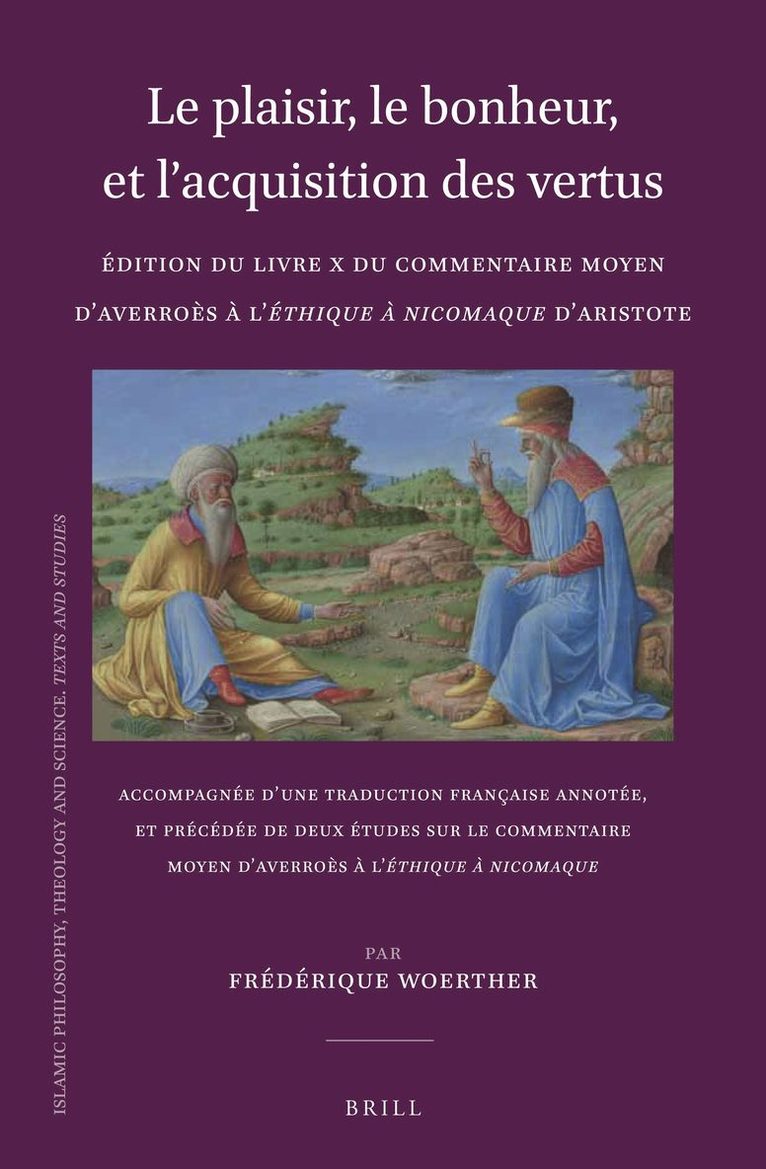
Le plaisir, le bonheur, et l’acquisition des vertus: Édition du Livre X du Commentaire moyen d’Averroès à l’Éthique à Nicomaque d’Aristote
Frédérique Woerther
Inbunden
2 179 kr
Hoppa över listan


Du kanske också är intresserad av
Del 102
Del 100
Le Cercle des lettres de l’alphabet Dā’irat al-aḥruf al-abjadiyya
Cécile Bonmariage, Sébastien Moureau
Inbunden
2 309 kr
Del 96
Del 49
Del 130
Del 108
Le plaisir, le bonheur, et l’acquisition des vertus: Édition du Livre X du Commentaire moyen d’Averroès à l’Éthique à Nicomaque d’Aristote
Frédérique Woerther
Inbunden
2 179 kr
Del 127
Del 125
Del 131
Del 98