
Assessment of Communication Disorders in Children
Resources and Protocols
Häftad, Engelska, 2012
2 159 kr
Tillfälligt slut
This second edition of a high-demand text offers a unique combination of scholarly information, invaluable resources, and time-saving protocols on assessment of communication disorders in children. Most resource books offer limited research and scholarly information, thus making them unsuitable as textbooks for academic courses on assessment and diagnosis. Similarly, most traditional textbooks do not include practical, easy-to-use, and time-saving resources and protocols that the practicing clinicians can readily use during assessment sessions. By combining the strengths of traditional textbooks and newer assessment resources and protocols, this one-of-a kind book offers a single, comprehensive source that is suitable as a textbook and useful as a practical clinical resource.While combining scholarly information needed for academic courses and practical tools for clinical assessment, this innovative book: Covers the full range of communication disorders in children, including nonverbal or minimally verbal children Includes an extensive discussion of issues in using standardized tests along with detailed information on psychometric principles Offers a detailed discussion of alternative assessment approaches that minimize the problems inherent to standardized tests Describes a new, comprehensive, and integrated assessment approach that derives its strengths from the traditional as well as several alternative approaches Provides an updated and thorough discussion of multicultural issues in assessing communication disorders in children Integrates multicultural assessment procedures into the assessment protocols offered for all communication disorders Contains two chapters for each disorder: one on resources that offers scholarly and research background on the disorder and one on resources that describe practical procedures and protocols that save preparation time and effort for the clinician and makes it possible to use as a textbook as well as a clinical resource book
Produktinformation
- Utgivningsdatum2012-08-22
- Mått216 x 279 x 28 mm
- Vikt1 315 g
- FormatHäftad
- SpråkEngelska
- Antal sidor560
- Upplaga2
- FörlagPlural Publishing Inc
- ISBN9781597564878
Tillhör följande kategorier
Hoppa över listan
![M. N. Hegde, Adriana Pena-Brooks - For /t/ /d/ /[iota]/ /[zeta]/ /[iota]/ /[zeta]/, Häftad](https://bilder.akademibokhandeln.se/images_akb/9781597561297_766)
![M. N. Hegde, Adriana Pena-Brooks - For /ld/ /l[alpha][upsilon] /lt/ /lz/ /rd/ /rk/ /rn/ /rt/, Häftad](https://bilder.akademibokhandeln.se/images_akb/9781597561341_766)
Mer från samma författare
Sound Stimuli: For Assessment and Treatment Protocols for Articulation and Phonological Disorders
M. N. Hegde, Adriana Pena-Brooks
Häftad, 2007
369 kr
For /bl/ /fl/ /gl/ /kl/ /pl/ /sl/ /pr/ /br/ /tr/ /dr/
M. N. Hegde, Adriana Pena-Brooks
Häftad, 2007
419 kr
For /ld/ /l[alpha][upsilon] /lt/ /lz/ /rd/ /rk/ /rn/ /rt/
M. N. Hegde, Adriana Pena-Brooks
Häftad, 2007
439 kr
For /ks/ /ns/ /ps/ /st/ /ts/ /bz/ /dz/ /gz/ /mz/ /nz/
M. N. Hegde, Adriana Pena-Brooks
Häftad, 2007
449 kr
Hoppa över listan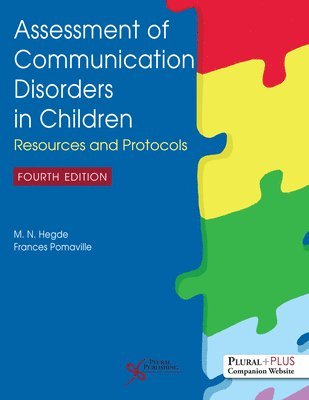
Du kanske också är intresserad av
For /ks/ /ns/ /ps/ /st/ /ts/ /bz/ /dz/ /gz/ /mz/ /nz/
M. N. Hegde, Adriana Pena-Brooks
Häftad, 2007
449 kr
Sound Stimuli: For Assessment and Treatment Protocols for Articulation and Phonological Disorders
M. N. Hegde, Adriana Pena-Brooks
Häftad, 2007
369 kr
Coursebook on Scientific and Professional Writing for Speech-Language Pathology
M. N. Hegde
Häftad, 2017
2 509 kr
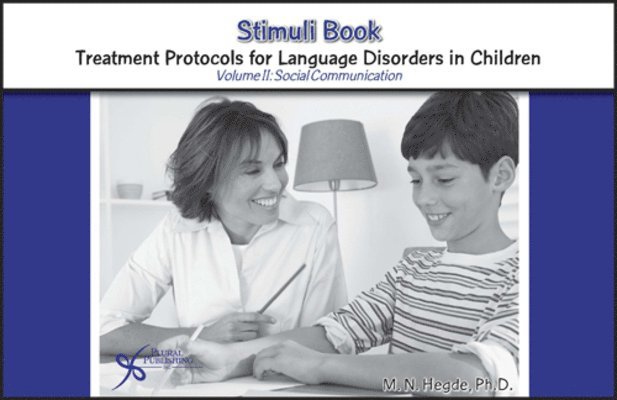
Stimulis Book for Treatment Protocols for Language Disorders in Children
M. N. Hegde
Häftad, 2007
449 kr