
Waves and Oscillations in Nature
An Introduction
Inbunden, Engelska, 2015
3 999 kr
Beställningsvara. Skickas inom 10-15 vardagar. Fri frakt för medlemmar vid köp för minst 249 kr.
Waves and oscillations are found in large scales (galactic) and microscopic scales (neutrino) in nature. Their dynamics and behavior heavily depend on the type of medium through which they propagate.Waves and Oscillations in Nature: An Introduction clearly elucidates the dynamics and behavior of waves and oscillations in various mediums. It presents different types of waves and oscillations that can be observed and studied from macroscopic to microscopic scales. The book provides a thorough introduction for researchers and graduate students in assorted areas of physics, such as fluid dynamics, plasma physics, optics, and astrophysics. The authors first explain introductory aspects of waves and electromagnetism, including characteristics of waves, the basics of electrostatics and magnetostatics, and Maxwell’s equations. They then explore waves in a uniform media, waves and oscillations in hydrodynamics, and waves in a magnetized medium for homogeneous and nonhomogeneous media. The book also describes types of shock waves, such as normal and oblique shocks, and discusses important details pertaining to waves in optics, including polarization from experimental and observational points of view. The book concludes with a focus on plasmas, covering different plasma parameters, quasilinear and nonlinear aspects of plasma waves, and various instabilities in hydrodynamics and plasmas.
Produktinformation
- Utgivningsdatum2015-05-20
- Mått156 x 234 x 35 mm
- Vikt907 g
- FormatInbunden
- SpråkEngelska
- Antal sidor552
- FörlagTaylor & Francis Inc
- ISBN9781466590939
Tillhör följande kategorier
Hoppa över listan
Mer från samma författare
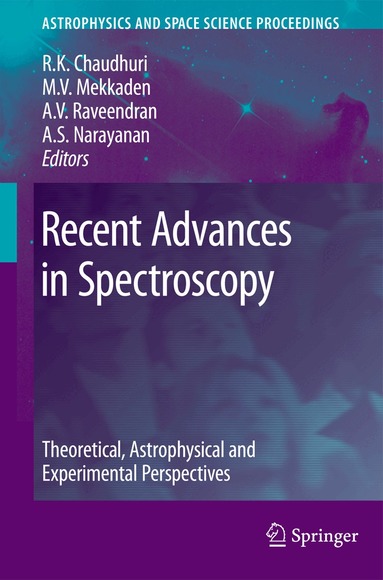
Recent Advances in Spectroscopy
Rajat K. Chaudhuri, M.V. Mekkaden, A. V. Raveendran, A. Satya Narayanan
Inbunden, 2010
2 879 kr
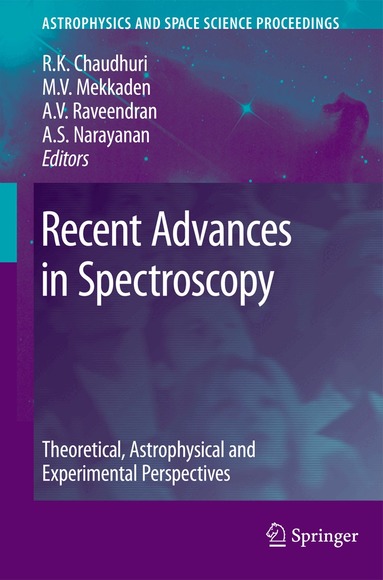
Recent Advances in Spectroscopy
Rajat K. Chaudhuri, M.V. Mekkaden, A. V. Raveendran, A. Satya Narayanan
Häftad, 2012
2 879 kr
Hoppa över listan



Du kanske också är intresserad av
Recent Advances in Spectroscopy
Rajat K. Chaudhuri, M.V. Mekkaden, A. V. Raveendran, A. Satya Narayanan
Inbunden, 2010
2 879 kr
Recent Advances in Spectroscopy
Rajat K. Chaudhuri, M.V. Mekkaden, A. V. Raveendran, A. Satya Narayanan
Häftad, 2012
2 879 kr
- Nyhet
Del 6
- Nyhet
Del 7
- Nyhet
Del 3