
Del 1219
Del 1219 i serien Advances in Experimental Medicine and Biology
Tumor Microenvironment
The Main Driver of Metabolic Adaptation
Häftad, Engelska, 2021
2 359 kr
Beställningsvara. Skickas inom 10-15 vardagar. Fri frakt för medlemmar vid köp för minst 249 kr.
The way a cell undergoes malignant transformation should meet their capacity of surviving in the microenvironment of the organ where the cancer will develop. Metabolic adaptation is for sure one of the criteria that must be accomplished, driven by metabolic plasticity that allows the adaptation of cancer cells to the availability of energy and biomass sources that will sustain cell survival and proliferation. Each human organ has a particular microenvironment which depends on several cell types and in some cases also on symbiotic microorganisms. These biological partners are constantly sharing organic compounds and signaling molecules that will control mitogenesis, cell death and differentiation, accounting for the organ's function. Nevertheless, cancer cells are capable of taking advantage of this metabolic and signaling microenvironmental dynamics.In this book, we intend to present the different components of the microenvironment driving the metabolic fitness of cancer cells. Themetabolic changes required for establishing a tumor in a given microenvironment and how these metabolic changes limit the response to drugs will generally be the major items addressed. It is important to mention not only aspects of the microenvironment that stimulate metabolic changes and that select better adapted tumor cells, but also how this regulation of cell plasticity is made. Thus, the signaling pathways that orchestrate and are orchestrated throughout this panoply of metabolic rearrangements will also be addressed in this book.The subjects will be presented from the conceptual point of view of the cross-cancer mechanisms and also particularizing some models that can be examples and enlightening within the different areas.
Produktinformation
- Utgivningsdatum2021-03-05
- Mått178 x 254 x 27 mm
- Vikt944 g
- FormatHäftad
- SpråkEngelska
- SerieAdvances in Experimental Medicine and Biology
- Antal sidor443
- FörlagSpringer Nature Switzerland AG
- ISBN9783030340278
Tillhör följande kategorier
Hoppa över listan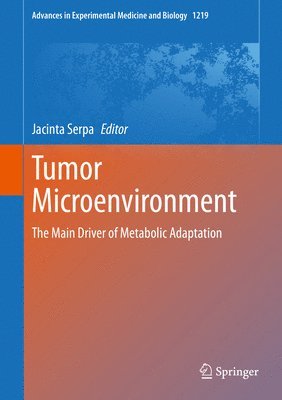








Du kanske också är intresserad av
Del 1501
Del 1219
Untersuchungen an Iso- und Heterocyclen niedriger Ringgröße
Karl-Dietrich Gundermann
Häftad, 1963
739 kr
Del 1219
Del 1219
Automation 2024: Advances in Automation, Robotics and Measurement Techniques
Roman Szewczyk, Cezary Zieliński, Małgorzata Kaliczyńska, Vytautas Bučinskas
Häftad, 2025
2 579 kr
Del 1219
Fifth International Conference on Computing and Network Communications
Sabu M. Thampi, Patrick Siarry, Mohammed Atiquzzaman, Ljiljana Trajkovic, Jaime Lloret Mauri
Inbunden, 2025
3 299 kr
Del 1219
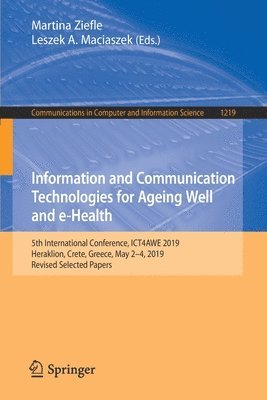
Information and Communication Technologies for Ageing Well and e-Health
Martina Ziefle, Leszek A. Maciaszek
Häftad, 2020
749 kr
Del 1219
Del 1219
Del 1219
Fifth International Conference on Computing and Network Communications
Sabu M. Thampi, Patrick Siarry, Mohammed Atiquzzaman, Ljiljana Trajkovic, Jaime Lloret Mauri
Häftad, 2026
3 299 kr