
Del i serien New Directions in German Studies
Stereotype and Destiny in Arthur Schnitzler’s Prose
Five Psycho-Sociological Readings
Häftad, Engelska, 2019
259 kr
Skickas . Fri frakt för medlemmar vid köp för minst 249 kr.
Finns i fler format (1)
What was the function of the invocation of destiny in the increasingly secularized era of turn-of-the-century Vienna? By exploring this question, Stereotype and Destiny in Arthur Schnitzler's Prose offers a new psycho-sociological perspective on the narrative works of Arthur Schnitzler. While Vienna 1900 as a site of crisis has been established in the scholarship, this book focuses on the presence of forces that deny the existence of said crisis and work to contain its subversive and critical potential. Stereotype and destiny emerge in Schnitzler’s prose texts as a form of these counter-critical forces. In her readings, Kolkenbrock shows that stereotype and destiny serve as an interrelated coping mechanism for a central psychological conflict of modernity: the paradoxical need to be recognized as ‘normal’ and ‘special’ at the same time. While, through the complex of "stereotype and destiny," Schnitzler’s prose addresses central modern questions of identity and subjecthood, Kolkenbrock’s close readings also reveal how the texts inscribe themselves aesthetically in the literary tradition of Romanticism and as such offer crucial sources for understanding Schnitzler’s representations of embattled subjecthood within broader social and aesthetic traditions.
Produktinformation
- Utgivningsdatum2019-08-22
- Mått140 x 216 x 12 mm
- Vikt327 g
- FormatHäftad
- SpråkEngelska
- SerieNew Directions in German Studies
- Antal sidor280
- FörlagBloomsbury Publishing Plc
- ISBN9781501357329
Tillhör följande kategorier
Hoppa över listan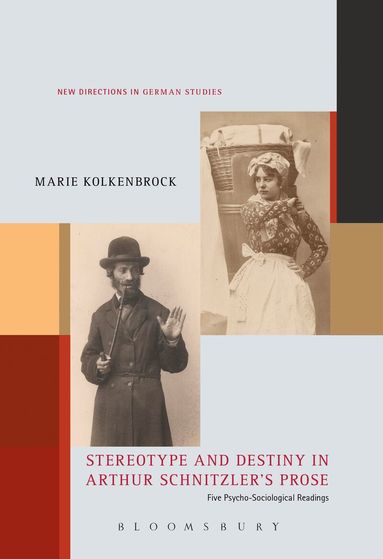




Du kanske också är intresserad av
Stereotype and Destiny in Arthur Schnitzler’s Prose
Marie Kolkenbrock, Imke Meyer
Inbunden, 2018
2 769 kr