
Social Housing and Urban Renewal
A Cross-National Perspective
Inbunden, Engelska, 2017
1 519 kr
Beställningsvara. Skickas inom 5-8 vardagar. Fri frakt för medlemmar vid köp för minst 249 kr.
This book offers a cross-national perspective on contemporary urban renewal in relation tosocial rental housing. Social housing estates – as developed either by governments (publichousing) or not-for-profit agencies – became a prominent feature of the 20th century urbanlandscape in Northern European cities, but also in North America and Australia. Manyestates were built as part of earlier urban renewal, ‘slum clearance’ programs especially inthe post-World War 2 heyday of the Keynesian welfare state. During the last three decades,however, Western governments have launched high-profile ‘new urban renewal’ programswhose aim has been to change the image and status of social housing estates away frombeing zones of concentrated poverty, crime and other social problems. This latest phaseof urban renewal – often called ‘regeneration’ – has involved widespread demolition ofsocial housing estates and their replacement with mixed-tenure housing developments inwhich poverty deconcentration, reduced territorial stigmatization, and social mixing of poortenants and wealthy homeowners are explicit policy goals. Academic critical urbanists, as well as housing activists, have however queried this dominantpolicy narrative regarding contemporary urban renewal, preferring instead to regard it asa key part of neoliberal urban restructuring and state-led gentrification which generate newsocio-spatial inequalities and insecurities through displacement and exclusion processes. Thisbook examines this debate through original, in-depth case study research on the processes andimpacts of urban renewal on social housing in European, U.S. and Australian cities. The bookalso looks beyond the Western urban heartlands of social housing to consider how renewal isoccurring, and with what effects, in countries with historically limited social housing sectors suchas Japan, Chile, Turkey and South Africa.
Produktinformation
- Utgivningsdatum2017-08-15
- Mått165 x 240 x 34 mm
- Vikt948 g
- FormatInbunden
- SpråkEngelska
- Antal sidor512
- FörlagEmerald Publishing Limited
- ISBN9781787141254
Tillhör följande kategorier
Hoppa över listan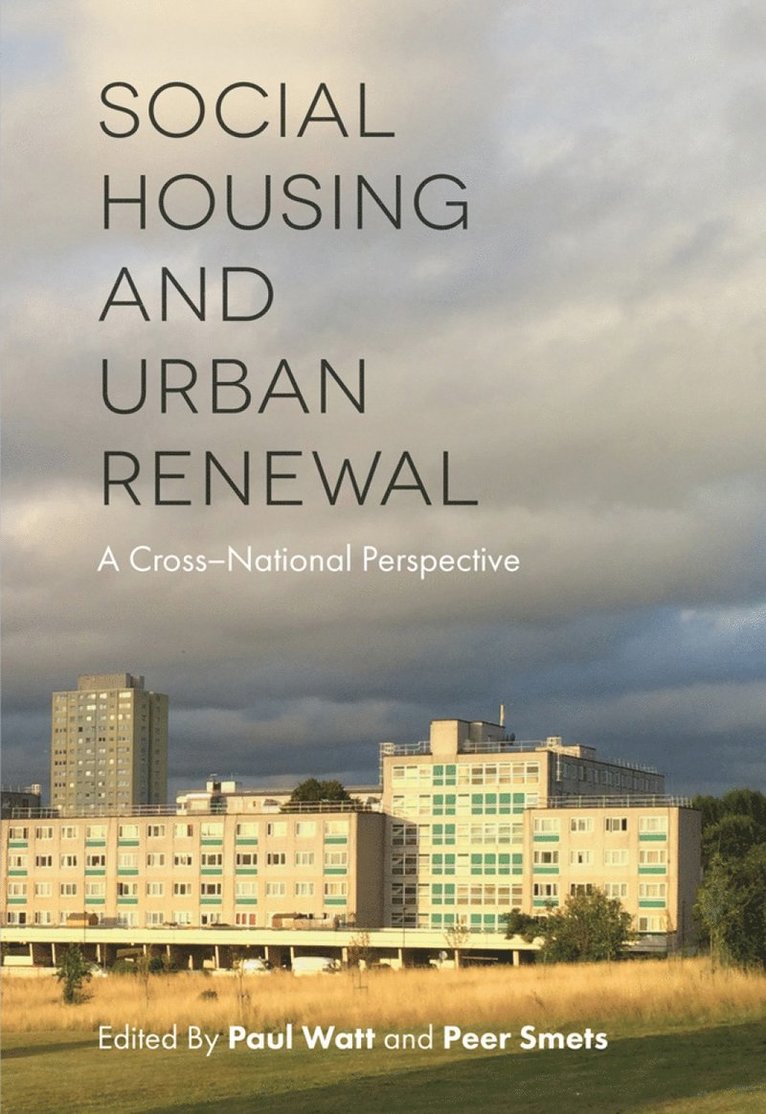







Du kanske också är intresserad av
Affordable Housing in the Urban Global South
Jan Bredenoord, Paul Van Lindert, Peer Smets
Häftad, 2014
1 329 kr
Cheap Print and Popular Song in the Nineteenth Century
Paul Watt, Derek B. Scott, Patrick Spedding
Häftad, 2020
749 kr
Bawdy Songbooks of the Romantic Period, Volume 4
Patrick Spedding, Paul Watt, Ed Cray, David Gregory, Derek B Scott
Inbunden, 2011
2 239 kr
Affordable Housing in the Urban Global South
Jan Bredenoord, Paul Van Lindert, Peer Smets
Inbunden, 2014
3 919 kr
Cultures of Work, the Neoliberal Environment and Music in Higher Education
Sally Macarthur, Julja Szuster, Paul Watt
Häftad, 2025
2 359 kr
The Oxford Handbook of Music and Intellectual Culture in the Nineteenth Century
Paul Watt, Paul Watt, Sarah Collins, Michael Allis
Inbunden, 2020
3 269 kr
Mobilities and Neighbourhood Belonging in Cities and Suburbs
Peer Smets, P. Watt, P. Smets
Inbunden, 2014
729 kr