
Pitman's Measure of Closeness
A Comparison of Statistical Estimatiors
Häftad, Engelska, 1994
1 109 kr
Beställningsvara. Skickas inom 5-8 vardagar. Fri frakt för medlemmar vid köp för minst 249 kr.
Pitman's Measure of Closeness (PMC) is simply an idea whose time has come. Certainly there are many different ways to estimate unknown parameters, but which method should you use? Posed as an alternative to the concept of mean-squared-error, PMC is based on the probabilities of the closeness of competing estimators to an unknown parameter. Renewed interest in PMC over the last 20 years has motivated the authors to produce this book, which explores this method of comparison and its usefulness.Written with research-oriented statisticians and mathematicians in mind, but also considering the needs of graduate students in statistics courses, this book provides a thorough introduction to the methods and known results associated with PMC. Following a foreword by C. R. Rao, the first three chapters focus on basic concepts, history, controversy, paradoxes and examples associated with the PMC criterion. The material is illustrated through realistic estimation problems and presented with a limited degree of technical difficulty. The last three chapters present a unified development of the extensive theoretical and mathematical research on PMC, albeit in the setup of a single parameter. Taken together, they serve as a single comprehensive source on this important topic. The text is highly referenced, allowing researchers to readily access the original articles.What lies ahead for PMC? This book begins to answer that question by presenting a unified discourse on this alternative criterion to traditional methods of comparison. Find out how the authors have begun to unravel the many attributes of PMC and their connections to other estimation criteria.
Produktinformation
- Utgivningsdatum1994-01-31
- Mått152 x 229 x undefined mm
- Vikt443 g
- FormatHäftad
- SpråkEngelska
- Antal sidor239
- FörlagSociety for Industrial & Applied Mathematics,U.S.
- ISBN9780898713084
Tillhör följande kategorier
Hoppa över listan

Du kanske också är intresserad av
Del 29
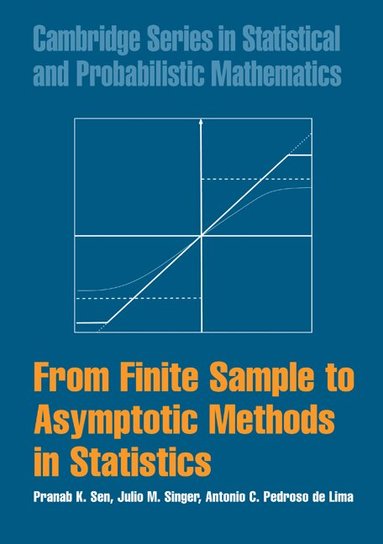
From Finite Sample to Asymptotic Methods in Statistics
Pranab K. Sen, Julio M. Singer, Antonio C. Pedroso de Lima
Inbunden, 2009
1 629 kr
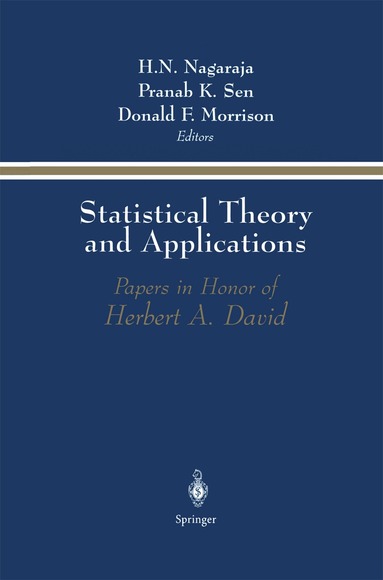
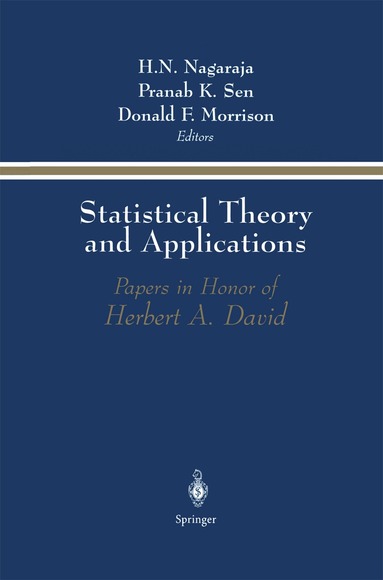
Statistical Theory and Applications
H. N. Nagaraja, H. A. David, H.N. Nagaraja, Pranab K. Sen, Donald F. Morrison
Inbunden, 1995
1 439 kr
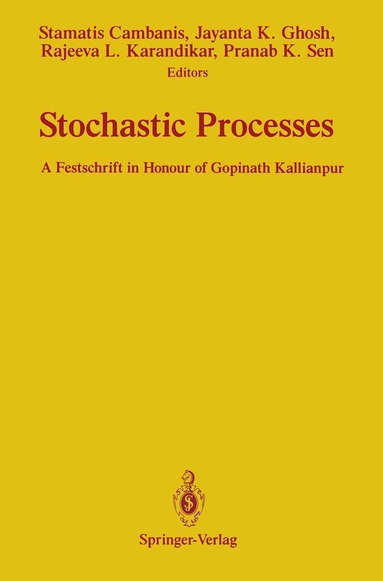
Stochastic Processes
Stamatis Cambanis, Jayanta K. Ghosh, Rajeeva L. Karandikar, Pranab K. Sen
Häftad, 2012
729 kr
Statistical Theory and Applications
H.N. Nagaraja, Pranab K. Sen, Donald F. Morrison
Häftad, 2011
1 439 kr