Beställningsvara. Skickas inom 7-10 vardagar. Fri frakt för medlemmar vid köp för minst 249 kr.
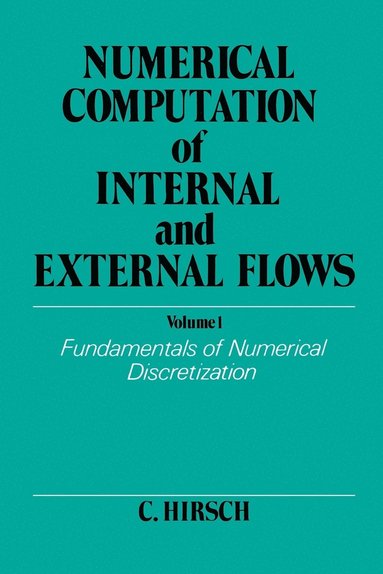
Numerical Computation of Internal and External Flows Volume 2: Computational Methods for Inviscid and Viscous Flows C. Hirsch, Vrije Universiteit Brussel, Brussels, BelgiumThis second volume deals with the applications of computational methods to the problems of fluid dynamics. It complements the first volume to provide an excellent reference source in this vital and fast growing area. The author includes material on the numerical computation of potential flows and on the most up-to-date methods for Euler and Navier-Stokes equations. The coverage is comprehensive and includes detailed discussion of numerical techniques and algorithms, including implementation topics such as boundary conditions. Problems are given at the end of each chapter and there are comprehensive reference lists. Of increasing interest, the subject has powerful implications in such crucial fields as aeronautics and industrial fluid dynamics. Striking a balance between theory and application, the combined volumes will be useful for an increasing number of courses, as well as to practitioners and researchers in computational fluid dynamics.Contents Preface Nomenclature Part V: The Numerical Computation of Potential Flows Chapter 13 The Mathematical Formulations of the Potential Flow Model Chapter 14 The Discretization of the Subsonic Potential Equation Chapter 15 The Computation of Stationary Transonic Potential Flows Part VI: The Numerical Solution of the System of Euler Equations Chapter 16 The Mathematical Formulation of the System of Euler Equations Chapter 17 The Lax - Wendroff Family of Space-centred Schemes Chapter 18 The Central Schemes with Independent Time Integration Chapter 19 The Treatment of Boundary Conditions Chapter 20 Upwind Schemes for the Euler Equations Chapter 21 Second-order Upwind and High-resolution Schemes Part VII: The Numerical Solution of the Navier-Stokes Equations Chapter 22 The Properties of the System of Navier-Stokes Equations Chapter 23 Discretization Methods for the Navier-Stokes Equations Index
Charles Sidney Hirsch was an American forensic pathologist who served as the Chief Medical Examiner of New York City from 1989 until 2013. He oversaw the identification of victims from the World Trade Center attacks in 2001.
Preface xvNomenclature xixPart V: The Numerical Computation of Potential Flows 1Chapter 13 The Mathematical Formulations of the Potential Flow Model 413.1 Conservative Form of the Potential Equation 413.2 The Non-conservative Form of the Isentropic Potential Flow Model 613.2.1 Small-perturbation potential equation 713.3 The Mathematical Properties of the Potential Equation 913.3.1 Unsteady potential flow 913.3.2 Steady potential flow 913.4 Boundary Conditions 1413.4.1 Solid wall boundary condition 1413.4.2 Far field conditions 1513.4.3 Cascade and channel flows 1713.4.4 Circulation and Kutta condition 1813.5 Integral or Weak Formulation of the Potential Model 1813.5.1 Bateman variational principle 1913.5.2 Analysis of some properties of the variational integral 20Chapter 14 The Discretization of the Subsonic Potential Equation 2614.1 Finite Difference Formulation 2714.1.1 Numerical estimation of the density 2914.1.2 Curvilinear mesh 3114.1.3 Consistency of the discretization of metric coefficients 3414.1.4 Boundary conditions—curved solid wall 3614.2 Finite Volume Formulation 3814.2.1 Jameson and Caughey’s finite volume method 3914.3 Finite Element Formulation 4214.3.1 The finite element—Galerkin method 4314.3.2 Least squares or optimal control approach 4714.4 Iteration Scheme for the Density 47Chapter 15 The Computation of Stationary Transonic Potential Flows 5715.1 The Treatment of the Supersonic Region: Artificial Viscosity—Density and Flux Upwinding 6115.1.1 Artificial viscosity—non-conservative potential equation 6215.1.2 Artificial viscosity—conservative potential equation 6615.1.3 Artificial compressibility 6715.1.4 Artificial flux or flux upwinding 7015.2 Iteration Schemes for Potential Flow Computations 7715.2.1 Line relaxation schemes 7715.2.2 Guidelines for resolution of the discretized potential equation 8115.2.3 The alternating direction implicit method—approximate factorization schemes 8815.2.4 Other techniques—multigrid methods 9815.3 Non-uniqueness and Non-isentropic Potential Models 10415.3.1 Isentropic shocks 10515.3.2 Non-uniqueness and breakdown of the transonic potential flow model 10515.3.3 Non-isentropic potential models 11215.4 Conclusions 117Part VI: The Numerical Solution of the System of Euler Equations 125Chapter 16 The Mathematical Formulation of the System of Euler Equations 13216.1 The Conservative Formulation of the Euler Equations 13216.1.1 Integral conservative formulation of the Euler equations 13316.1.2 Differential conservative formulation 13416.1.3 Cartesian system of coordinates 13416.1.4 Discontinuities and Rankine-Hugoniot relations—entropy condition 13516.2 The Quasi-linear Formulation of the Euler Equations 13816.2.l The Jacobian matrices for conservative variables 13816.2.2 The Jacobian matrices for primitive variables 14516.2.3 Transformation matrices between conservative and non-conservative variables 14716.3 The Characteristic Formulation of the Euler Equations—Eigenvalues and Compatibility Relations 15016.3.1 General properties of characteristics 15116.3.2 Diagonalization of the Jacobian matrices 15316.3.3 Compatibility equations 15416.4 Characteristic Variables and Eigenvalues for One-dimensional Flows 15716.4.1 Eigenvalues and eigenvectors of Jacobian matrix 15816.4.2 Characteristic variables 16216.4.3 Characteristics in the xt-plane—shocks and contact discontinuities 16816.4.4 Physical boundary conditions 17116.4.5 Characteristics and simple wave solutions 17316.5 Eigenvalues and Compatibility Relations in Multidimensional Flows 17616.5.1 Jacobian eigenvalues and eigenvectors in primitive variables 17716.5.2 Diagonalization of the conservative Jacobians 18016.5.3 Mach cone and compatibility relations 18416.5.4 Boundary conditions 19116.6 Some Simple Exact Reference Solutions for One-dimensional Inviscid Flows 19616.6.1 The linear wave equation 19616.6.2 The inviscid Burgers equation 19616.6.3 The shock tube problem or Riemann problem 20416.6.4 The quasi-one-dimensional nozzle flow 211Chapter 17 The Lax–Wendroff Family of Space-centred Schemes 22417.1 The Space-centred Explicit Schemes of First Order 22617.1.1 The one-dimensional Lax–Friedrichs scheme 22617.1.2 The two-dimensional Lax–Friedrichs scheme 22917.1.3 Corrected viscosity scheme 23317.2 The Space-centred Explicit Schemes of Second Order 23417.2.1 The basic one-dimensional Lax–Wendroff scheme 23417.2.2 The two-step Lax–Wendroff schemes in one dimension 23817.2.3 Lerat and Peyret’s family of non-linear two-step Lax–Wendroff schemes 24617.2.4 One-step Lax–Wendroff schemes in two dimensions 25117.2.5 Two-step Lax–Wendroff schemes in two dimensions 25817.3 The Concept of Artificial Dissipation or Artificial Viscosity 27217.3.1 General form of artificial dissipation terms 27317.3.2 Von Neumann–Richtmyer artificial viscosity 27417.3.3 Higher-order artificial viscosities 27917.4 Lerat’s Implicit Schemes of Lax–Wendroff Type 28317.4.1 Analysis for linear systems in one dimension 28517.4.2 Construction of the family of schemes 28817.4.3 Extension to non-linear systems in conservation form 29217.4.4 Extension to multi-dimensional flows 29617.5 Summary 296Chapter 18 The Central Schemes with Independent Time Integration 30718.1 The Central Second-order Implicit Schemes of Beam and Warming in One Dimension 30918.1.1 The basic Beam and Warming schemes 31018.1.2 Addition of artificial viscosity 31518.2 The Multidimensional Implicit Beam and Warming Schemes 32618.2.1 The diagonal variant of Pulliam and Chaussee 32818.3 Jameson’s Multistage Method 33418.3.1 Time integration 33418.3.2 Convergence acceleration to steady state 335Chapter 19 The Treatment of Boundary Conditions 34419.1 One-dimensional Boundary Treatment for Euler Equations 34519.1.1 Characteristic boundary conditions 34619.1.2 Compatibility relations 34719.1.3 Characteristic boundary conditions as a function of conservative and primitive variables 34919.1.4 Extrapolation methods 35319.1.5 Practical implementation methods for numerical boundary conditions 35719.1.6 Nonreflecting boundary conditions 36919.2 Multidimensional Boundary Treatment 37219.2.1 Physical and numerical boundary conditions 37219.2.2 Multidimensional compatibility relations 37619.2.3 Farfield treatment for steadystate flows 37719.2.4 Solid wall boundary 37919.2.5 Nonreflective boundary conditions 38419.3 The Far-field Boundary Corrections 38519.4 The Kutta Condition 39519.5 Summary 401Chapter 20 Upwind Schemes for the Euler Equations 40820.1 The Basic Principles of Upwind Schemes 40920.2 One-dimensional Flux Vector Splitting 41520.2.1 Steger and Warming flux vector splitting 41520.2.2 Properties of split flux vectors 41720.2.3 Van Leer’s flux splitting 42020.2.4 Non-reflective boundary conditions and split fluxes 42520.3 One-dimensional Upwind Discretizations Based on Flux Vector Splitting 42620.3.1 First-order explicit upwind schemes 42620.3.2 Stability conditions for first-order flux vector splitting schemes 42820.3.3 Non-conservative firstorder upwind schemes 43820.4 Multi-dimensional Flux Vector Splitting 43820.4.1 Steger and Warming flux splitting 44020.4.2 Van Leer flux splitting 44020.4.3 Arbitrary meshes 44120.5 The Godunov-type Schemes 44320.5.1 The basic Godunov scheme 44420.5.2 Osher’s approximate Riemann solver 45320.5.3 Roe’s approximate Riemann solver 46020.5.4 Other Godunov-type methods 46920.5.5 Summary 47220.6 First-order Implicit Upwind Schemes 47320.7 Multi-dimensional First-order Upwind Schemes 475Chapter 21 Second-order Upwind and High-resolution Schemes 49321.1 General Formulation of Higher-order Upwind Schemes 49421.1.1 Higher-order projection stages-variable extrapolation or MUSCL approach 49521.1.2 Numerical flux for higher-order upwind schemes 49821.1.3 Second-order space- and time-accurate upwind schemes based on variable extrapolation 49921.1.4 Linearized analysis of second-order upwind schemes 50221.1.5 Numerical flux for higher-order upwind schemes—flux extrapolation 50421.1.6 Implicit second-order upwind schemes 51221.1.7 Implicit second-order upwind schemes in two dimensions 51421.1.8 Summary 51621.2 The Definition of High-resolution Schemes 51721.2.1 The generalized entropy condition for inviscid equations 51921.2.2 Monotonicity condition 52521.2.3 Total variation diminishing (TVD)schemes 52821.3 Second-order TVD Semi-discretized Schemes with Limiters 53621.3.1 Definition of limiters for the linear convection equation 53721.3.2 General definition of flux limiters 55021.3.3 Limiters for variable extrapolation—MUSCL—method 55221.4 Timeintegration Methods for TVD Schemes 55621.4.1 Explicit TVD schemes of first-order accuracy in time 55721.4.2 Implicit TVD schemes 55821.4.3 Explicit second-order TVD schemes 56021.4.4 TVD schemes and artificial dissipation 56421.4.5 TVD limiters and the entropy condition 56821.5 Extension to Non-linear Systems and to Multi-dimensions 57021.6 Conclusions to Part VI 583Part VII: The Numerical Solution of the Navier-Stokes Equations 595Chapter 22 The Properties of the System of Navier–Stokes Equations 59722.1 Mathematical Formulation of the Navier–Stokes Equations 59722.1.1 Conservative form of the Navier–Stokes equations 59722.1.2 Integral form of the Navier–Stokes equations 59922.1.3 Shock waves and contact layers 60022.1.4 Mathematical properties and boundary conditions 60122.2 Reynolds-averaged Navier–Stokes Equations 60322.2.1 Turbulent-averaged energy equation 60422.3 Turbulence Models 60622.3.1 Algebraic models 60822.3.2 One- and two-equation models—k–ε models 61322.3.3 Algebraic Reynolds stress models 61522.4 Some Exact One-dimensional Solutions 61822.4.1 Solutions to the linear convection-diffusion equation 61822.4.2 Solutions to Burgers equation 62022.4.3 Other simple test cases 621Chapter 23 Discretization Methods for the Navier–Stokes Equations 62423.1 Discretization of Viscous and Heat Conduction Terms 62523.2 Time-dependent Methods for Compressible Navier–Stokes Equations 62723.2.1 First-order explicit central schemes 62823.2.2 One-step Lax–Wendroff schemes 62923.2.3 Two-step Lax–Wendroff schemes 63023.2.4 Central schemes with separate space and time discretization 63623.2.5 Upwind schemes 64823.3 Discretization of the Incompressible Navier–Stokes Equations 65423.3.1 Incompressible Navier–Stokes equations 65423.3.2 Pseudo-compressibility method 65623.3.3 Pressure correction methods 66123.3.4 Selection of the space discretization 66623.4 Conclusions to Part VII 674Index 685
Charles Hirsch, European Editor of the International Journal of Computational Fluid Dynamics) Hirsch, Charles (Professor of Fluid Mechanics at Vrije Universiteit Brussel, President of NUMECA International (leading CFD Software House)