
NATO and Article 5
The Transatlantic Alliance and the Twenty-First-Century Challenges of Collective Defense
Inbunden, Engelska, 2017
1 759 kr
Beställningsvara. Skickas inom 10-15 vardagar. Fri frakt för medlemmar vid köp för minst 249 kr.
Finns i fler format (1)
For much of the last 25 years, NATO has focused on crisis managementin places such as Kosovo and Afghanistan,resulting in major changes to alliance strategy, resourcing,force structure, and training. Re-embracing collective defense —which lies at the heart of the Treaty of Washington’s Article 5 commitment— is no easy feat, and not something NATO can do through rhetoric and official pronouncements. Nonetheless,this shift is vitally necessary if the alliance is to remain the bulwark of Western defense and security. Russia’s illegal annexation of Crimea and its invasion of Ukraine have fundamentally upended the security environment in Europe, thrusting NATO into the spotlight as the primary collective defense tool most European states rely upon to ensure their security.Collective defense is one of the alliance’s threecore missions, along with crisis management and cooperative security. It is defined in Article 5, the most well-known and arguably most important part of NATO’s founding treaty, which states: “The Parties agree that an armed attack against one or more of them in Europe or North America shall be considered an attack against them all.” Although all three missions are vital to the interests of NATO’s many member states, collective defense has become first among equals once again. However,three very significant hurdles stand in the way of the alliance and its member states as they attempt to re-embrace collective defense. These loosely correspond to an ends-waysmeans construct. First is the alliance's strategy toward Russia. Is Russia an adversary,a partner,neither,or both? How should strategy and policies change to place the alliance and its members on more solid ground when it comes to managing Russia? Second are the ongoing disputes over resourcing and burden-sharing. In recent years, it has become commonplace for American leaders to publicly berate European allies in an effort to garner more contributions to the common defense. How might the alliance better measure and more equitably share security burdens? Third is the alliance’s readiness to fulfill its objectives. Many allies have announced or are implementing increases in defense spending. However, governments of European NATO member states are strongly incentivized by domestic politics to favor acquisition of military hardware or spending on personnel salaries and benefits,usually at the expense of readiness. The result is that NATO military forces risk quickly becoming hollow in a way that is often underappreciated, which will prevent the alliance from fulfilling the collective defense promise inherent in Article 5. The book examines all such questions to assess NATO’s return to collective defense and offer a roadmap for overcoming those challenges in both the short and long-term.
Produktinformation
- Utgivningsdatum2017-10-04
- Mått158 x 239 x 18 mm
- Vikt413 g
- FormatInbunden
- SpråkEngelska
- Antal sidor180
- FörlagBloomsbury Publishing Plc
- ISBN9781538107027
- UtmärkelserWinner of Madigan Award for Scholarship at the US Army War College 2018
Tillhör följande kategorier
Hoppa över listan






Mer från samma författare
Future of American Landpower: Does Forward Presence Still Matter? The Case of the Army in Europe (Enlarged Edition)
John R. Deni, Strategic Studies Institute
Häftad, 2013
209 kr
NATO Missile Defense and the European Phased Adaptive Approach: The Implications of Burden Sharing and the Underappreciated Role of The U.S. Army (Enlarged Edition)
John R. Deni, Strategic Studies Institute, U.S. Army War College, Steven J. Whitmore
Häftad, 2014
209 kr
Augmenting Our Influence: Alliance Revitalization and Partner Development
John R. Deni
Häftad, 2014
229 kr
Hoppa över listan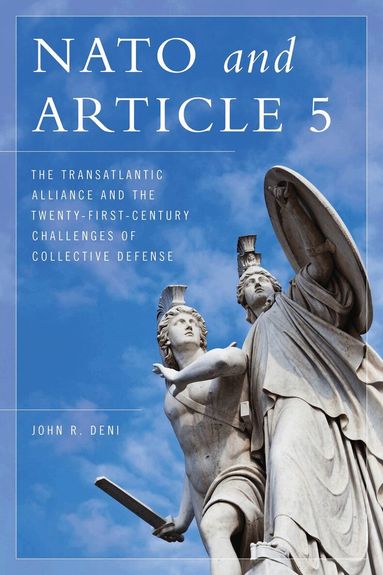


Du kanske också är intresserad av
New Realities: Energy Security in the 2010s and Implications for the U.S. Military
John R. Deni
Häftad, 2015
379 kr
Augmenting Our Influence: Alliance Revitalization and Partner Development
John R. Deni
Häftad, 2014
229 kr
Political and Socio-Economic Change: Revolutions and Their Implications for the U.S. Military
Strategic Studies Institute, U.S. Army War College, John R. Deni
Häftad, 2015
229 kr
Future of American Landpower: Does Forward Presence Still Matter? the Case of the Army in the Pacific
John R. Deni, Strategic Studies Institute, U.S. Army War College
Häftad, 2014
119 kr