
Del i serien Textbooks in Mathematics
Mathematical Modeling
Branching Beyond Calculus
Inbunden, Engelska, 2018
2 389 kr
Beställningsvara. Skickas inom 10-15 vardagar. Fri frakt för medlemmar vid köp för minst 249 kr.
Finns i fler format (1)
Mathematical Modeling: Branching Beyond Calculus reveals the versatility of mathematical modeling. The authors present the subject in an attractive manner and flexibley manner. Students will discover that the topic not only focuses on math, but biology, engineering, and both social and physical sciences. The book is written in a way to meet the needs of any modeling course. Each chapter includes examples, exercises, and projects offering opportunities for more in-depth investigations into the world of mathematical models. The authors encourage students to approach the models from various angles while creating a more complete understanding. The assortment of disciplines covered within the book and its flexible structure produce an intriguing and promising foundation for any mathematical modeling course or for self-study. Key Features: Chapter projects guide more thorough investigations of the models The text aims to expand a student’s communication skills and perspectives WThe widespread applications are incorporated, even includinge biology and social sciences Its structure allows it to serve as either primary or supplemental text Uses Mathematica and MATLAB are used to develop models and computations
Produktinformation
- Utgivningsdatum2018-02-06
- Mått178 x 254 x 29 mm
- Vikt800 g
- FormatInbunden
- SpråkEngelska
- SerieTextbooks in Mathematics
- Antal sidor304
- FörlagTaylor & Francis Inc
- ISBN9781498770712
Tillhör följande kategorier
Hoppa över listan
Mer från samma serie
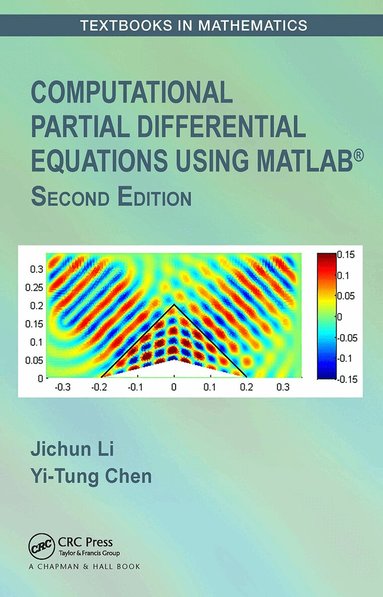
Computational Partial Differential Equations Using MATLAB®
Jichun Li, Yi-Tung Chen
Inbunden, 2019
2 789 kr