
Del i serien Textbooks in Mathematics
Introduction to Mathematical Proofs
Häftad, Engelska, 2023
999 kr
Beställningsvara. Skickas inom 10-15 vardagar. Fri frakt för medlemmar vid köp för minst 249 kr.
Finns i fler format (1)
An Introduction to Mathematical Proofs presents fundamental material on logic, proof methods, set theory, number theory, relations, functions, cardinality, and the real number system. The text uses a methodical, detailed, and highly structured approach to proof techniques and related topics. No prerequisites are needed beyond high-school algebra. New material is presented in small chunks that are easy for beginners to digest. The author offers a friendly style without sacrificing mathematical rigor. Ideas are developed through motivating examples, precise definitions, carefully stated theorems, clear proofs, and a continual review of preceding topics. Features Study aids including section summaries and over 1100 exercises Careful coverage of individual proof-writing skills Proof annotations and structural outlines clarify tricky steps in proofs Thorough treatment of multiple quantifiers and their role in proofs Unified explanation of recursive definitions and induction proofs, with applications to greatest common divisors and prime factorizations About the Author:Nicholas A. Loehr is an associate professor of mathematics at Virginia Technical University. He has taught at College of William and Mary, United States Naval Academy, and University of Pennsylvania. He has won many teaching awards at three different schools. He has published over 50 journal articles. He also authored three other books for CRC Press, including Combinatorics, Second Edition, and Advanced Linear Algebra.
Produktinformation
- Utgivningsdatum2023-01-21
- Mått178 x 254 x 25 mm
- Vikt1 220 g
- FormatHäftad
- SpråkEngelska
- SerieTextbooks in Mathematics
- Antal sidor412
- FörlagTaylor & Francis Ltd
- ISBN9781032475226
Tillhör följande kategorier
Hoppa över listan
Mer från samma serie
Computational Partial Differential Equations Using MATLAB®
Jichun Li, Yi-Tung Chen
Inbunden, 2019
2 789 kr
Hoppa över listan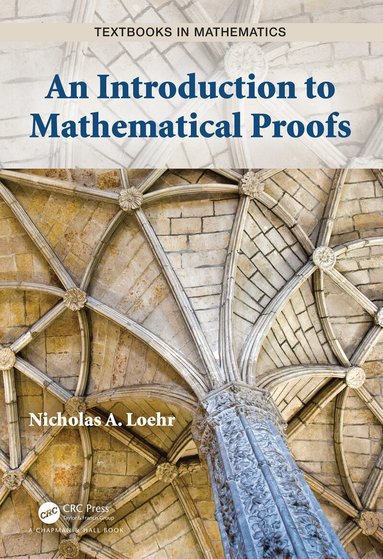






Du kanske också är intresserad av
- Nyhet
Del 7
- Nyhet
Del 11
- Nyhet
Del 4
- Nyhet
Del 6
- Nyhet
Del 3
- Nyhet