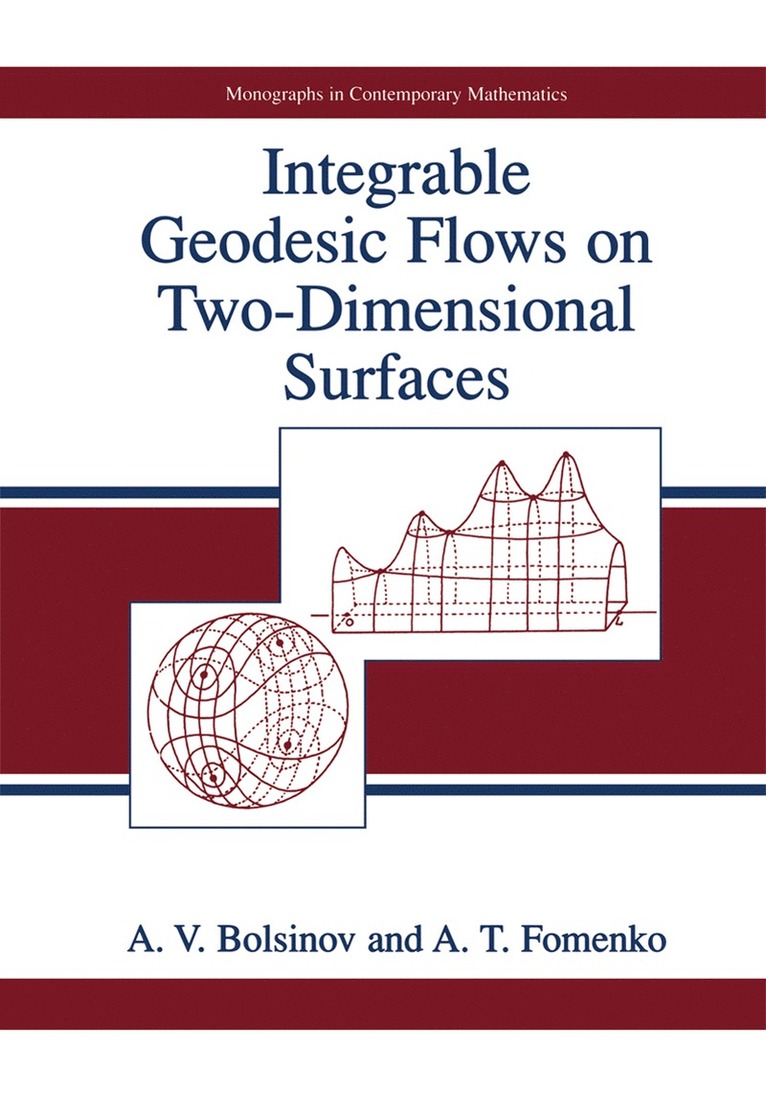
Presenting a new approach to qualitative analysis of integrable geodesic flows based on the theory of topological classification of integrable Hamiltonian systems, this book applies this technique systematically to a wide class of integrable systems. The first part of the book provides an introduction to the qualitative theory of integrable Hamiltonian systems and their invariants (symplectic geometry, integrability, the topology of Liouville foliations, the orbital classification theory for integrable nondegenerate Hamiltonian systems with two degrees of freedom, obstructions to integrability, for example). In the second part, the class of integrable geodesic flows on two-dimensional surfaces is discussed both from the classical and contemporary point of view. The authors classify them up to different equivalence relations such as an isometry, the Liouville equivalence, the trajectory equivalence (smooth and continuous), and the geodesic equivalence. A new technique, which provides the possibility to classify integrable geodesic flows up to these kinds of equivalences, is presented together with applications.
1. Basic Notions.- 1.1. Linear Symplectic Geometry.- 1.2. Symplectic and Poisson Manifolds.- 1.3. Local Properties of Symplectic Manifolds.- 1.4. Liouville Integrable Hamiltonian Systems. Liouville Theorem.- 1.5. Nonresonant and Resonant Systems.- 1.6. Rotation Number.- 1.7. Momentum Mapping of an Integrable Hamiltonian System and Its Bifurcation Diagram.- 1.8. Nondegenerate Singularities of the Momentum Mapping and Bott Functions.- 1.9. Bott Integrals from the Point of View of the Four-Dimensional Symplectic Manifold.- 1.10. Main Types of Equivalence of Dynamical Systems.- 2. Topology of Foliations Generated by Morse Functions on Two-Dimensional Surfaces.- 2.1. Simple Morse Functions.- 2.2. Reeb Graph of a Morse Function.- 2.3. Concept of an Atom.- 2.4. Simple Molecules.- 2.5. Complicated Atoms.- 2.6. Classification of Atoms.- 2.7. Notion of a Molecule.- 2.8. Approximation of Complicated Molecules by Simple Ones.- 3. Rough Liouville Equivalence of Integrable Systems with Two Degrees of Freedom.- 3.1. Classification of Nondegenerate Critical Submanifolds on Isoenergy 3-Surfaces.- 3.2. The Topological Structure of a Neighborhood of a Singular Leaf.- 3.3. Topologically Stable Hamiltonian Systems.- 3.4. 2-Atoms and 3-Atoms.- 3.5. Classification of 3-Atoms.- 3.6. 3-Atoms as Bifurcations of Liouville Tori.- 3.7. The Molecule of an Integrable System.- 4. Liouville Equivalence of Iintegrable Systems with Two Degrees of Freedom.- 4.1. Admissible Coordinate Systems on the Boundary of a 3-Atom.- 4.2. Gluing Matrices and Superfluous Frames.- 4.3. Invariants (Numerical Marks) r, ?, and n.- 4.4. The Marked Molecule.- 4.5. Influence of the Orientation.- 4.6. Realization Theorem.- 4.7. Simple Examples of Molecules.- 4.8. Hamiltonian Systems with Critical Klein Bottles.- 5. TrajectoryClassification of Integrable Systems with Two Degrees of Freedom.- 5.1. Rotation Function and Rotation Vector.- 5.2. Reduction of the Three-Dimensional.- 5.3. General Concept of Constructing Trajectory Invariants of Integrable Hamiltonian Systems.- 6. Integrable Geodesic Flows on Two-Dimensional Surfaces.- 6.1. Statement of the Problem.- 6.2. Topological Obstructions to Integrability of Geodesic Flows on Two-Dimensional Surfaces.- 6.3. Two Examples of Integrable Geodesic Flows.- 6.4. Riemannian Metrics Whose Geodesic Flows are Integrable by Means of Linear or Quadratic Integrals. Local Theory.- 6.5. Linearly and Quadratically Integrable Geodesic Flows on Closed Surfaces.- 7. Liouville Classification of Integrable Geodesic Flows on Two-Dimensional Surface.- 7.1. Liouville Classification of Linearly and Quadratically Integrable Geodesic Flows on the Torus.- 7.2. Liouville Classification of Linearly and Quadratically Integrable Geodesic Flows on the Klein Bottle.- 7.3. Liouville Classification of Linearly and Quadratically Integrable Geodesic Flows on the Two-Dimensional Sphere.- 7.4. Liouville Classification of Linearly and Quadratically Integrable Geodesic Flows on the Projective Plane.- 8. Trajectory Classification of Integrable Geodesic Flows on Two-Dimensional Surfaces.- 8.1. Case of the Torus.- 8.2. Case of the Sphere.- 8.3. Examples of Integrable Geodesic Flows on the Sphere.- 8.4. Non-Triviality of Trajectory Equivalence Classes and Metrics with Closed Geodesics.- 9. Maupertuis Principle and Geodesic Equivalence.- 9.1. General Maupertuis Principle.- 9.2. Maupertuis Principle in Rigid Body Dynamics.- 9.3. Maupertuis Principle and an Explicit Form of the Metric on the Sphere, Generated by a Quadratic Hamiltonian on the Lie Algebra e(3).- 9.4. Classical Cases of Integrability in Rigid Body Dynamics and Related Integrable Geodesic Flows on the Sphere.- 9.5. Conjecture on Geodesic Flows with Integrals of High Degree.- 9.6. Dini Theorem and the Geodesic Equivalence of Riemannian Metrics.- 9.7. Generalized Dini-Maupertuis Principle.- 9.8. Trajectory Equivalence of the Neumann Problem and Jacobi Problem.- 9.9. Explicit Forms of Some Remarkable Hamiltonians and Their Integrals in Separating Variables.- 10. Euler Case in Rigid Body Dynamics and Jacobi Problem About Geodesics on the Ellipsoid. Trajectory Isomorphism.- 10.1. Introduction.- 10.2. Jacobi Problem and Euler Case.- 10.3. Liouville Foliations.- 10.4. Rotation Functions.- 10.5. The Main Theorem.- 10.6. Smooth Invariants.- 10.7. Topological Non-Conjugacy of the Jacobi Problem and the Euler Case.