
Foreign Policy of Islamist Political Parties
Ideology in Practice
Häftad, Engelska, 2019
749 kr
Beställningsvara. Skickas inom 3-6 vardagar. Fri frakt för medlemmar vid köp för minst 249 kr.
Finns i fler format (1)
Does political Islam have a specific vision of global politics? How has the foreign policy of Islamist forces developed in order to impose their ideas onto the diplomatic agenda of other countries? How do these actors perceive the world, international affairs, and the way Islamic countries should engage with the international system?Eager to break with the dominant grammar of international relations, and instead to fuse Muslim states in a unique religious and political entity, Muslim actors have had to face up to the realities that they had promised to transform. Drawing on a series of case studies, this collective work sheds light on six national trajectories of Islamism: in Morocco (the Party of Justice and Development), Tunisia (Ennhada), Egypt (the Muslim Brotherhood), Palestine (Hamas), Lebanon (Hizbullah) and Turkey (AKP). It looks at what has been produced by the representatives of political Islam in each case, and the way these representatives have put their words and their ideological aspirations into action within their foreign policies.
Produktinformation
- Utgivningsdatum2019-11-27
- Mått156 x 234 x 17 mm
- Vikt337 g
- FormatHäftad
- SpråkEngelska
- Antal sidor216
- FörlagEdinburgh University Press
- ISBN9781474426657
Tillhör följande kategorier
Hoppa över listan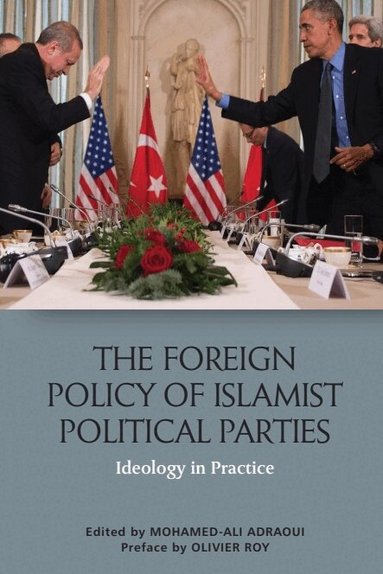








Du kanske också är intresserad av
- Nyhet
Del 3
- Nyhet
- Nyhet
Del 7
- Nyhet
Del 4
- Nyhet
Del 6
- Nyhet
Del 11
- Nyhet
Del 1