
Del 15 i serien Space Technology Library
Essential Spaceflight Dynamics and Magnetospherics
Inbunden, Engelska, 2002
3 289 kr
Beställningsvara. Skickas inom 10-15 vardagar. Fri frakt för medlemmar vid köp för minst 249 kr.
Finns i fler format (1)
Essential Spaceflight Dynamics and Magnetospherics describes, in the first instance, some of the key aspects of celestial mechanics and spaceflight dynamics. It begins with classical two and three body problems illustrative of the aesthetic aspects of applying analytical methods of investigation to celestial mechanics. Then, osculating orbital elements are introduced as well as analysis techniques sufficient to evaluate the influence of various disturbing forces on spacecraft. Next a theory of manoeuvres is outlined and the methodology of making interplanetary trajectory corrections. Ideas involving various approaches to orbital element determinations using measured data are also considered. The forces applied to a spacecraft can result in the development of torques that influence attitude motion and the effects of the most important of these are described in terms of equilibrium positions, periodic motions, steady-state and transient motions. Also considered is the problem of attitude control of a spacecraft using active and/or passive methods of orientation and stabilization. In addition, a more advanced treatment of the development of attitude control systems is provided.
Produktinformation
- Utgivningsdatum2002-12-31
- Mått210 x 297 x 28 mm
- Vikt741 g
- FormatInbunden
- SpråkEngelska
- SerieSpace Technology Library
- Antal sidor397
- Upplaga2003
- FörlagKluwer Academic Publishers
- ISBN9781402010637
Tillhör följande kategorier
Hoppa över listan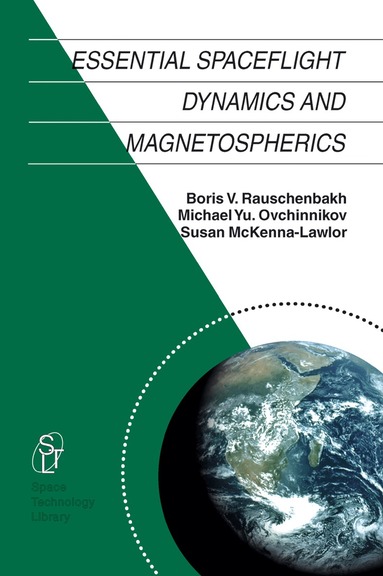







Du kanske också är intresserad av
Del 15
Essential Spaceflight Dynamics and Magnetospherics
V. Rauschenbakh, M. Y. Ovchinnikov, Susan M.P. McKenna-Lawlor
Häftad, 2010
3 289 kr
Del 292
- Nyhet
Del 6
- Nyhet
Del 3
- Nyhet
Del 4
- Nyhet
Del 7
- Nyhet
- Nyhet
Del 11