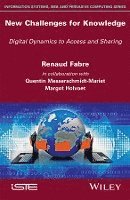
Digital Factory for Knowledge
Production and Validation of Scientific Results
AvRenaud Fabre,Alain Bensoussan,Lucille Colin,Marie Blanquart,Louki-Geronimo Richou
2 319 kr
Beställningsvara. Skickas inom 7-10 vardagar. Fri frakt för medlemmar vid köp för minst 249 kr.
Produktinformation
- Utgivningsdatum2018-03-09
- Mått163 x 239 x 18 mm
- Vikt431 g
- FormatInbunden
- SpråkEngelska
- Antal sidor198
- FörlagISTE Ltd and John Wiley & Sons Inc
- ISBN9781786302410
Tillhör följande kategorier
Renaud Fabre, CNRS, France, is Professor of Economics and former President of the University of Paris 8 (Vincennes-Saint Denis) in France. He is the former director of Scientific and Technical Information at the National Scientific Research Centre (2013–2017)./p>Alain Bensoussan, Sciences Po Paris, France, is an advanced technology lawyer and President of the Bensoussan-Lexing office. He is an international specialist in the law of digital technology and robotics.Lucille Colin, Sciences Po Paris, France.Marie Blanquart, Sciences Po Paris, France.Louki-Géronimo Richou, Sciences Po Paris, France.
- Preface xiRenaud FABRE and Alain BENSOUSSANPart 1. Scientific Resources and Data Economy 1Chapter 1. Data Production and Sharing: Towards a Universal Right? 3Marie BLANQUART, Thomas DESCOUS and Ewen HUET1.1. The right to knowledge today: between attempts at universalization and “self-regulation” by the GAFA 41.1.1. Towards the emergence of a universal right to knowledge subject to divergent economic thinking 51.1.2. The recognition of a universal right to knowledge: a “realistic utopia”? 61.2. Platform and scientific community rights: the absence of an upfront legal framework 71.2.1. A system partly caused by the development of the digital sector 71.2.2. The now-fragile law attempting to protect the results of research 81.2.3. Intellectual property rights 81.2.4. The notion of databases and protection by sui generis law 91.2.5. Problems with the legal statute of knowledge 111.3. The need to elaborate several types of legislation 121.3.1. Platform rights 121.3.2. Text and Data Mining: the great new stake 141.4. Open Science: an achievable goal? 15Chapter 2. Data: a Simple Raw Material? 19Bertrand PELETIER and Thomas DESCOUS2.1. The new generation of data: management issues arising from ownership rights 192.2. How to transform these data into knowledge? 202.3. A new knowledge economy is necessary 212.3.1. The information war and the stakes of data protection 212.4. International scientific publishing: high added-value services and researcher community 222.4.1. The open platform as the preferred tool for sharing and exploiting data 222.4.2. An undeniable added value in processing data brought about by platforms 24Chapter 3. New Knowledge Tools 27Christoph LOHSCHELDER3.1. Sharing and uncertainty 273.2. Platform construction 283.3. Machine learning 303.4. Promising progress to be qualified… 31Part 2. The Knowledge Factory 33Chapter 4. Economic Models of Knowledge Sharing 35Vincent GIACOBBI4.1. A quick historic overview 354.2. Property and/or sharing 354.3. An immaterial good capable of fueling the production of material goods 374.4. The large stakes of knowledge production 384.4.1. Limits of this model: consistency, reliability and indistinction 394.4.2. Business models of knowledge sharing 394.4.3. Some numbers 404.5. Development prospects allowing for new fields of study and more nimbly integrating researchers into the economic chain 41Chapter 5. From the Author to the Valorizer 43Lucile COLLIN5.1. The author and the valorizer: conciliation and efficiency of the interaction 435.2. One point on patents 445.3. The innovation cycle 455.4. The law for a Digital Republic 465.5. Scientific openness surpassing ancient legal tools 48Chapter 6. Valorization: a Global Geopolitical Stake 51Marie BLANQUART6.1. A multispeed competition 516.1.1. The United States: a country losing its lead 516.1.2. French stagnation 536.1.3. The expanding Chinese model 546.2. International cooperation in the scientific sector 576.2.1. A developing European project 576.2.2. International organizations 58Chapter 7. Focus: the Chinese Patent Strategy 61Vincent GIACOBBI7.1. Chinese expansion 627.2. An inflation of Chinese patents 637.3. Some fallbacks in China nuancing its strategic position 657.3.1. A fallback in favor of applied research 667.3.2. Territorial withdrawal 667.3.3. A long certification process with uncertain ends 667.3.4. The procedure for submitting a dispute on a patent 677.4. Contestable and contested digital supremacy 68Chapter 8. Artificial Intelligence Policies 71Maximilian NOMINACHER and Bertrand PELETIER8.1. Policies concerning “strong” AI 728.2. Policies concerning “weak” AI 728.3. Policies concerning artificial intelligence safety 748.4. From practice to ethics: what is AI’s legal status? 75Chapter 9. New Formulations of Results and New “Markets” 77Louki-Géronimo RICHOU9.1. Making universal: establishing common standards of expression 789.1.1. Requirement of uniqueness 799.1.2. Hierarchy requirement 799.2. To adapt: from popularization to simplification 829.2.1. Versatility or specialization? 839.2.2. Simplifying rather than popularizing 849.2.3. Measures following the precautionary principle: archiving and protection 859.2.4. Preserving the researcher while optimizing knowledge for the general interest during the digital era 859.3. Developing the general state of knowledge with care 87Chapter 10. Open Science: a Common Good that Needs to be Valued? 89Nicolas MASSEREAU10.1. A global challenge that must take the economy into account 9010.2. A wide variety of public policies respond to this challenge 9010.2.1. Enterprises and States 9010.2.2. Valorization as a junction point 9110.2.3. Basic research: competing with applied research? 9310.3. The French case and international rankings 9410.4. The limits of the patent system and publication count 9610.5. Investment tools aiming to correct these failures 9810.6. How to measure innovation? 10010.6.1. The university: the first knowledge production framework recognized by law 10010.6.2. Research data: a new intangible “place” for producing knowledge 10110.7. The application of research is not an end in itself 102Conclusion 105Renaud FABRE and Alain BENSOUSSANAppendices 109Appendix 1. Extract from the CNRS White Paper: “The Work of Science and the Digital Field: Data, Publications, Platforms. A Systematic Analysis of the Law for a Digital Republic” 111Appendix 2. Extract from the CNRS White Paper “Open Science in a Digital Republic: Studies and Proposals for Law Application. StrategicApplication Guide” 161Bibliography 179List of Authors 183Index 185
Du kanske också är intresserad av
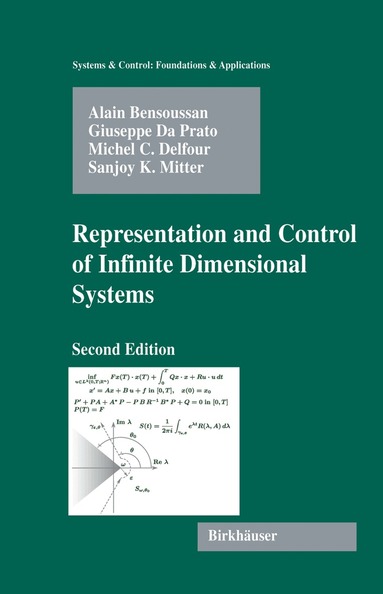
Representation and Control of Infinite Dimensional Systems
Alain Bensoussan, Giuseppe Da Prato, Michel C. Delfour, Sanjoy K. Mitter
699 kr
Future Tendencies in Computer Science, Control and Applied Mathematics
Alain Bensoussan, Jean-Pierre Verjus
729 kr
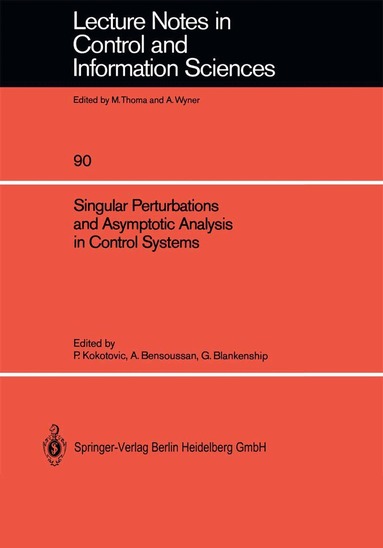
Singular Perturbations and Asymptotic Analysis in Control Systems
Petar V. Kokotovic, Alain Bensoussan, Gilmer L. Blankenship
709 kr
Reliability Prediction for Microelectronics
Joseph B. Bernstein, Alain Bensoussan, Emmanuel Bender
1 709 kr
Representation and Control of Infinite Dimensional Systems
Alain Bensoussan, Giuseppe Da Prato, Michel C. Delfour, Sanjoy K. Mitter
2 769 kr