
Del 1
What makes Grammaticalization?
A Look from its Fringes and its Components
Inbunden, Engelska, 2004
3 689 kr
Beställningsvara. Skickas inom 5-8 vardagar. Fri frakt för medlemmar vid köp för minst 249 kr.
The status of grammaticalization has been the subject of many controversial discussions. The contributions to What makes Grammaticalization? approach the prevalent phenomenon from the angle of language structure and focus on the interrelation between the levels of phonology, pragmatics (inference), discourse and the lexicon and some of them try to integrate the areal perspective. A wealth of data from Slavonic languages as well as from languages of other genetic and areal affiliation is discussed. The book is of interest to linguists specializing in grammaticalization, lexicalization and morphological typology, to language typologists as well as to functional, historical and cognitive linguists.
Produktinformation
- Utgivningsdatum2004-12-16
- Mått155 x 230 x 24 mm
- Vikt624 g
- FormatInbunden
- SpråkEngelska
- SerieTrends in Linguistics. Studies and Monographs [TiLSM]
- Antal sidor360
- Upplaga4001
- FörlagDe Gruyter
- ISBN9783110181524
Tillhör följande kategorier
Hoppa över listan

![Walter Bisang, Andrej Malchukov - [Set Grammaticalization Scenarios, Vol 1+2], Inbunden](https://bilder.akademibokhandeln.se/images_akb/9783110712681_383)
Mer från samma författare
Unity and Diversity in Grammaticalization Scenarios
Walter Bisang, Andrej Malchukov
Inbunden, 2020
769 kr
Grammaticalization Scenarios from Europe and Asia
Walter Bisang, Andrej Malchukov
Inbunden, 2020
6 189 kr
Grammaticalization Scenarios from Africa, the Americas, and the Pacific
Walter Bisang, Andrej Malchukov
Inbunden, 2020
6 059 kr
Unity and diversity in grammaticalization scenarios
Walter Bisang, Andrej Malchukov
Inbunden, 2017
729 kr
Hoppa över listan
Mer från samma serie
Towards a Holistic Understanding of Language Contact in the Past
Nikolaos Lavidas, Ioanna Sitaridou, Igor Yanovich
Inbunden, 2025
2 569 kr
Del 219
Bibliography on Writing and Written Language
Konrad Ehlich, Florian Coulmas, Gabriele Graefen
Inbunden, 1996
4 869 kr
Del 27
Hoppa över listan
Du kanske också är intresserad av
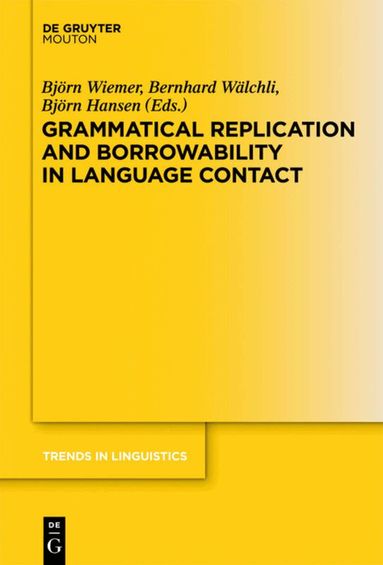
Grammatical Replication and Borrowability in Language Contact
Björn Wiemer, Bernhard Wälchli, Björn Hansen
Inbunden, 2012
3 109 kr
Del 23
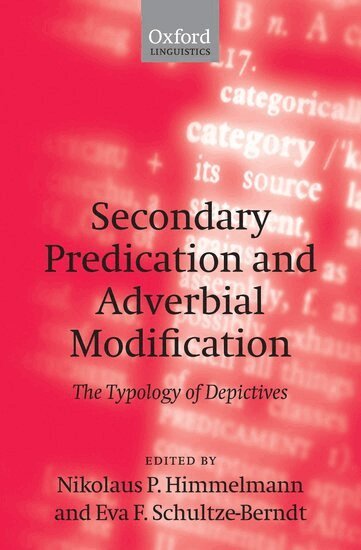
Secondary Predication and Adverbial Modification
Nikolaus P. Himmelmann, Eva F. Schultze-Berndt
Inbunden, 2005
1 639 kr
Del 178
Essentials of Language Documentation
Jost Gippert, Nikolaus P. Himmelmann, Ulrike Mosel
Häftad, 2006
349 kr
Del 276
Contemporary Approaches to Baltic Linguistics
Peter Arkadiev, Axel Holvoet, Björn Wiemer
Häftad, 2017
509 kr
Convergence and Divergence in the Eastern Circum-Baltic Area
Björn Wiemer, Peter Arkadiev, Petar Kehayov, Rogier Blokland
Inbunden, 2025
4 889 kr
Del 361
Contemporary Approaches to Baltic Linguistics
Peter Arkadiev, Axel Holvoet, Björn Wiemer
Inbunden, 2015
3 109 kr